































Essential Parable Vocabulary Word Search | Grades 6–8 ELA

Paste this activity's link or code into your existing LMS (Google Classroom, Canvas, Teams, Schoology, Moodle, etc.).
Students can open and work on the activity right away, with no student login required.
You'll still be able to track student progress and results from your teacher account.
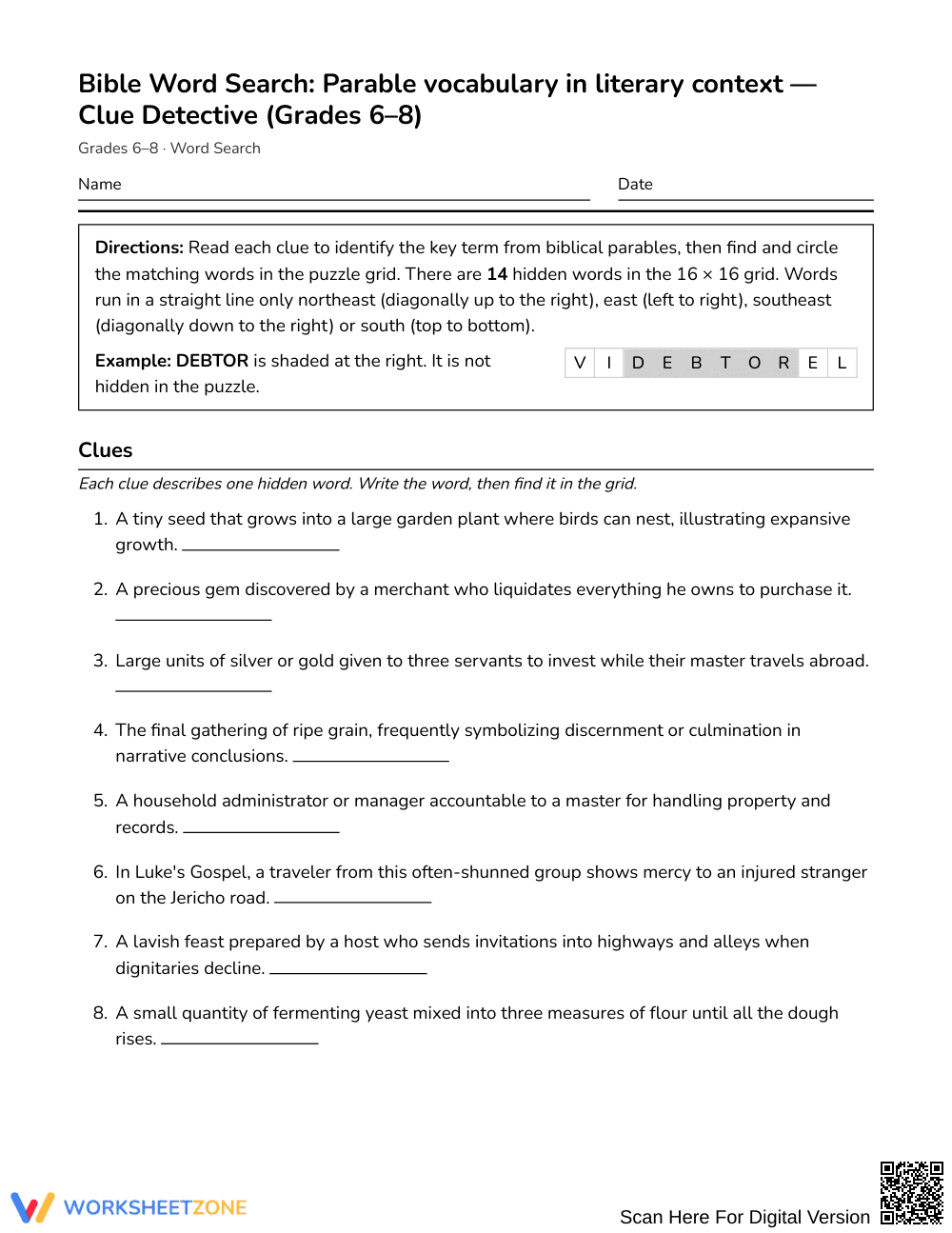
This Grade 6–8 vocabulary word search reinforces 14 key literary terms drawn from biblical parables through active context-clue analysis. Students examine rich narrative descriptions to identify foundational cultural allusions before tracking down hidden terms. The activity strengthens contextual comprehension, critical deduction, and cultural literacy across intermediate English Language Arts classrooms.
At a Glance
- Grade: Grades 6–8 · Subject: English Language Arts (ELA)
- Standard: Not standards-assessed — vocabulary enrichment
- Skill Focus: Parable vocabulary in literary context
- Format: 3 pages · 14 words · Answer key included · PDF
- Best For: Literary vocabulary enrichment and independent review
- Time: 20–30 minutes
What's Inside
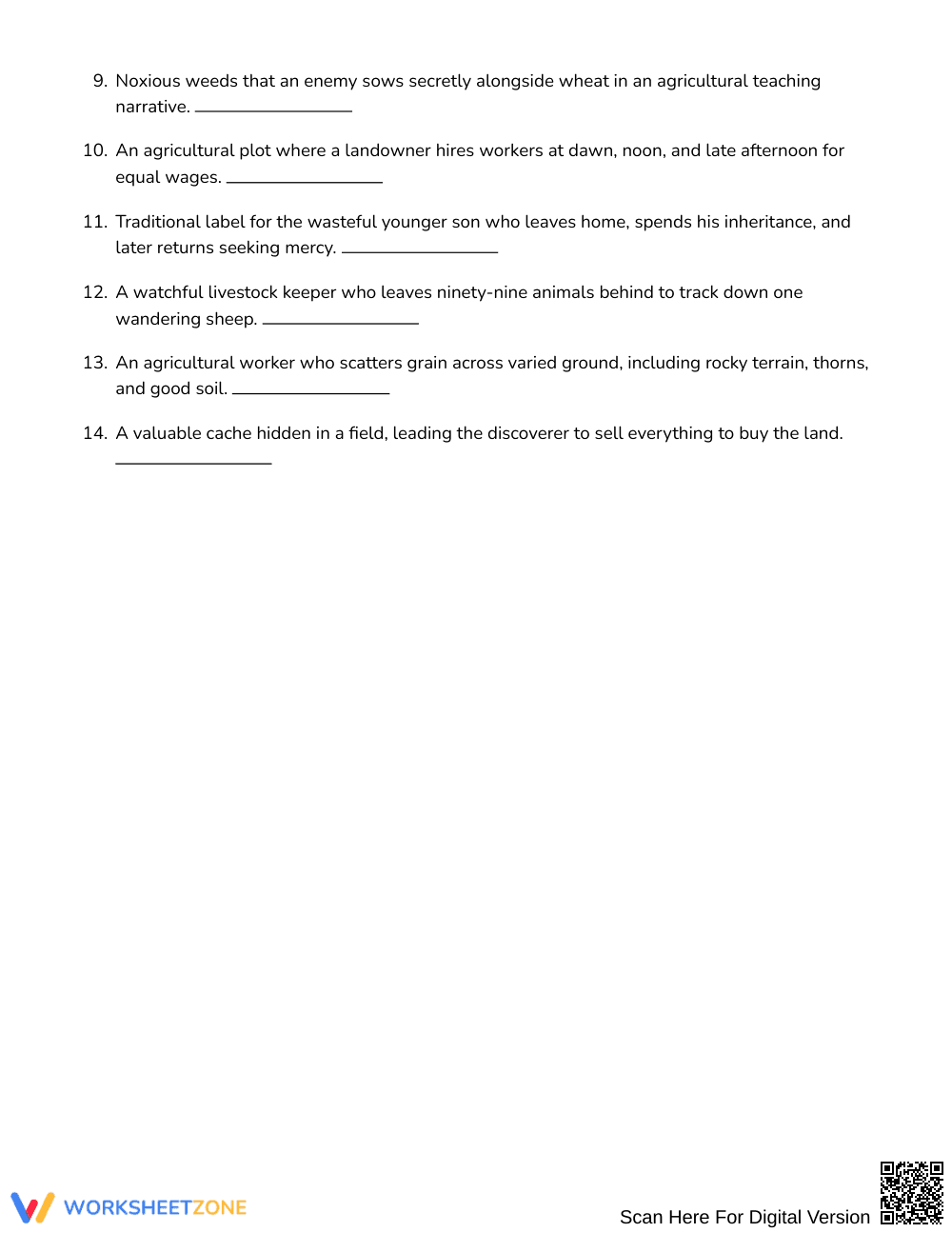
This 3-page printable activity features a 16 by 16 letter grid alongside 14 clue-driven vocabulary challenges. Instead of passively copying an alphabetized list, students read narrative clues defining terms such as prodigal, steward, and vineyard. A complete 3-page answer key provides clear letter highlighting for immediate verification and swift grading.
Puzzle Structure and Mechanics
The puzzle engages intermediate learners through an intentional clue-detective format:
- Grid Dimensions: A 16 by 16 grid containing 14 hidden literary terms embedded among distractors.
- Search Directions: Words run along four distinct vectors: northeast (NE), east (E), southeast (SE), and south (S).
- Clue-Based Identification: A shuffled word bank pairs with contextual clues summarizing classic parable storylines, requiring students to match narrative details to specific vocabulary before searching.
Standards Alignment
This resource serves as targeted vocabulary enrichment and is not aligned to a formal state standard. It provides supplementary cross-curricular engagement with literary allusions, supporting secondary text analysis without rigid standards-based scoring criteria.
How to Use It
Use this activity after introducing figurative language, allegories, or cultural archetypes in an ELA unit. As a mid-week reinforcement task, students solve the 14 clues individually or with a partner to solidify literary recall. During classwork, observe whether students identify the correct word from narrative clues prior to scanning the grid, noting any confusion between historical terms like steward and sower. Expected completion time spans 20 to 30 minutes.
Who It's For
This word search is designed for Grades 6–8 English Language Arts students studying world literature, allegory, or biblical allusions. For learners requiring reading support, teachers can highlight bold key phrases in the clues or read them aloud during small-group rotations. Pair this puzzle with an introductory narrative reading passage on parables or a student anchor chart displaying common literary archetypes.
Contextual vocabulary acquisition accelerates when students actively retrieve definitions rather than memorize isolated terms, a principle emphasized in research by Fisher & Frey (2014). This vocabulary enrichment activity reinforces 14 high-frequency literary terms from biblical parables through structured context clues and grid-based word discovery. Middle school learners in Grades 6–8 build cultural literacy by interpreting descriptive cues for narrative words like talents, stewards, and prodigals before confirming spelling patterns within a 16 by 16 letter grid. By linking narrative reading comprehension with purposeful lexical retrieval, the resource supports long-term vocabulary retention and prepares students to recognize cross-textual allusions in classical literature. Incorporating 20 to 30 minutes of clue-based vocabulary practice strengthens decoding automaticity and analytical reasoning across intermediate English Language Arts classrooms, creating an efficient bridge between discrete word knowledge and holistic literary interpretation.


