


























Views
Downloads



Essential Packaging Design Worksheet | Grade 10 Geometry
Paste this activity's link or code into your existing LMS (Google Classroom, Canvas, Teams, Schoology, Moodle, etc.).
Students can open and work on the activity right away, with no student login required.
You'll still be able to track student progress and results from your teacher account.
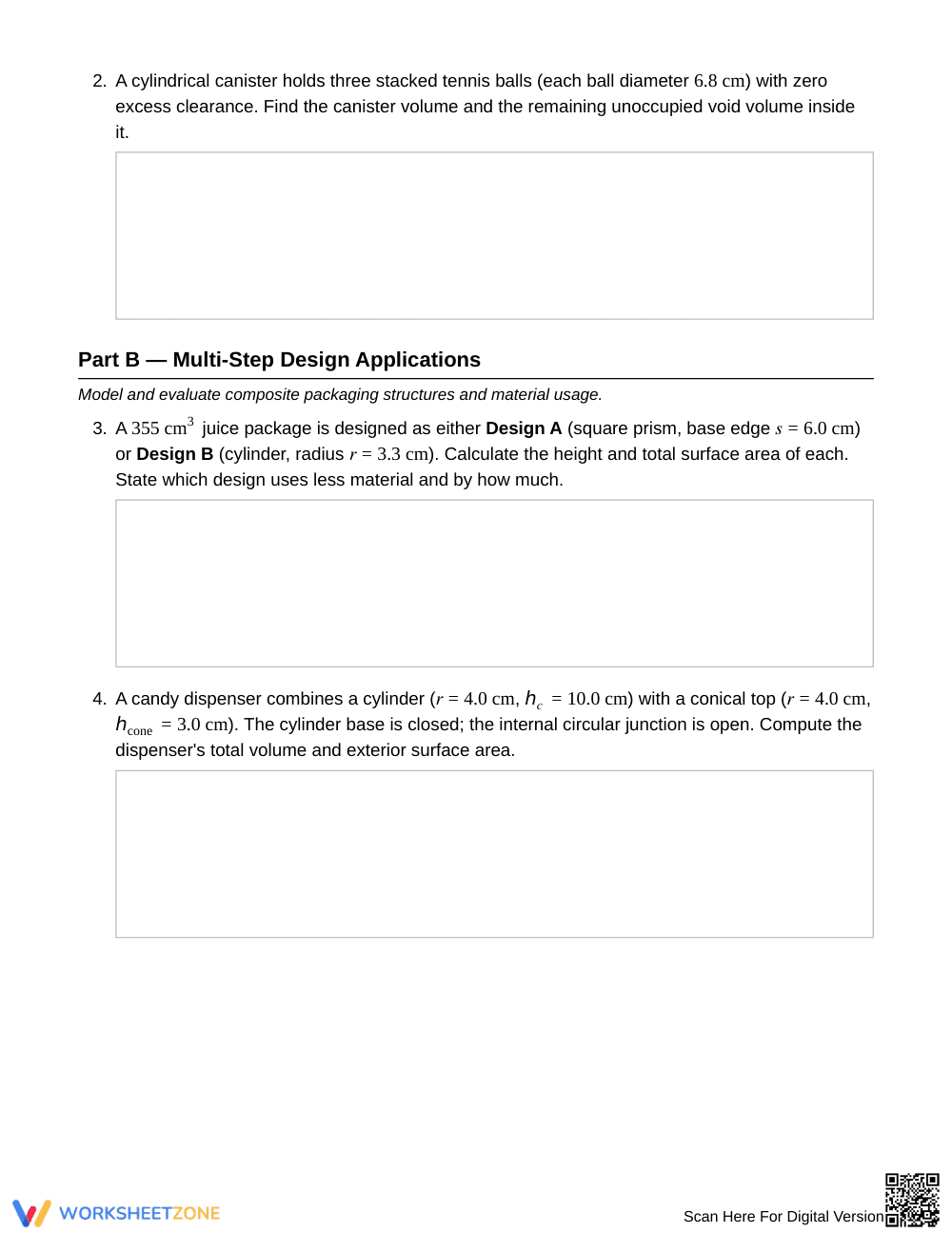
This Grade 10 geometry worksheet enables students to model, evaluate, and optimize real-world packaging designs using surface area and volume formulas. High school learners calculate material costs, evaluate void space, and select optimal shapes under strict geometric constraints across 10 structured modeling problems.
At a Glance
- Grade: 10 · Subject: Geometry
- Standard:
HSG-MG.A.3— Apply geometric methods to solve design and packaging optimization problems- Skill Focus: Compare Packaging Designs Under Constraints
- Format: 4 pages · 10 problems · Answer key included · PDF
- Best For: Geometry design modeling practice
- Time: 45–60 minutes
What's Inside
The 4-page worksheet includes reference formulas and a worked composite dispenser model showing how to exclude shared interior faces. Across 10 multi-step problems, students evaluate packaging efficiency, compute composite volumes, analyze cardstock costs, and solve gable carton dimensions. A 2-page answer key provides step-by-step mathematical solutions.
Skill Progression
- Guided Practice (Part A): Students solve 2 direct packaging problems using reference formulas, calculating carton surface area with allowances and tennis ball canister void volume.
- Supported Practice (Part B): Learners complete 6 multi-step applications, finding composite volumes, gable carton surface areas, and packaging efficiencies for 48 cylindrical cans.
- Independent Practice (Part C): Students solve 2 optimization scenarios, evaluating volume thresholds and footprint limits to select the most cost-effective commercial container.
This gradual-release structure transitions learners smoothly from basic formula application to independent engineering justification.
Standards Alignment
This resource aligns to HSG-MG.A.3: Apply geometric methods to solve design problems, satisfying physical constraints and minimizing costs. It also reinforces supporting standard HSG-GMD.A.3 through volume calculations with prisms, cylinders, cones, and spheres. Both standard codes can be copied directly into lesson plans, IEP goals, or district curriculum mapping tools.
How to Use It
Assign this worksheet during a 45–60 minute session following direct instruction on 3D volume and surface area. In collaborative pairs, students work through Part B packaging comparisons before completing Part C individually. For formative assessment, check whether students correctly exclude internal junction interfaces when calculating exterior surface areas of composite solids.
Who It's For
This resource is designed for Grade 10 Geometry students learning geometric modeling and optimization. It offers scaffolding through the worked cosmetic dispenser model and extends learning through unit cost analysis. Pair this printable with 3D solid manipulatives or an introductory lesson on surface area and volume optimization.
According to Fisher & Frey (2014), structured gradual-release frameworks significantly improve student problem-solving accuracy when tackling complex, multi-step modeling tasks. This 4-page Grade 10 Geometry resource operationalizes standard HSG-MG.A.3 by guiding high school learners through authentic packaging design optimization under strict physical and financial constraints. Students evaluate 10 structured geometric problems, moving from direct surface area formulas with material waste margins to advanced composite structures, such as gable cartons and 48-can storage arrays. By calculating packaging efficiency percentages, comparing cardstock laminate expenses, and verifying volumetric thresholds against bounding box constraints, learners connect abstract solid geometry to industrial manufacturing decisions. Complete with reference formulas, a worked cosmetic dispenser model, and a detailed 2-page answer key, this worksheet equips educators with a rigorous classroom resource that builds measurable mastery in spatial reasoning, cost optimization, and real-world geometric modeling.


