




























Views
Downloads



Essential Orbital Scaling Worksheet | Grade 12 Science

Paste this activity's link or code into your existing LMS (Google Classroom, Canvas, Teams, Schoology, Moodle, etc.).
Students can open and work on the activity right away, with no student login required.
You'll still be able to track student progress and results from your teacher account.
This Grade 12 worksheet trains students to evaluate exoplanetary data and mathematically defend Keplerian orbital scaling relationships. Working with synthetic observational records, high school learners apply Kepler’s Third Law and universal gravitation to substantiate physical mechanisms, determine stellar mass, and disprove competing astrophysical claims.
At a Glance
- Grade: 12 · Subject: Earth & Space Science
- Standard: Orbital Mechanics — Analyze planetary motion data to defend gravitational and orbital scaling relationships
- Skill Focus: Defend an Orbital Scaling Inference
- Format: 5 pages · 8 problems · Answer key included · PDF
- Best For: Advanced planetary dynamics and astrophysics units
- Time: 45–60 minutes
What's Inside
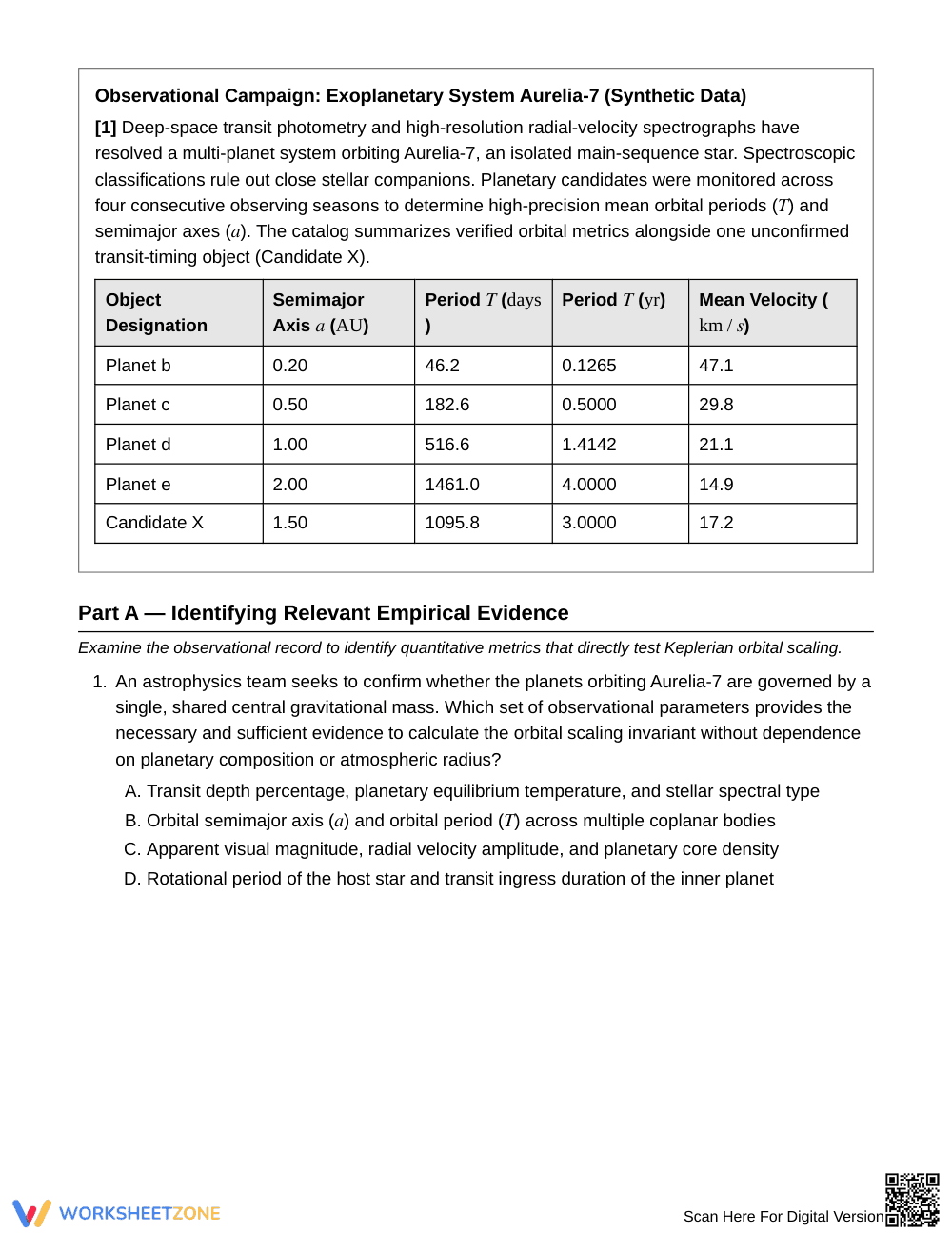
The 5-page worksheet includes 8 analytical tasks anchored by an orbital mechanics reference sheet, governing equations, and a transit catalog for System Aurelia-7. Students complete multiple-choice parameter identification, ratio calculations, algebraic derivations, and claim evaluations. A 4-page answer key provides step-by-step mathematical solutions and explanations.
Skill Progression
- Guided Practice: Tasks 1 and 2 guide students to identify empirical parameters and calculate scaling ratios using system baseline data.
- Supported Practice: Tasks 3 through 6 challenge learners to derive Newton's gravitational basis for Kepler's Third Law, calculate stellar mass, extrapolate orbits, and prove velocity scaling.
- Independent Practice: Tasks 7 and 8 require students to independently evaluate and refute competing claims regarding circumstellar drag and magnetic forces.
This gradual-release sequence moves students from foundational data extraction to sophisticated mathematical argumentation and counter-argument refutation.
Standards Alignment
This resource aligns with high school Earth and space science standards requiring mathematical models of orbital motion to confirm universal gravitation. It reinforces core principles of scale, proportion, and celestial dynamics. Both standard codes can be copied directly into lesson plans, IEP goals, or district curriculum mapping tools.
How to Use It
Deploy this worksheet after direct instruction on Keplerian mechanics during an orbital dynamics unit. For formative assessment, check whether students recognize that gas drag cannot extend an orbital period at a fixed semimajor axis in Task 7. The 8 problems require 45 to 60 minutes of analytical work.
Who It's For
This activity is designed for Grade 12 Earth and Space Science students or physics learners studying gravitation. Differentiate instruction by offering intermediate arithmetic check-ins during velocity derivations, and pair this resource with planetary spectroscopy lecture slides or an exoplanet transit simulation lab.
High school science instruction achieves maximum efficacy when students construct evidence-based arguments rather than memorizing algebraic formulas in isolation. Grounded in research by Fisher & Frey (2014) on structured gradual release, this Grade 12 orbital mechanics resource equips learners to defend an orbital scaling inference through disciplined quantitative reasoning. By scrutinizing high-precision observational data from multi-planet systems, students evaluate how orbital period scales nonlinearly with distance according to Kepler’s Third Law and gravitational field equations. Learners progress through 8 scaffolded tasks that demand calculating system constants, deriving velocity relationships, and refuting flawed astrophysical counterclaims. Such evidence-to-mechanism explanations foster durable mastery of celestial mechanics while preparing students for college-level astrophysics coursework. The rigorous multi-step problem progression ensures that high school seniors can independently interpret empirical transit photometry, calculate central stellar masses, and evaluate competing scientific hypotheses with analytical precision.


