
































Essential Optimism Word Search | Grades 7–8 Behavior

Paste this activity's link or code into your existing LMS (Google Classroom, Canvas, Teams, Schoology, Moodle, etc.).
Students can open and work on the activity right away, with no student login required.
You'll still be able to track student progress and results from your teacher account.
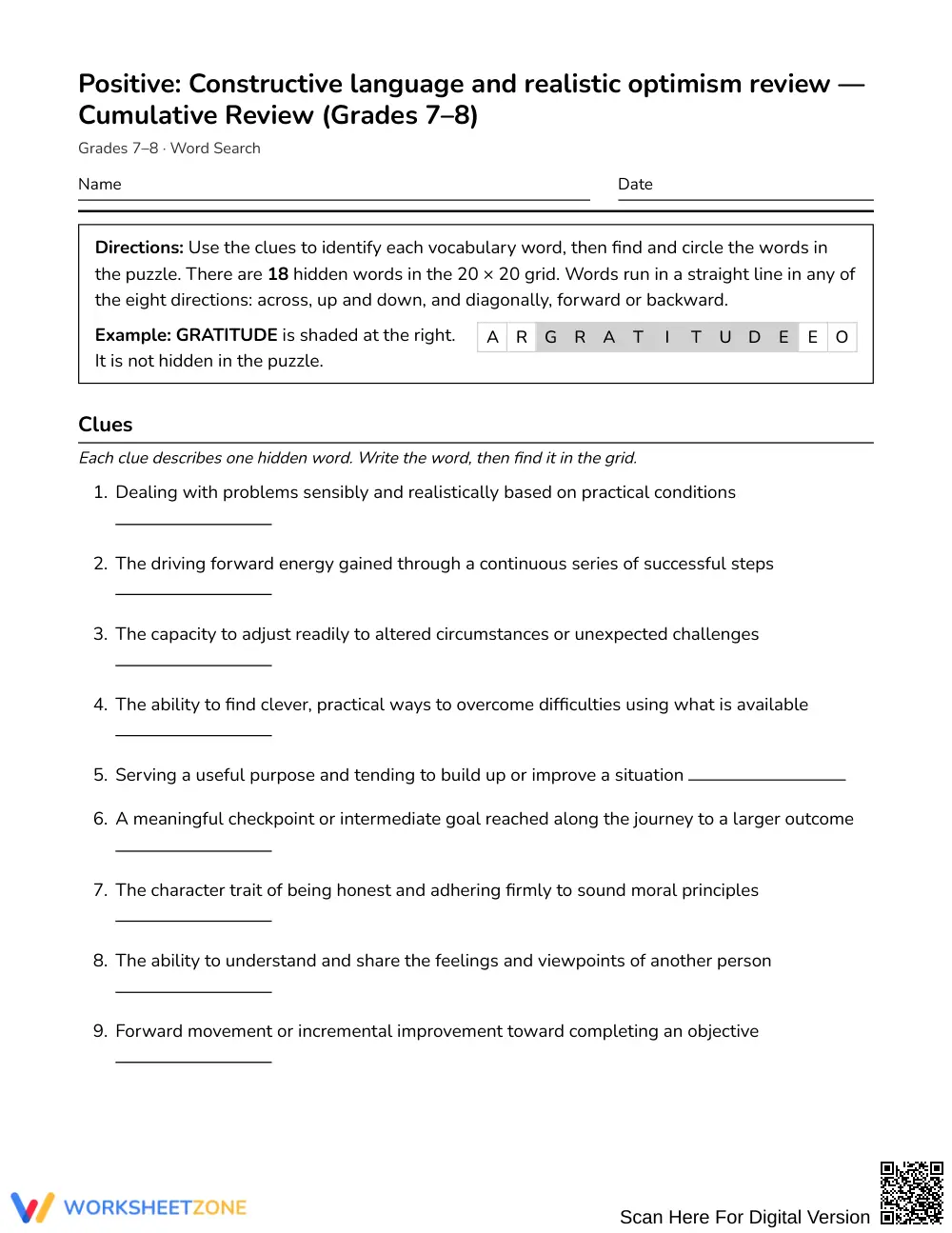
This constructive language and realistic optimism review activity reinforces growth mindset vocabulary across Grades 7–8. Students connect key behavioral concepts—such as reframing setbacks, maintaining perspective, and taking proactive initiative—to clear contextual definitions before locating each term in a dense letter grid, building cognitive familiarity and positive self-talk strategies.
At a Glance
- Grade: Grades 7–8 · Subject: Behavior Worksheets
- Standard: Not standards-assessed — vocabulary enrichment
- Skill Focus: Constructive language and realistic optimism review
- Format: 3 pages · 18 words · Answer key included · PDF
- Best For: Advisory, SEL warm-ups, or counseling groups
- Time: 20–30 minutes
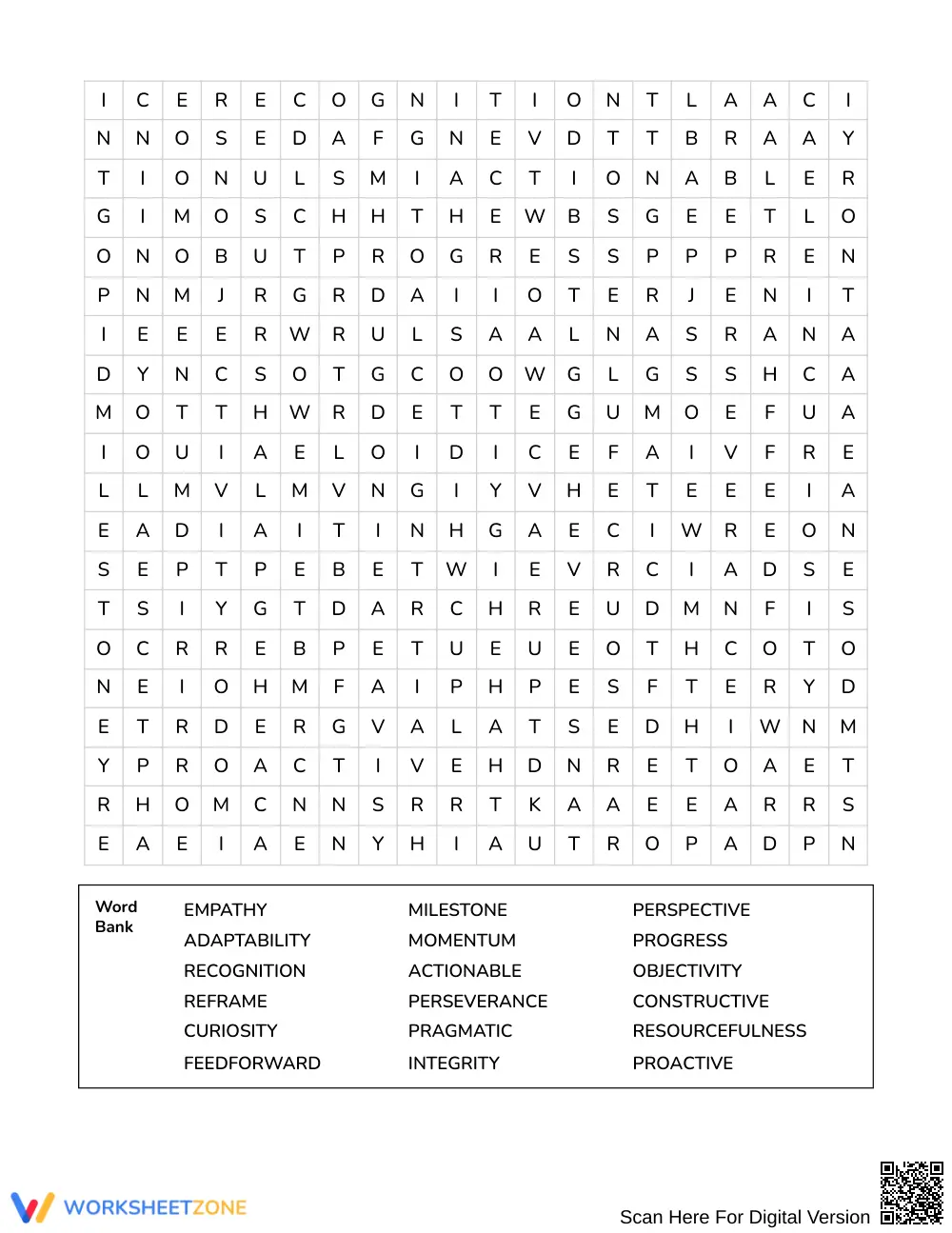
What's Inside: The 3-page printable includes 18 hidden vocabulary terms paired with definitions, a 20 × 20 puzzle grid, and a full 4-page answer key showing exact letter coordinates. Rather than simple letter-matching, students read functional definitions for concepts like feedforward, adaptability, and pragmatic to identify the target vocabulary before searching the grid.
Puzzle Structure and Mechanics:
- Clue-Driven Identification: Students read 18 actionable definitions covering resilient thinking, social awareness, and goal management to reinforce meaning prior to word location.
- Multi-Directional Grid: Hidden words appear across a challenging 20 × 20 letter matrix running in all 8 compass directions: North, Northeast, East, Southeast, South, Southwest, West, and Northwest.
- Shuffled Word Bank: Words are arranged in a shuffled sequence to encourage active scanning, close visual tracking, and cognitive persistence.
Standards Alignment: This activity serves as targeted vocabulary enrichment and character education; it is not aligned to an academic content standard. Teachers can integrate these growth mindset terms across advisory curricula, social-emotional learning modules, or behavioral intervention plans.
How to Use It: Deploy this word search during advisory periods or homeroom as a calm transition activity following challenging testing blocks. Alternatively, assign it after direct instruction on emotional regulation and cognitive reframing so students can apply definitions in small discussion pairs. While learners work, observe which students grasp terms like feedforward versus those needing concrete examples of constructive feedback. Expected completion time ranges from 20 to 30 minutes.
Who It's For: Designed specifically for middle school learners in Grades 7–8 developing emotional literacy and self-advocacy skills. It offers low-stakes independent practice for general classrooms, small-group counseling, or Tier 2 behavioral interventions. Pair this resource with a reflective journaling prompt or a classroom anchor chart on reframing cognitive distortions.
Vocabulary acquisition in behavioral health and social-emotional domains provides adolescent learners with the precise semantic tools required for effective emotional regulation. According to the RAND AIRS 2024 report on non-academic competencies, middle school students explicitly taught growth mindset terminology demonstrate measurable gains in emotional resilience and problem-solving persistence. This constructive language and realistic optimism review activity reinforces 18 core competencies—including adaptability, feedforward, and pragmatic problem-solving—through structured clue identification and puzzle engagement. Although designed as vocabulary enrichment rather than a standards-assessed academic task, systematic engagement with functional definitions supports positive self-talk and cognitive reframing across diverse educational settings. The resource delivers practical character development tools for secondary classrooms.


