





























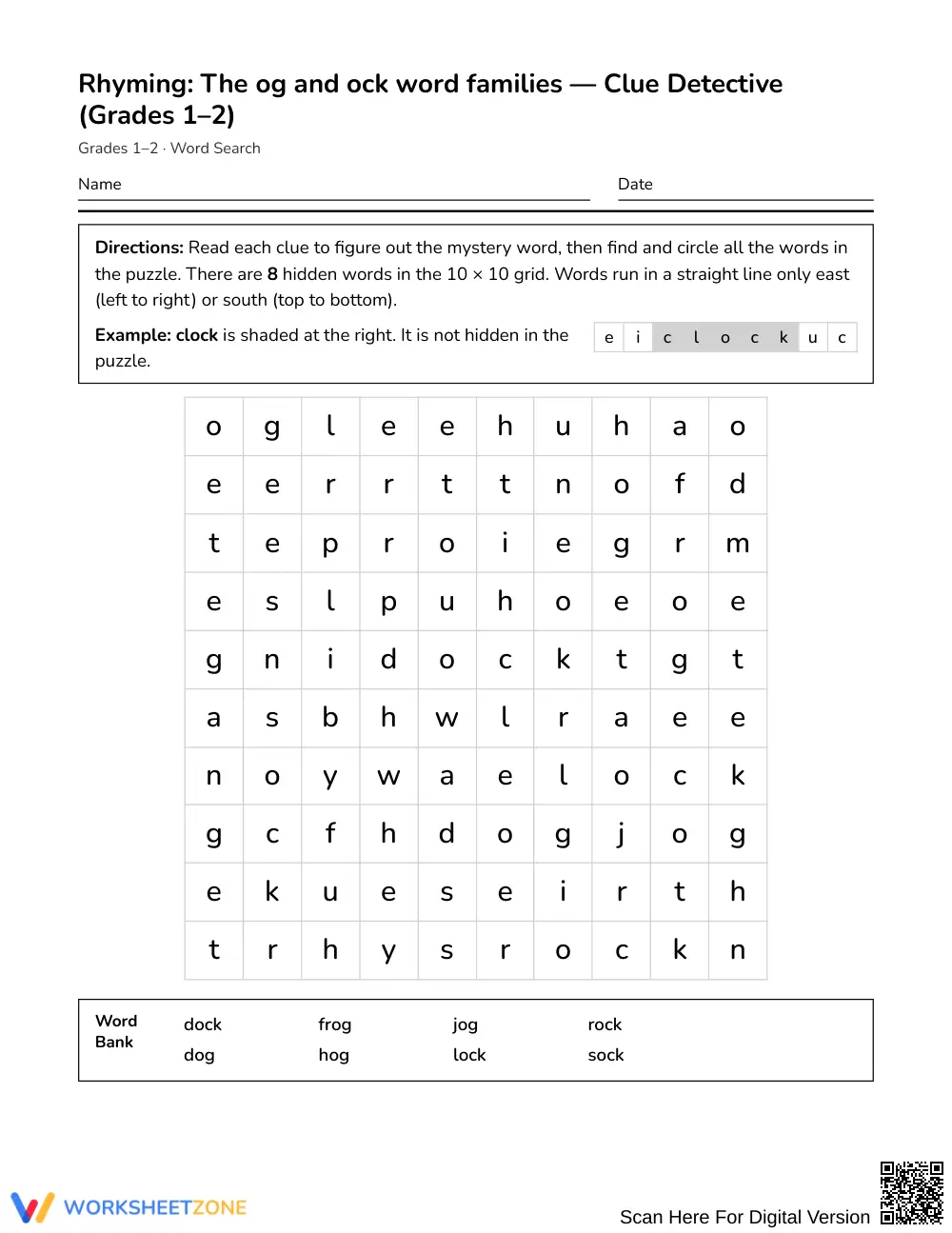


Essential OG & OCK Word Family Word Search | Grades 1–2 ELA

Paste this activity's link or code into your existing LMS (Google Classroom, Canvas, Teams, Schoology, Moodle, etc.).
Students can open and work on the activity right away, with no student login required.
You'll still be able to track student progress and results from your teacher account.
This Grades 1–2 word search builds rhyming awareness and decoding fluency through targeted vocabulary practice with the og and ock word families. Students read clue definitions, deduce target vocabulary, and identify 8 words hidden within a structured letter grid. The activity reinforces phonemic patterns and strengthens reading comprehension through active word recognition.
At a Glance
- Grade: Grades 1–2 elementary · Subject: English Language Arts (ELA)
- Standard: Not standards-assessed — vocabulary enrichment
- Skill Focus: Decoding and rhyming the og and ock word families
- Format: 2 pages · 8 words · Full student page and teacher answer key included · PDF
- Best For: Literacy centers and independent phonics review
- Time: 15–20 minutes
What's Inside
This 2-page resource features a detective-themed word search alongside a complete 2-page teacher answer key. Instead of browsing a passive word list, students read 8 riddle-style clues to identify target words before locating them in the puzzle. The printable includes an alphabetical word bank for support and an uncluttered layout suited for early readers.
Puzzle Mechanics and Structure
The activity is built specifically for early elementary learners to ensure an accessible puzzle experience:
- Grid Dimensions: Features a clear 10 x 10 grid layout designed for emerging readers.
- Search Directions: Words run only East (left to right) and South (top to bottom), avoiding diagonal or backward paths.
- Clues and Word Bank: Students solve 8 definition clues or reference the alphabetical word bank containing DOG, DOCK, FROG, HOG, JOG, LOCK, ROCK, and SOCK.
Standards Alignment
This word search serves as supplemental vocabulary enrichment and is not aligned to an official academic standard. Rather than formal standard benchmarking, this resource strengthens foundational phonemic awareness by reinforcing common spelling rimes across the og and ock word families.
How to Use It
This word search fits smoothly into early literacy instruction during small-group rotations or following direct instruction on short vowel phonics patterns. In a literacy center, students can collaborate in pairs to read clues aloud and hunt for matching words. During independent work, teachers can observe whether students decode clues independently or rely on the word bank. Most learners complete the activity within 15 to 20 minutes.
Who It's For
This activity is designed for students in Grades 1–2 developing early reading skills, as well as English language learners acquiring high-frequency vocabulary. Teachers can differentiate by having emerging readers highlight the rhyming word endings in color or by pairing this puzzle with a short-vowel rhyming anchor chart.
This Grades 1–2 vocabulary enrichment activity targets the og and ock word families through definition-based word search puzzles that foster orthographic mapping and phonemic awareness. Rather than relying on rote memorization, students actively connect phonetic word endings to semantic meanings through contextual clues. According to Fisher & Frey (2014), purposeful word play and guided vocabulary tasks support foundational literacy by anchoring sound-spelling correspondences in meaningful contexts. Engaging young learners in structured clue-reading reinforces lexical retrieval and print concepts, enabling beginning readers to recognize familiar rimes across new vocabulary items. Designed as supplemental vocabulary enrichment without formal standards alignment, this two-page printable provides focused practice that bridges decoding instruction with independent word recognition. Educators can utilize the resource during phonics blocks to monitor phonological awareness and build confidence in early reading development across diverse classroom settings.


