


























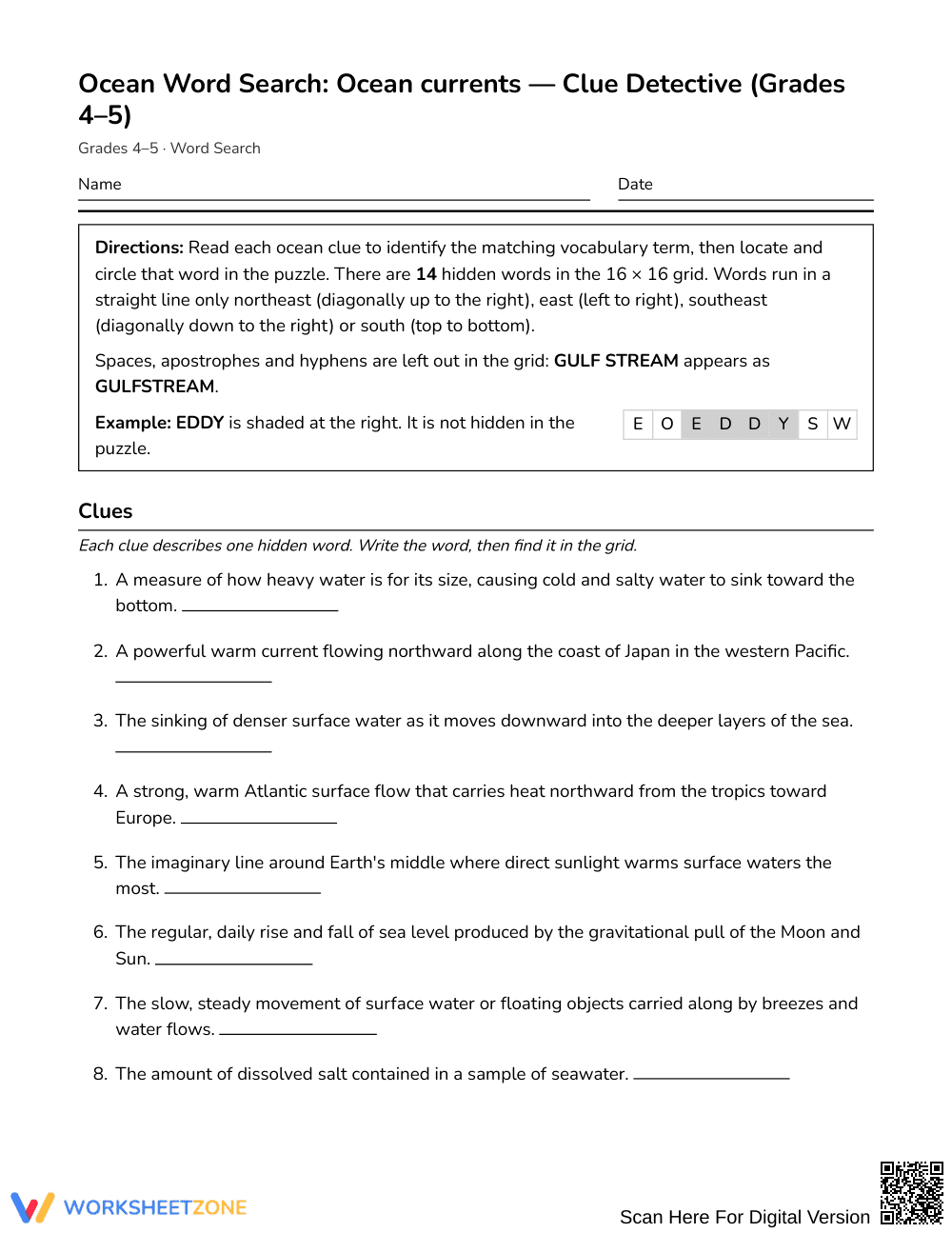


Essential Ocean Currents Word Search | Grades 4–5 Science
Paste this activity's link or code into your existing LMS (Google Classroom, Canvas, Teams, Schoology, Moodle, etc.).
Students can open and work on the activity right away, with no student login required.
You'll still be able to track student progress and results from your teacher account.
This ocean currents word search reinforces foundational Earth science terminology for upper elementary learners. Students read 14 descriptive scientific clues, identify matching marine terms, and locate each target word within the letter grid. By connecting rigorous scientific definitions with engaging puzzle mechanics, learners solidify their understanding of global oceanic circulation, density differences, and surface flows.
At a Glance
- Grade: Grades 4–5 · Subject: Science
- Standard: Not standards-assessed — vocabulary enrichment and concept reinforcement
- Skill Focus: Ocean currents and marine circulation vocabulary
- Format: 3 pages · 14 words · Full answer key included · PDF
- Best For: Earth science unit vocabulary review and active early finishers
- Time: 20–30 minutes of focused individual student practice
What's Inside
This 3-page printable activity features a Clue Detective format where students decode 14 scientific descriptions before searching for terms. Rather than passively copying words, learners read rigorous clues explaining phenomena like salinity, upwelling, and the Coriolis effect. The resource includes a complete 3-page solution guide showing exact word placements and completed clue pairings for rapid grading.
Puzzle Mechanics and Structure
The activity is built on a 16 x 16 letter grid designed specifically for intermediate elementary search strategies. Words run in four distinct orientations: northeast, east, southeast, and south. Students encounter a shuffled word bank alongside 14 clue prompts, requiring them to cross-reference scientific definitions against letter arrangements without reverse or backward placements.
Standards Alignment
This word search serves as science vocabulary enrichment and is not aligned to a formal performance standard. It is designed to reinforce essential academic domain vocabulary during Earth science instruction on hydrosphere dynamics and ocean systems.
How to Use It
Implement this word search after direct instruction on marine systems as an independent vocabulary check, or assign it during collaborative station rotations. While students work, conduct a quick formative observation: check whether learners identify terms from clues independently or rely on the letter grid first. Most students complete the full 14-word puzzle in 20 to 30 minutes.
Who It's For
This resource is tailored for Grades 4–5 science students studying Earth systems. To differentiate, pair emerging readers with a peer partner or highlight clue keywords, while advanced learners write original application sentences for each term. Pair this activity naturally with a labeled world ocean currents map or global conveyor belt diagram.
Mastering ocean currents vocabulary requires upper elementary students to connect specialized domain terms with concrete physical mechanisms. According to Fisher & Frey (2014), intentional vocabulary acquisition is most effective when learners repeatedly interact with academic language across varied contexts, including definitional analysis, contextual clues, and active retrieval practice. This ocean currents resource supports that instructional framework by challenging students to evaluate 14 functional scientific clues rather than performing rote letter matching. By analyzing terms such as thermohaline circulation, upwelling, salinity, and the Coriolis effect, learners bridge conceptual science understanding with precise reading comprehension. The structured clue detective format demands that students synthesize definitions before searching the letter grid, reinforcing long-term memory pathways for complex Earth science systems. Teachers can deploy this focused enrichment tool during marine science units to solidify foundational scientific literacy efficiently across diverse elementary classrooms.


