


























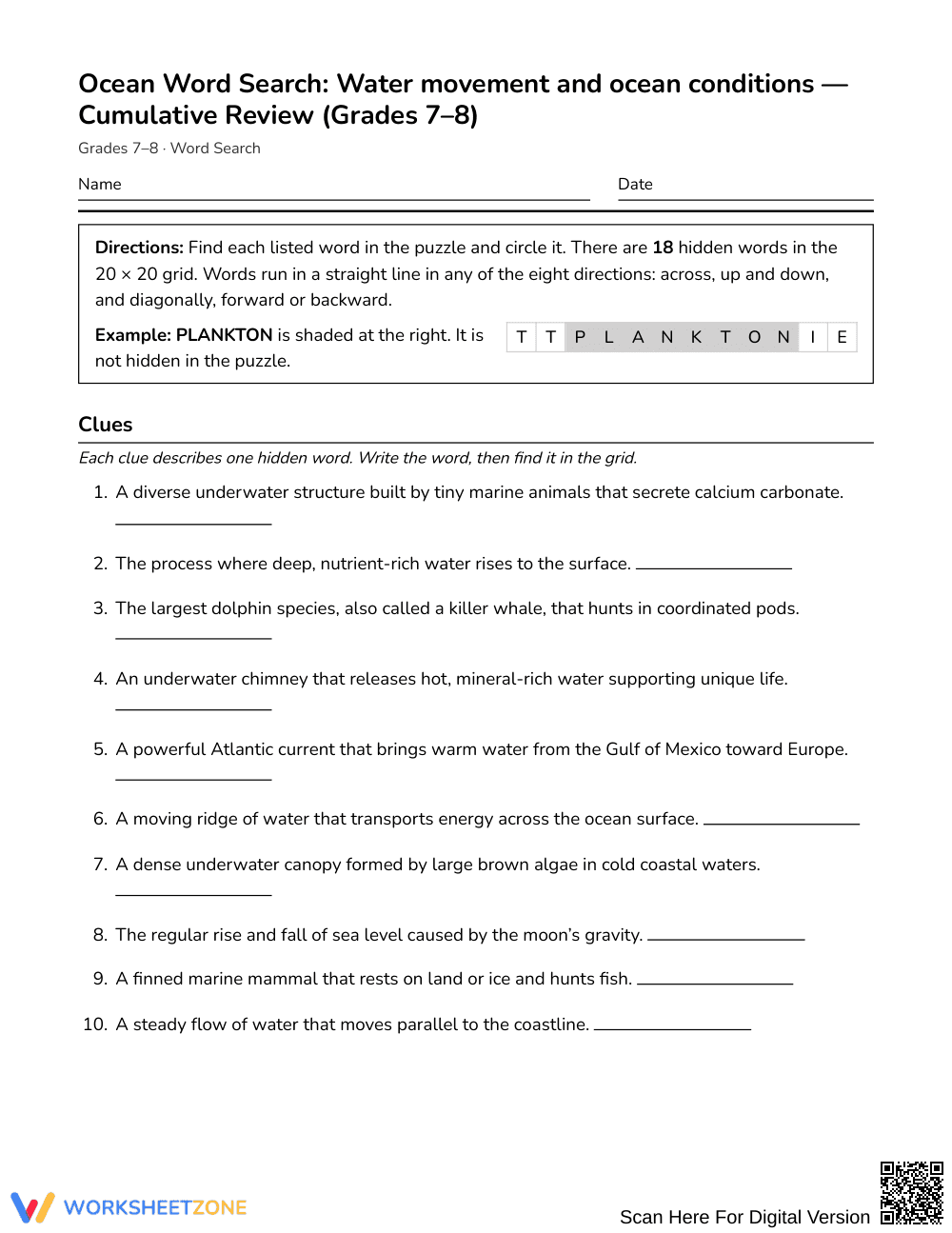


Essential Ocean Conditions Word Search | Grades 7–8 Science
Paste this activity's link or code into your existing LMS (Google Classroom, Canvas, Teams, Schoology, Moodle, etc.).
Students can open and work on the activity right away, with no student login required.
You'll still be able to track student progress and results from your teacher account.
This science word search reinforces student understanding of ocean water movement, marine ecosystems, and hydrological conditions across 18 key vocabulary terms. Designed for Grades 7–8 Earth Science classes, the activity strengthens scientific literacy by pairing terminology with clear definitions, helping learners connect foundational concepts like upwelling and thermocline to real-world ocean processes.
At a Glance
- Grade: Grades 7–8 · Subject: Science
- Standard: Not standards-assessed — vocabulary enrichment
- Skill Focus: Water movement and ocean conditions
- Format: 3 pages · 18 words · Answer key included · PDF
- Best For: Vocabulary review and unit wrap-up
- Time: 20–30 minutes
What's Inside: The 3-page printable PDF features an 18-word puzzle accompanied by complete, student-friendly clues defining physical ocean features, coastal habitats, and marine organisms. The resource provides a shuffled word bank alongside content definitions, supported by a 4-page answer key that highlights exact word placements for quick, hassle-free grading.
Puzzle Mechanics: Built on a challenging 20 × 20 letter grid, this puzzle conceals words in all eight compass directions: north, northeast, east, southeast, south, southwest, west, and northwest. Students read each clue to identify terms like salinity, Gulf Stream, and hydrothermal vent before searching the grid, engaging both retrieval and visual scanning skills.
Standards Alignment: This resource is designed strictly for vocabulary enrichment and is not aligned to a specific state or national content standard. It supports general Earth Science literacy by reinforcing academic language associated with marine systems, currents, and ocean topography.
How to Use It: Deploy this activity immediately after direct instruction on global ocean currents as a consolidation task, or assign it as an independent station activity during an Earth systems unit. While students search, circulate to check whether they can define terms like upwelling without looking at the clue sheet. The activity typically takes 20 to 30 minutes to complete.
Who It's For: This resource serves general science students in Grades 7–8 needing targeted vocabulary reinforcement. It pairs naturally with an introductory lecture on ocean circulation, an anchor chart of ocean layers, or a reading passage detailing coastal marine biomes.
Integrating domain-specific vocabulary into middle school Earth Science supports conceptual retention and reading comprehension across scientific texts. According to Fisher & Frey (2014), intentional exposure to technical terminology through varied retrieval tasks helps adolescent learners internalize foundational language necessary for complex scientific inquiry. This ocean conditions word search targets essential terminology related to water movement, thermal layers, and marine biology, presenting 18 core terms such as thermocline, salinity, and upwelling within a 20 × 20 letter matrix. Rather than relying on rote memorization, students review contextual definitions alongside letter-pattern recognition, reinforcing lexical familiarity and orthographic memory. The self-contained activity functions effectively as an introductory hook, a formative review, or a flexible sub plan, giving educators a straightforward resource to strengthen student confidence with complex science vocabulary before formal unit evaluations.


