































Essential Newton's 2nd Law Worksheet | Grades 8–12 Science

Paste this activity's link or code into your existing LMS (Google Classroom, Canvas, Teams, Schoology, Moodle, etc.).
Students can open and work on the activity right away, with no student login required.
You'll still be able to track student progress and results from your teacher account.
Students master the real‑world application of Newton’s Second Law by solving 24 problems that translate force, mass, and acceleration into everyday scenarios such as carts, vehicles, and rockets. They analyze forces, calculate net force, and justify design choices, building confidence for lab work and engineering discussions.
At a Glance
- Grade: Grades 8–12 (high‑school) · Subject: Science
- Standard:
— Apply Newton’s Second Law to real‑world contexts involving motion, force, and design- Skill Focus: Real‑world application of Newton’s Second Law
- Format: 4 pages of clear diagrams, 24 problems with worked examples, answer key included, PDF ready
- Best For: Lab labs, physics units, engineering projects, and interdisciplinary STEM challenges
- Time: 45–60 minutes
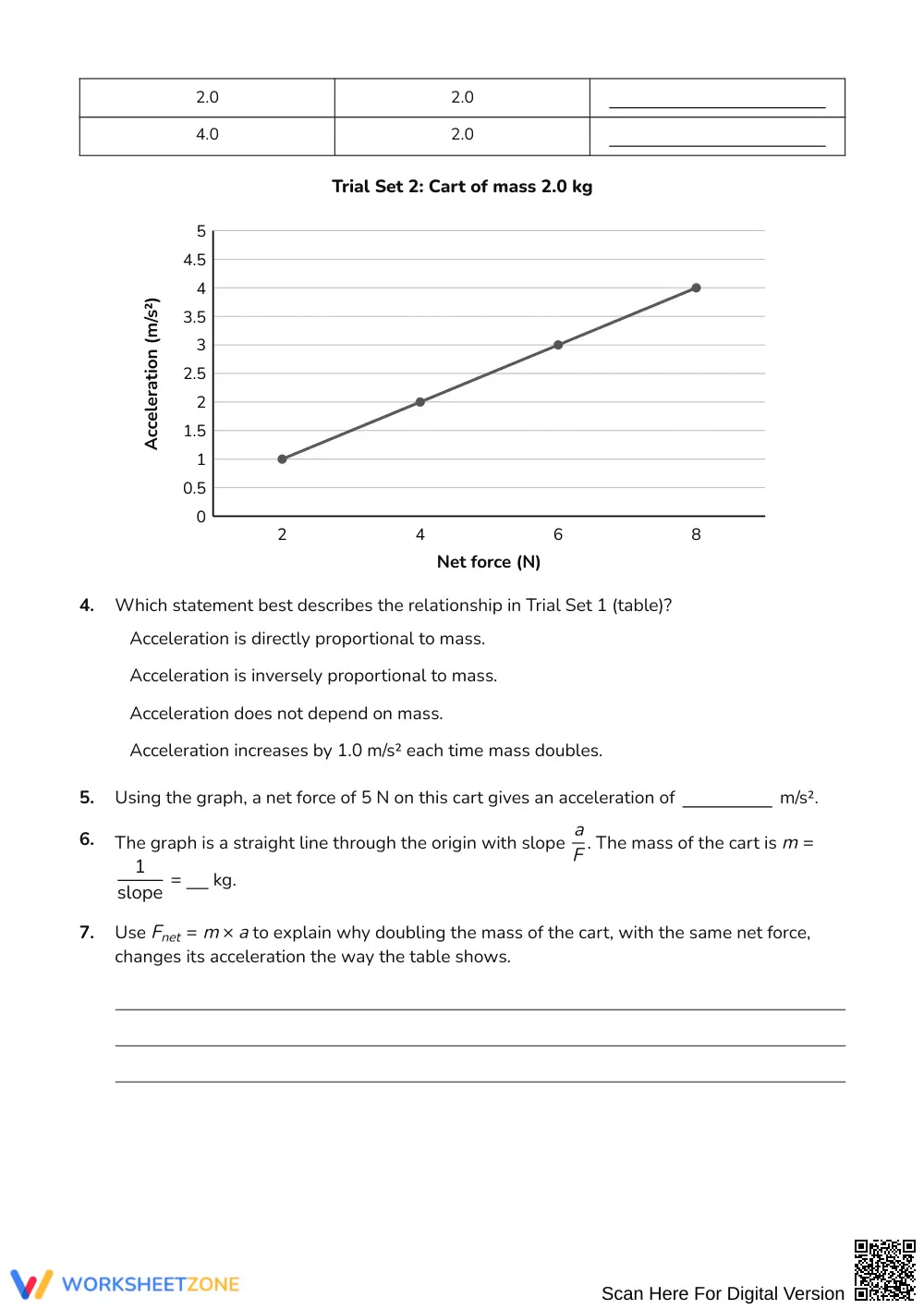
What’s Inside – The packet spans four printed pages, each packed with a mix of multiple‑choice, short‑answer, and extended‑response items. Students encounter free‑body diagrams, data tables, graph interpretation, and real‑life design prompts. A concise answer key follows the last page, and sentence frames appear in the first section to scaffold explanations.
- Guided practice: 8 problems with worked examples and sentence frames to model the a = F/m relationship.
- Supported practice: 8 problems that remove the frames but keep a hint box, encouraging independent reasoning.
- Independent practice: 8 open‑ended problems requiring full calculations and written justification.
This progression mirrors the classic I Do, We Do, You Do release model, moving students from teacher‑led modeling to autonomous application.
Standards Alignment – Standard: (unspecified) – Students apply Newton’s Second Law to real‑world contexts, translating force, mass, and acceleration into quantitative explanations. Both standard references can be copied directly into lesson plans, IEP goals, or district curriculum mapping tools.
How to Use It – Before a unit on forces, preview Part A as a quick diagnostic (5 minutes) to gauge prior knowledge. During lab work, assign Part B and Part C for data‑collection practice, then have students complete Part E as a post‑lab reflection (15‑20 minutes). Observe student explanations to inform immediate feedback.
Who It’s For – Ideal for high‑school science students (grades 8‑12) who need concrete connections between equations and everyday motion. The worksheet’s built‑in sentence frames support English‑language learners, while the open‑ended sections challenge advanced learners. Pair it with a free‑body‑diagram anchor chart or a short video on Newton’s laws for a cohesive lesson.
Research demonstrates that contextualized physics problems significantly improve the transfer of abstract principles to novel physical scenarios (Fisher & Frey, 2014). This instructional resource operationalizes those empirical findings by systematically guiding secondary science students from conceptual formulas to authentic mechanical situations, including braking vehicles, rolling carts, and launching rockets. When learners repeatedly calculate force, mass, and acceleration across diverse everyday domains, they bridge the gap between mathematical manipulation and deep conceptual comprehension. Furthermore, explicit scaffolding helps students construct coherent written scientific explanations and justify design decisions with quantitative evidence. The included complete answer key supports rapid feedback loops, enabling timely interventions and informed instructional adjustments during formative stages of learning. By grounding mathematical relationships in concrete phenomena, this structured practice strengthens student retention, builds problem solving confidence, and prepares high school learners for rigorous performance based laboratory assessments and advanced science coursework throughout the academic year.


