


























Views
Downloads

Essential Mixed Number Constraints Worksheet | Grade 6 Math
Paste this activity's link or code into your existing LMS (Google Classroom, Canvas, Teams, Schoology, Moodle, etc.).
Students can open and work on the activity right away, with no student login required.
You'll still be able to track student progress and results from your teacher account.
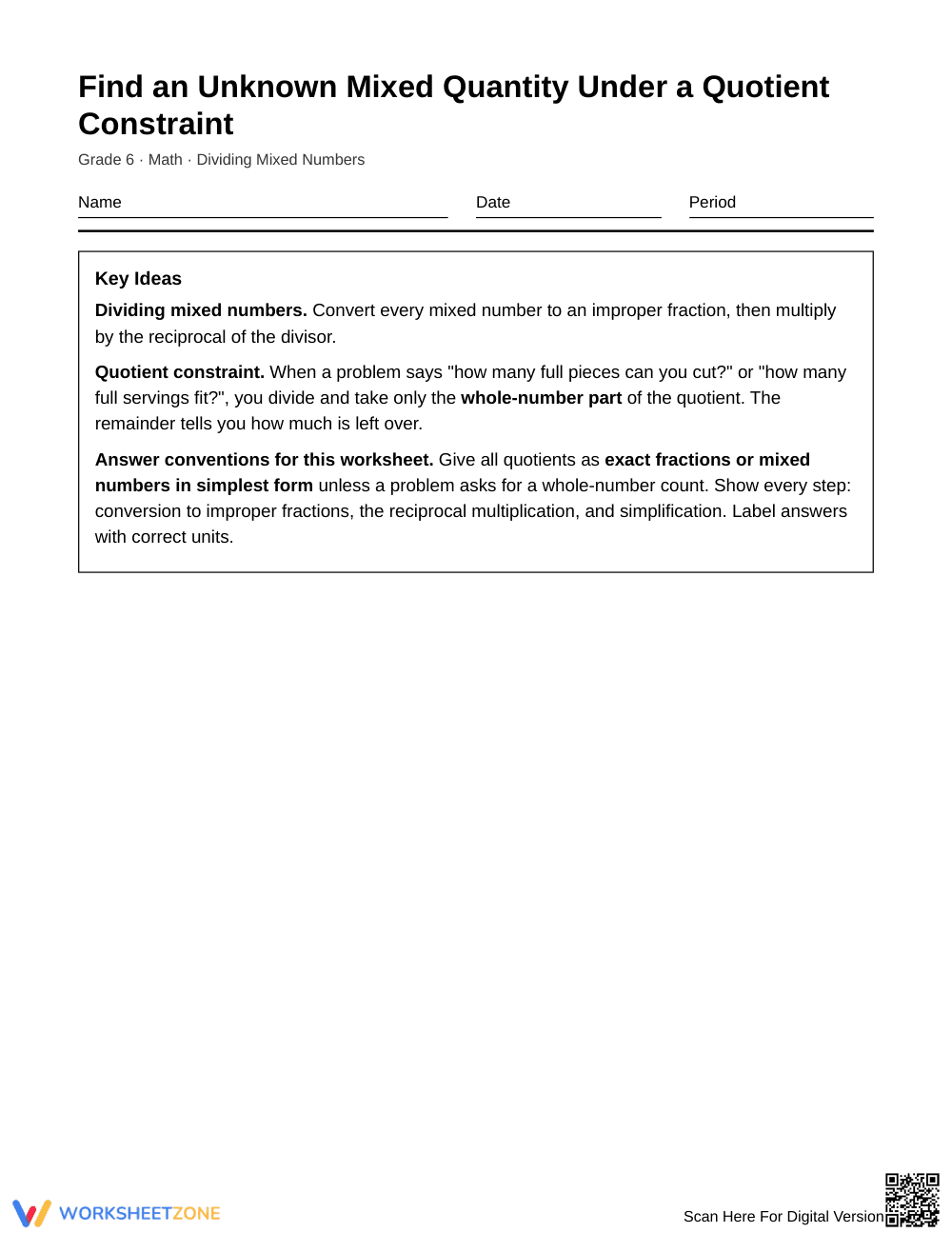
This Grade 6 math worksheet guides students through dividing mixed numbers when real-world constraints limit solutions to whole units. Learners compute improper fraction quotients, extract discrete whole-number quantities, and interpret fractional remainders within contextual measurement scenarios, securing conceptual mastery of complex fraction division.
At a Glance
- Grade: 6 · Subject: Math
- Standard:
6.NS.A.1— Divide fractions and mixed numbers to solve contextual word problems- Skill Focus: Mixed number division under quotient constraints
- Format: 5 pages · 6 problems · Answer key included · PDF
- Best For: Guided practice and math intervention
- Time: 40–50 minutes
What's Inside
This 5-page student packet provides 6 rigorous word problems organized across three distinct developmental sections, supported by a 3-page comprehensive answer key. Features include structured organizational tables for improper fraction conversions and reciprocal operations, unassisted multi-step real-world problems, and a student-authored constraint task requiring written mathematical justification.
Skill Progression
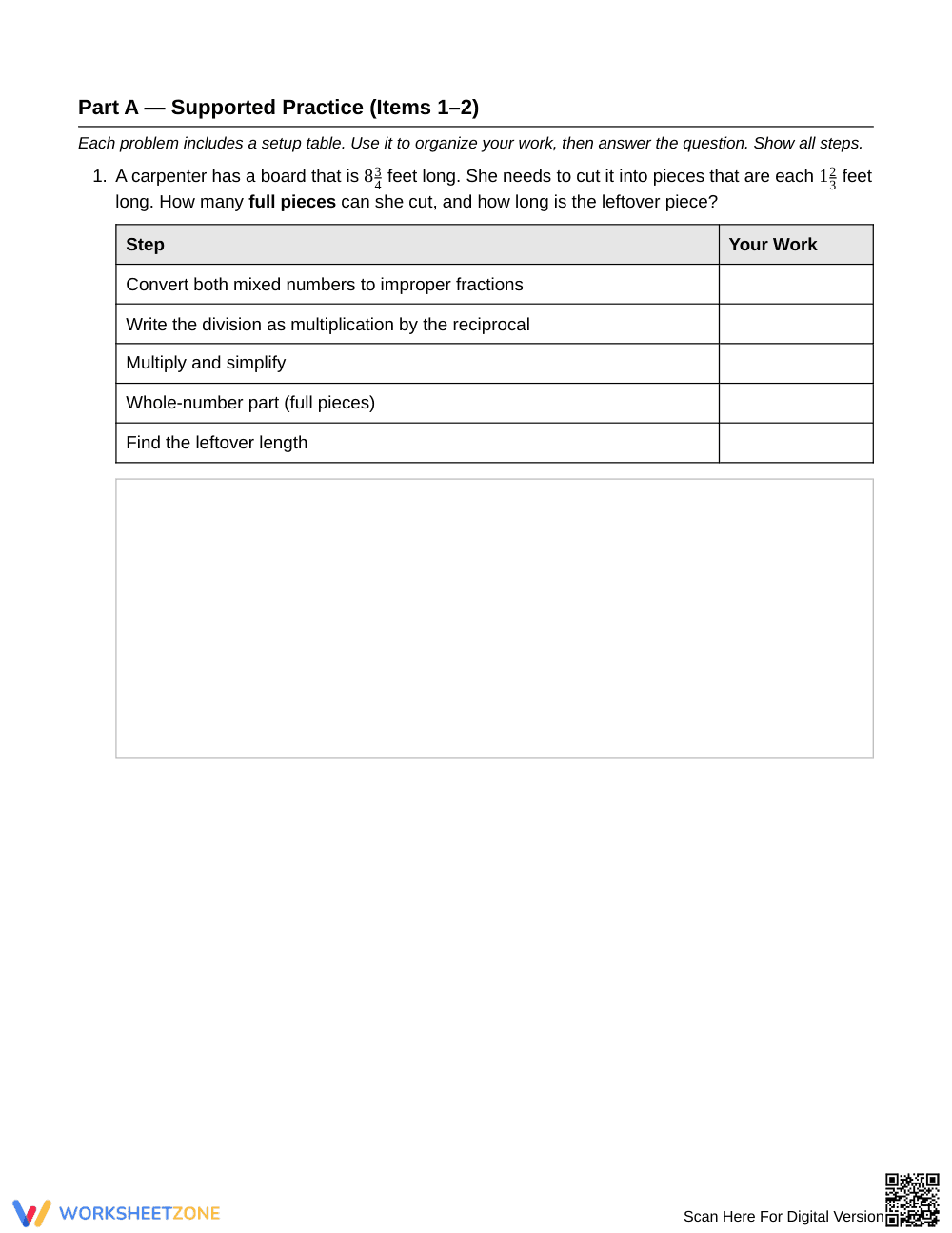
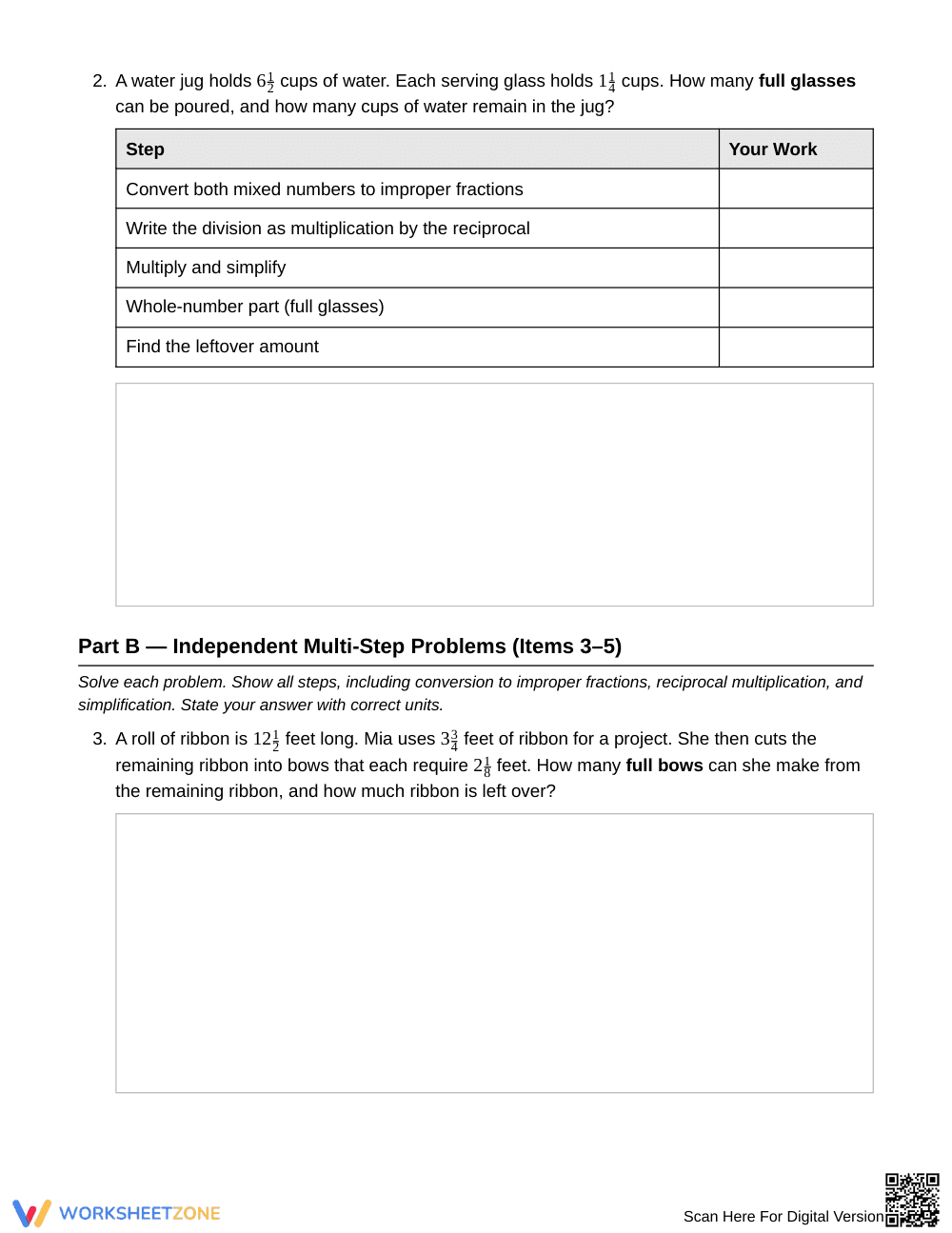
- Guided and Supported Practice (Items 1–2): Two scaffolded problems use 5-step tables that guide learners through improper conversions, reciprocal multiplication, and isolating whole-number pieces from remaining amounts.
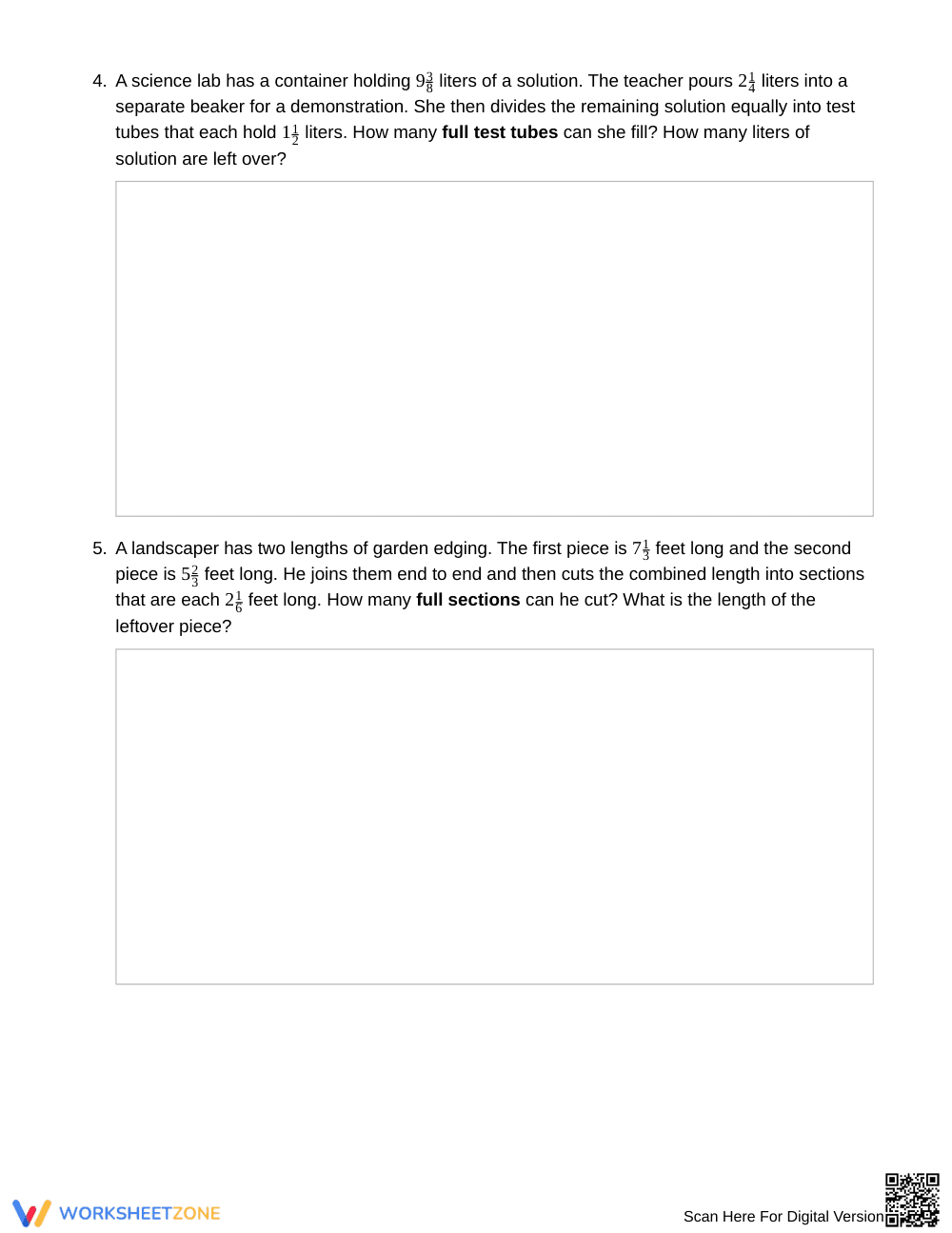
- Independent Multi-Step Practice (Items 3–5): Three contextual problems remove graphic organizers, challenging students to combine multi-step operations like subtraction and addition prior to dividing constrained mixed quantities.
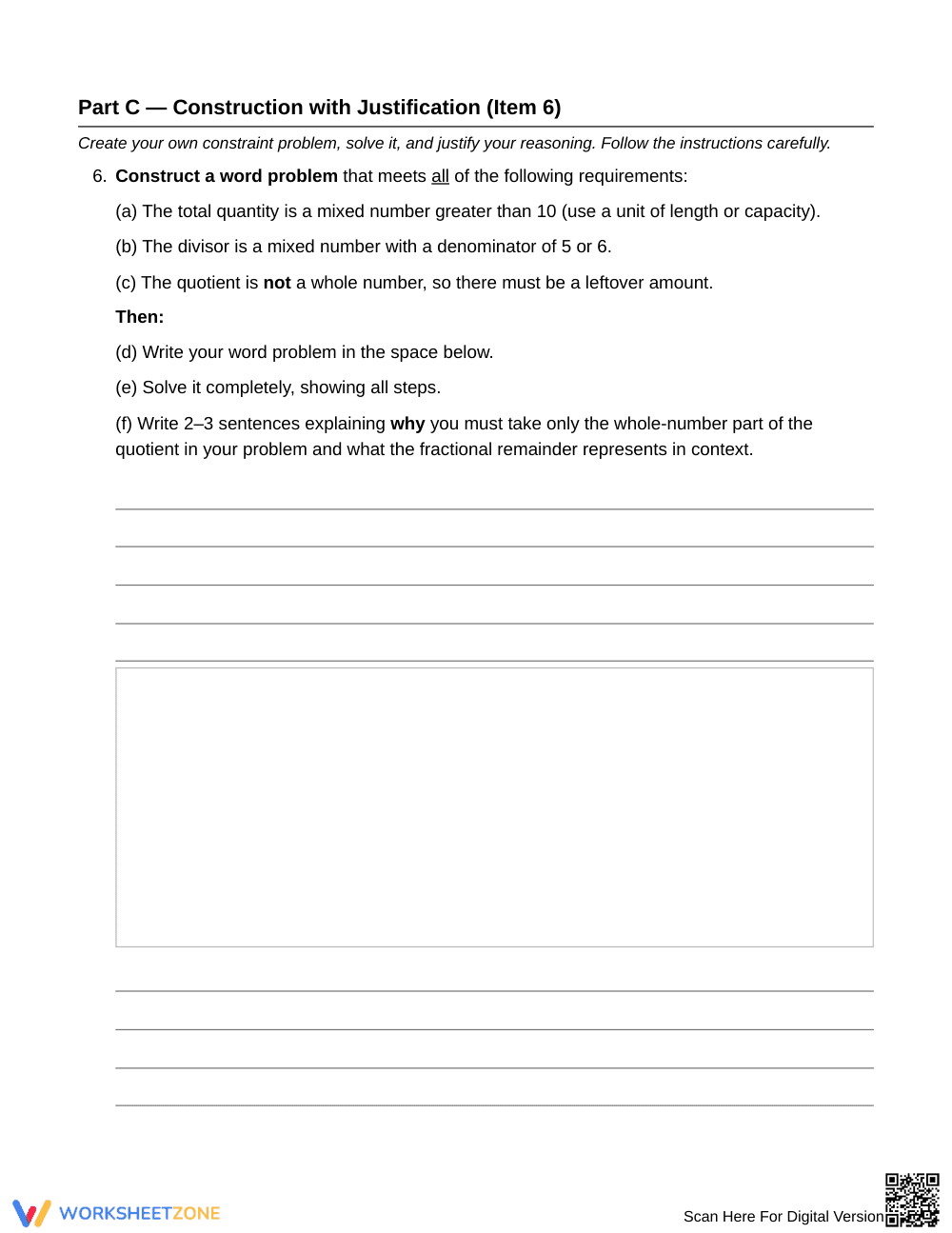
- Generative Construction (Item 6): Students construct an original constraint problem meeting precise numeric conditions and articulate why contextual constraints dictate whole-number quotients.
This sequence embodies the gradual release of responsibility model, shifting cognitive ownership from structured tables to independent mathematical reasoning.
Standards Alignment
This resource aligns directly with `6.NS.A.1`: Interpret and compute quotients of fractions, and solve word problems involving division of fractions by fractions. It also supports `6.EE.B.6` by requiring learners to construct real-world constraints using mathematical variables. Both standard codes can be copied directly into lesson plans, IEP goals, or district curriculum mapping tools.
How to Use It
Implement this worksheet following direct instruction on reciprocal multiplication to solidify conceptual quotient interpretation. In small-group settings, leverage Part A's setup tables to diagnose conversion errors before students tackle Part B independently. For formative assessment, evaluate whether students correctly express leftover quantities using the appropriate measurement unit. Expected completion time is 40 to 50 minutes.
Who It's For
This worksheet serves sixth-grade general math students, Tier 2 intervention cohorts, and accelerated fifth graders tackling advanced fraction division. Support struggling learners by offering fraction strips, or challenge early finishers to verify solutions algebraically. This packet pairs naturally with teacher-led anchor charts illustrating reciprocal division models.
According to Fisher & Frey (2014), structured gradual release frameworks provide the essential cognitive scaffolding necessary for students to transition from procedural algorithms to conceptual mastery. Under standard 6.NS.A.1, sixth-grade learners frequently struggle when word problems require interpreting non-integer remainders under real-world constraints rather than executing routine reciprocal operations. By engaging with structured setup tables, students systematically break down multi-step mixed number division: converting mixed values to improper fractions, multiplying by reciprocals, and distinguishing the whole-number quotient from the remaining fractional quantity. The final construction task deepens understanding by prompting learners to write authentic word problems and explain why physical constraints restrict outputs to whole units. This targeted progression reinforces standard 6.NS.A.1, preparing students to solve complex fraction division word problems with verified procedural fluency and lasting mathematical reasoning across authentic applications.


