


























Views
Downloads



Essential Magnitude vs. Intensity Worksheet | Grade 8
Paste this activity's link or code into your existing LMS (Google Classroom, Canvas, Teams, Schoology, Moodle, etc.).
Students can open and work on the activity right away, with no student login required.
You'll still be able to track student progress and results from your teacher account.
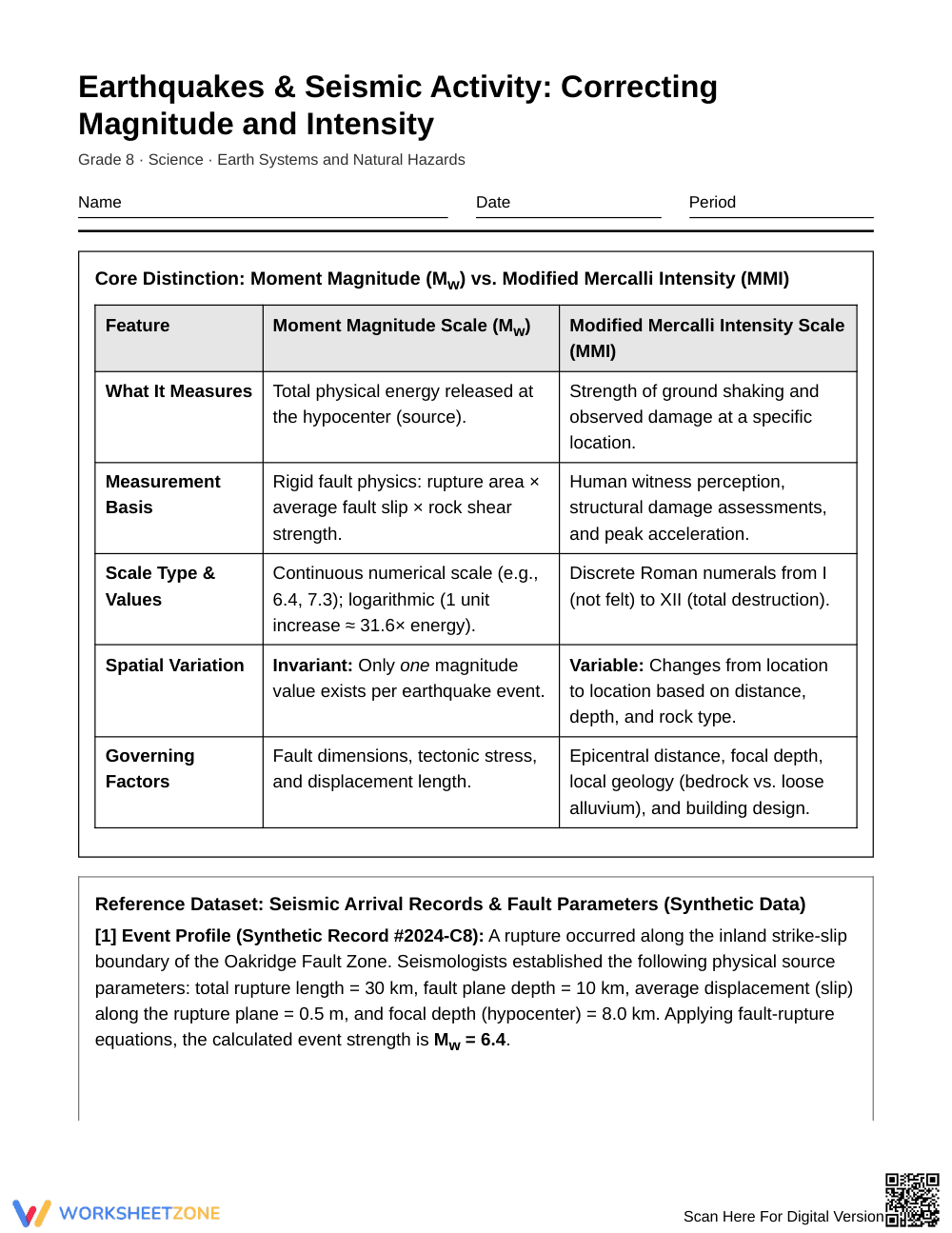
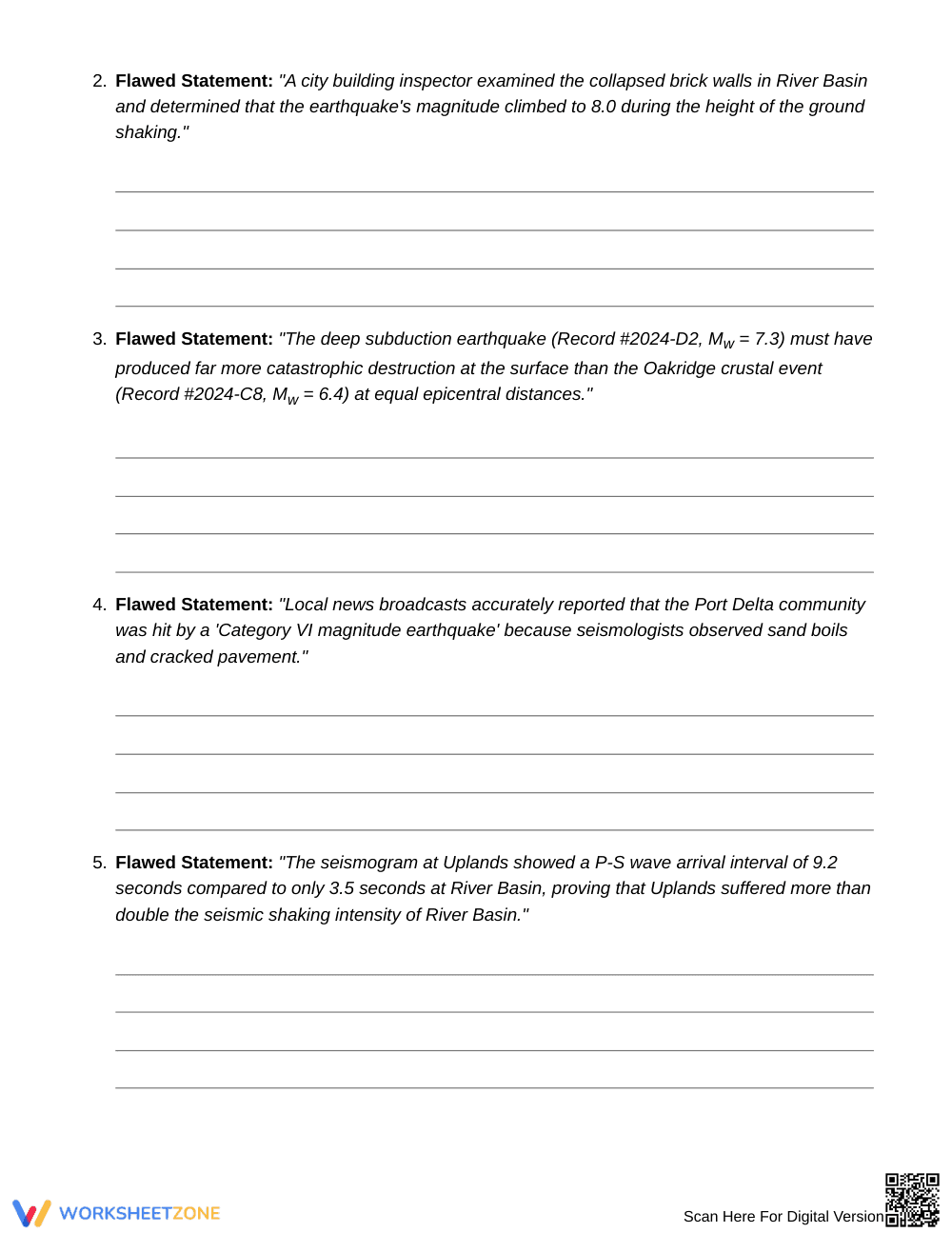
This Grade 8 science worksheet builds precise scientific reasoning about the difference between earthquake magnitude and shaking intensity. Students analyze eight flawed statements drawn from realistic seismic data, diagnose the specific misconception in each one, and write evidence-based corrections grounded in fault-rupture physics and Modified Mercalli Intensity observations. By the end of the activity, students can confidently distinguish a single-value source measurement from a location-dependent damage assessment.
At a Glance
- Grade: 8 · Subject: Science
- Skill Focus: Correcting magnitude-intensity confusion
- Format: 5 pages · 8 problems · Answer key included · PDF
- Best For: Formative review after earthquake instruction
- Time: 30–45 minutes
What's Inside
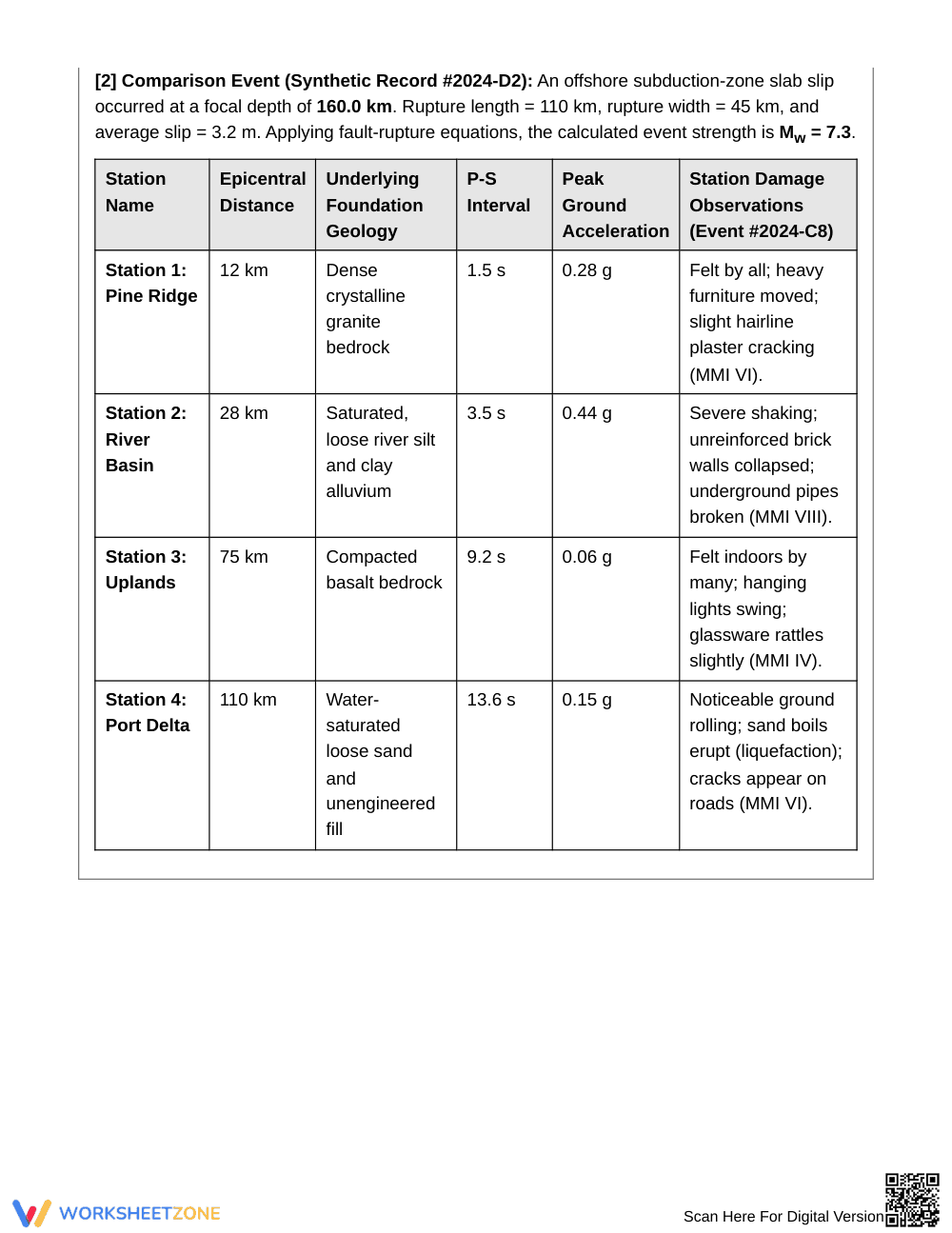
The worksheet opens with a reference table comparing the Moment Magnitude Scale and the Modified Mercalli Intensity Scale across five features: measurement basis, scale type, spatial variation, and governing factors. A synthetic seismic dataset provides two event profiles and four station records with epicentral distances, geology types, P-S intervals, peak ground accelerations, and damage observations. A modeled example walks students through diagnosing and correcting a sample misconception before they tackle eight independent error-analysis tasks. A three-page answer key supplies explanations for every problem.
Skill Progression
- Guided Practice: One worked example demonstrates the diagnosis workflow, showing students how to identify the confused variable, cite reference data, and rewrite claims with accurate terminology.
- Supported Practice: Problems 1 through 4 target common errors, including site amplification, focal depth, and mixing scale terms.
- Independent Practice: Problems 5 through 8 introduce subtler errors involving P-S wave intervals, magnitude calculations, and fault geometry without scaffolded prompts.
How to Use It
Assign the worksheet after instruction on seismic waves and measurement scales. Students work through the problems independently or in pairs over 30 to 45 minutes. As a formative assessment check, listen for whether students attribute damage differences to local geology rather than magnitude changes. The resource also works well for station rotations, homework, or review sessions.
This five-page science worksheet targets one of the most persistent misconceptions in middle school earth science: the confusion between earthquake magnitude and shaking intensity. Research from the RAND AIRS 2024 report on science assessment confirms that error-analysis tasks, where students identify, diagnose, and repair flawed scientific claims, produce stronger conceptual gains than traditional recall questions, particularly in geoscience domains where everyday language conflicts with technical terminology. The eight problems move students through a structured gradual-release sequence, beginning with a fully modeled correction and progressing to independent analysis of nuanced errors involving site geology, focal depth, and scale terminology. Each task requires students to cite specific data from synthetic seismic records, reinforcing evidence-based reasoning and critical thinking skills. The included three-page answer key provides detailed explanations that educators can use for whole-class review, small-group intervention, or direct student feedback during regular class time.


