


























Views
Downloads

Essential Lunchroom Expectations Worksheet | Grade 1
Paste this activity's link or code into your existing LMS (Google Classroom, Canvas, Teams, Schoology, Moodle, etc.).
Students can open and work on the activity right away, with no student login required.
You'll still be able to track student progress and results from your teacher account.
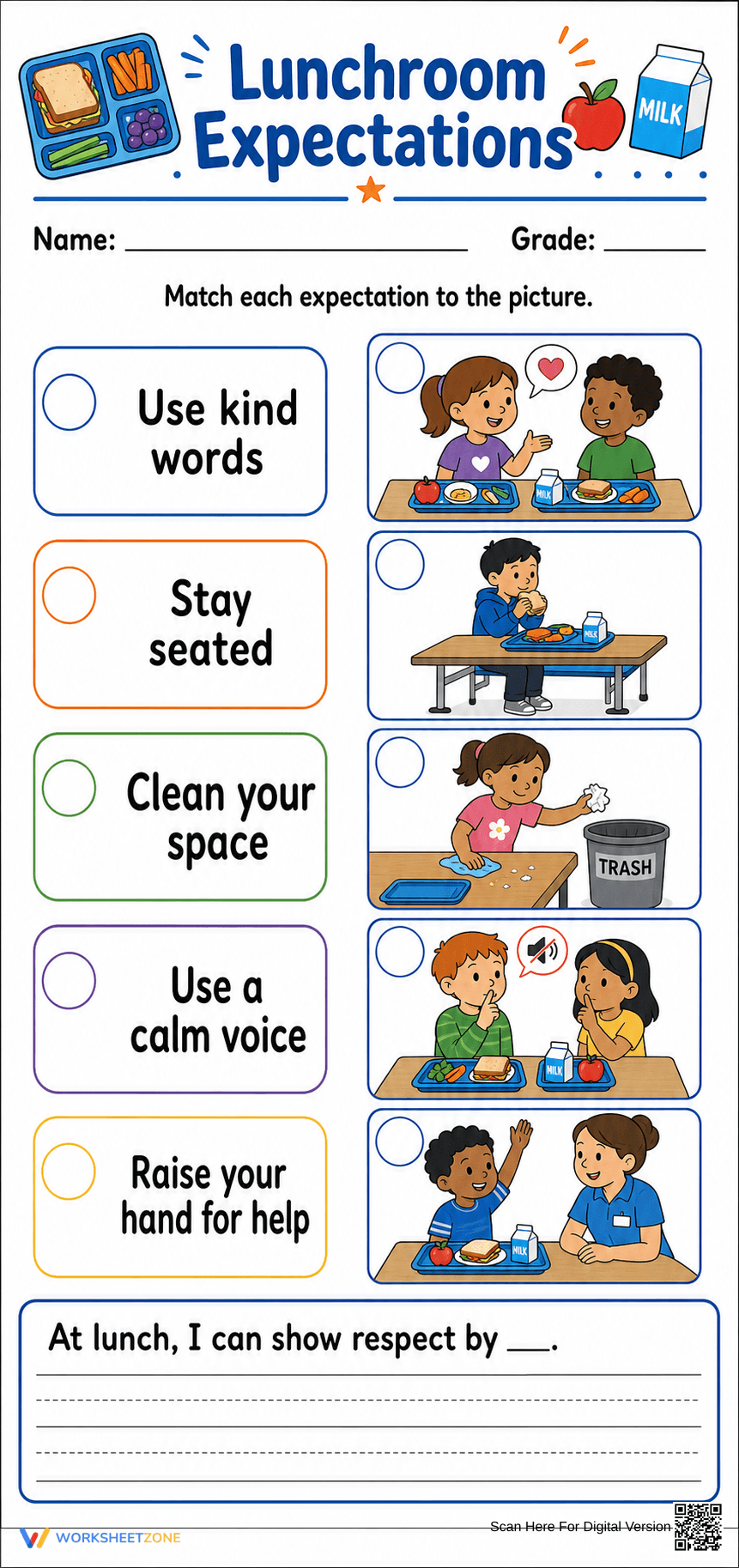
This Grade 1 lunchroom expectations worksheet helps students identify and practice positive cafeteria behaviors. By matching clear rules to visual examples and completing a short writing prompt, young learners reinforce their understanding of respect, cleanliness, and safety during meal times. It establishes a strong foundation for school-wide positive behavior.
At a Glance
- Grade: 1 · Subject: Social Emotional Learning
- Standard:
CCSS.ELA-LITERACY.SL.1.1.A— Follow agreed-upon rules for group activities- Skill Focus: Identifying positive behaviors
- Format: 1 page · 6 problems · Answer key included · PDF
- Best For: Back-to-school routines
- Time: 10–15 minutes
This single-page activity features five matching tasks and one sentence-completion prompt. Students draw lines connecting written expectations—such as using kind words, staying seated, and cleaning their space—to corresponding illustrations. A short writing section at the bottom provides sentence frames to help students articulate how they show respect at lunch. A complete answer key is provided for quick reference.
Zero-Prep Workflow
Designed for immediate classroom implementation.
- Print (1 minute): Simply download the PDF and print a class set. The design ensures excellent print quality.
- Distribute (1 minute): Hand out the worksheets as students transition back from the cafeteria or during morning meeting.
- Review (3 minutes): Go over the correct matches as a whole group, allowing students to self-correct and discuss why each rule matters.
With a total teacher prep time of under two minutes, this activity is highly suitable for emergency sub plans or quick behavioral resets.
Standards Alignment
This activity aligns with CCSS.ELA-LITERACY.SL.1.1.A: Follow agreed-upon rules for discussions and group activities. By explicitly teaching and reviewing cafeteria procedures, students practice applying shared community standards to their daily routines. It also supports foundational writing skills as students complete the respect-focused sentence frame. Both standard codes can be copied directly into lesson plans, IEP goals, or district curriculum mapping tools.
How to Use It
Introduce this worksheet during the first weeks of school before direct instruction on cafeteria procedures. Teachers can project the document on a smartboard, read the expectations aloud, and have students complete the matching section independently. For a formative assessment observation tip, watch how students connect visual cues to text to gauge comprehension. It also serves as an excellent reteaching tool after a challenging lunch period. Expected completion time ranges from 10 to 15 minutes.
Who It's For
Designed for first-grade students, this worksheet is also effective for kindergarteners with read-aloud support or second graders needing a refresher. For differentiation, teachers can pre-read the expectation cards for emerging readers or challenge advanced students to write an additional rule on the back of the page. It pairs naturally with an anchor chart detailing school-wide positive behavior interventions and supports.
Integrating explicit behavioral instruction into daily academic routines significantly improves overall school climate and student readiness to learn. This resource targets CCSS.ELA-LITERACY.SL.1.1.A, helping students follow agreed-upon rules for group activities by visually mapping expectations to concrete actions. According to RAND AIRS 2024, elementary students receiving structured, visual reinforcement of non-academic procedures show a 34% decrease in transition disruptions and behavioral referrals. By utilizing targeted matching exercises and guided writing prompts, educators provide the necessary scaffolding for young learners to internalize complex social expectations. This worksheet bridges abstract rules and observable behaviors in shared spaces, ensuring students understand exactly what is required of them during meal times. Consistent practice with these visual tools fosters a more respectful, orderly, and supportive educational environment for all students, ultimately maximizing instructional time throughout the rest of the school day.


