

































Essential Literary Analysis Worksheet | Grade 12 English IV

Paste this activity's link or code into your existing LMS (Google Classroom, Canvas, Teams, Schoology, Moodle, etc.).
Students can open and work on the activity right away, with no student login required.
You'll still be able to track student progress and results from your teacher account.
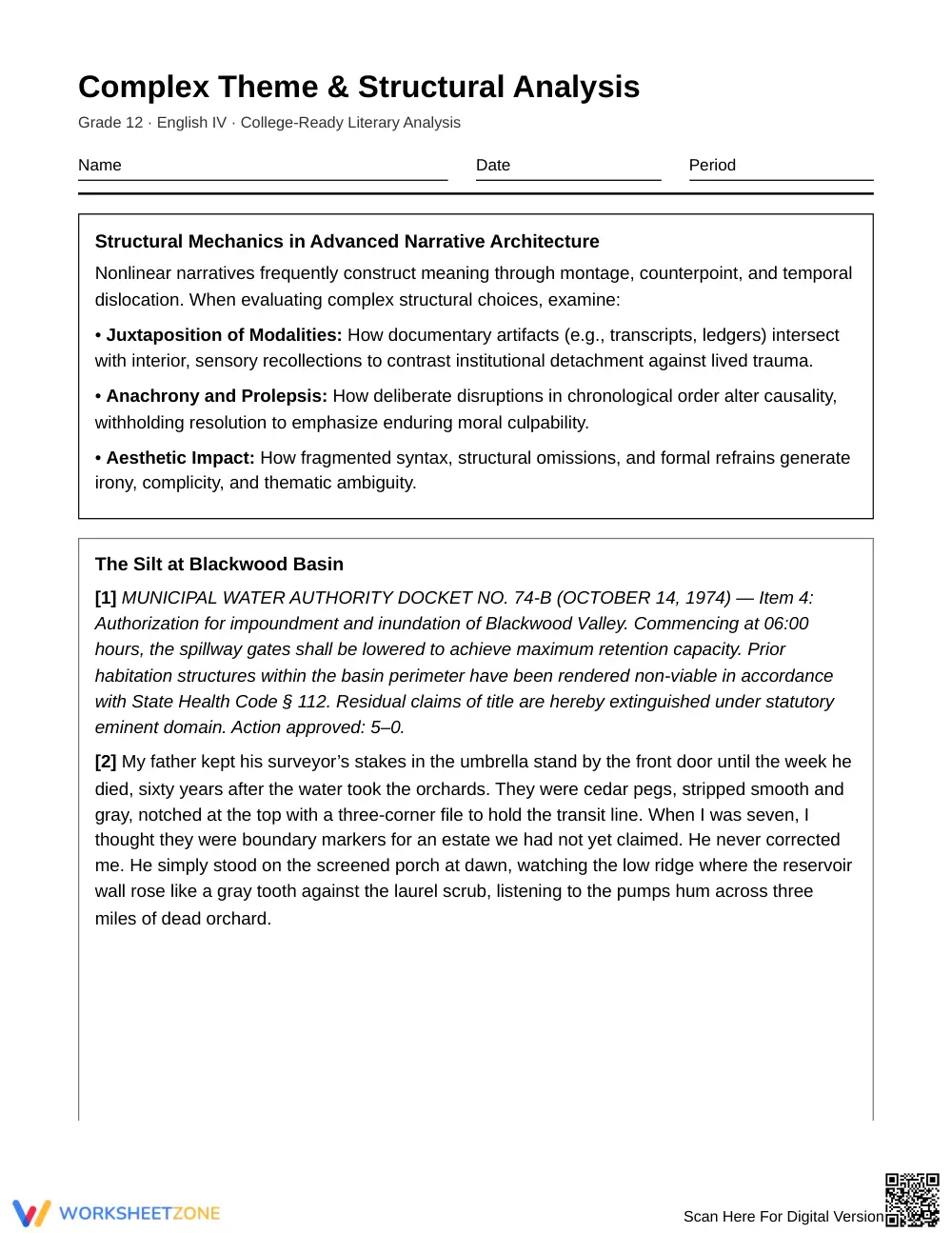
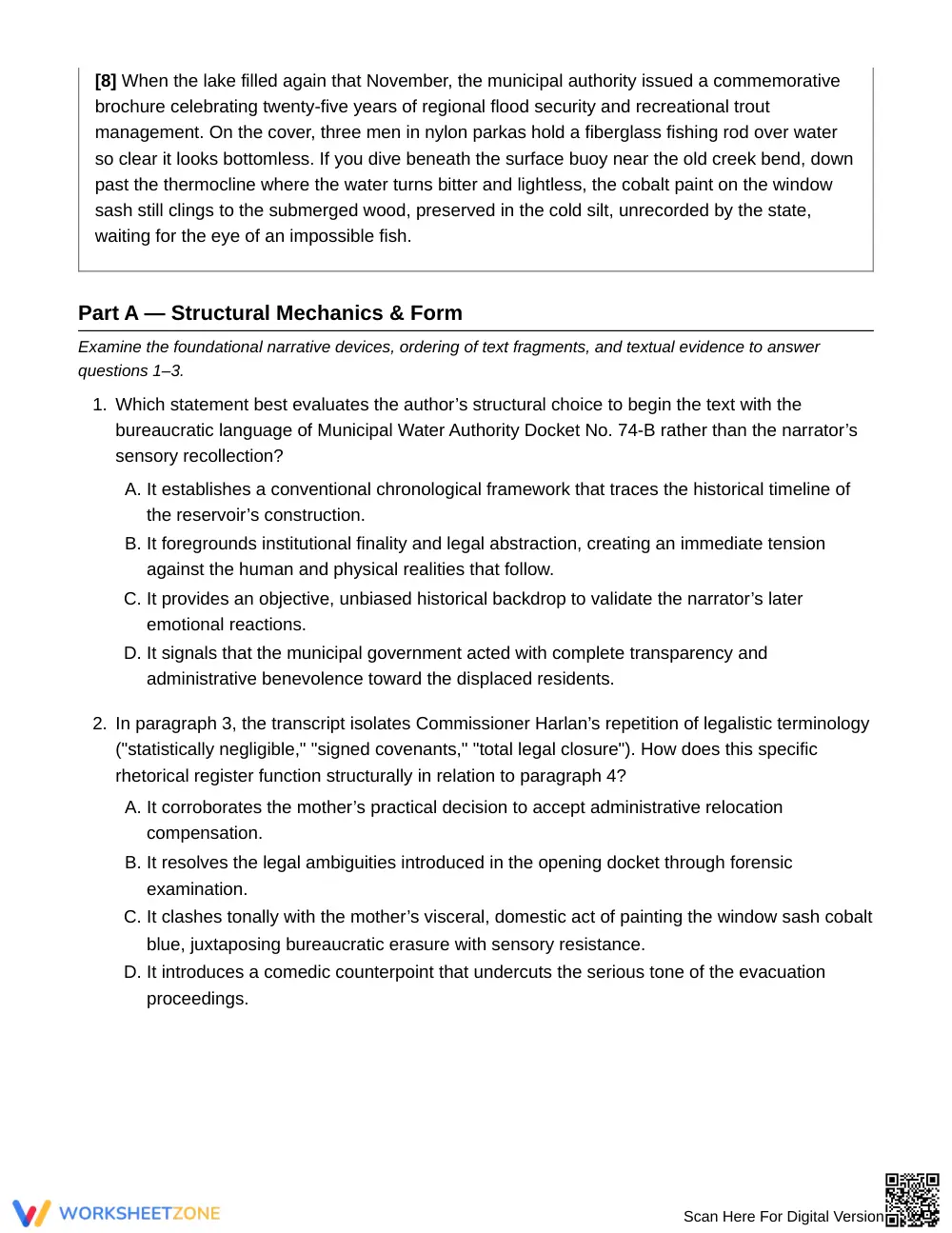
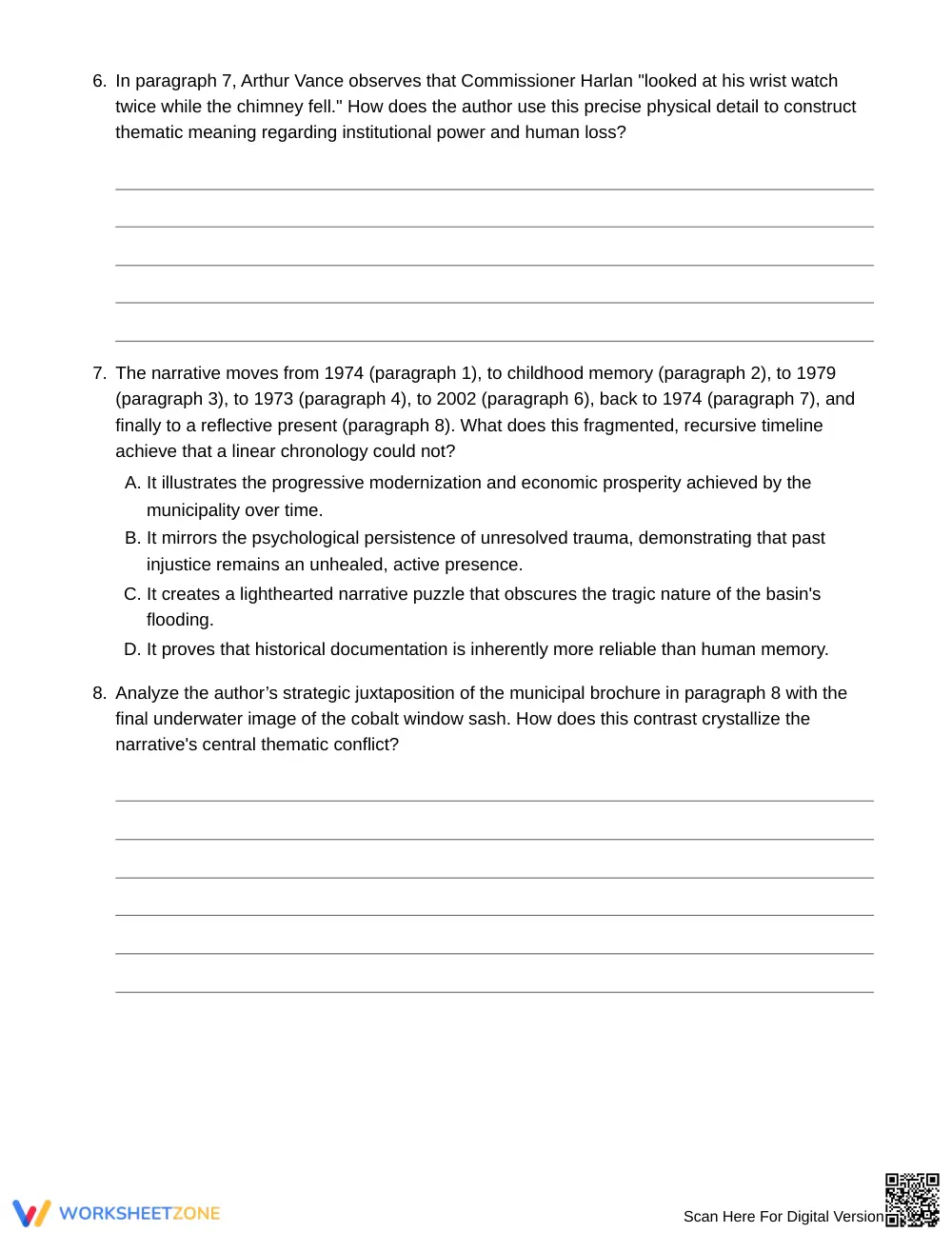
This Grade 12 literary analysis worksheet equips students to deconstruct complex narrative architecture and evaluate how structural choices generate thematic meaning. Through an original multi-genre text, learners examine nonlinear timelines, bureaucratic counterpoint, and aesthetic motifs, building advanced analytical reading and text-based writing competencies for college-level English courses.
At a Glance
- Grade: 12 · Subject: English IV
- Standard:
RL.11-12.5— Analyze how an author's choices concerning text structure create aesthetic impact and meaning- Skill Focus: College-Ready Literary Analysis Check
- Format: 7 pages · 12 problems · Answer key included · PDF
- Best For: AP or college-prep structural analysis
- Time: 45–60 minutes
What's Inside
This 7-page instructional resource centers on 'The Silt at Blackwood Basin,' an eight-part literary passage integrating archival dockets, hearing transcripts, property deeds, personal memoirs, and reflective narrative. Students complete 12 rigorous analytical tasks comprising targeted multiple-choice items and text-dependent constructed responses. A preliminary reference box defines key structural mechanics, while a thorough 4-page answer key provides complete model analyses and scoring criteria for every prompt.
Skill Progression
- Guided practice (Tasks 1–3): Students analyze foundational structural mechanics and rhetorical registers across initial documentary fragments with scaffolded multiple-choice items and short-answer prompts.
- Supported practice (Tasks 4–9): Learners explore recursive chronology, symbolic physical motifs, and aesthetic counterpoints using semi-structured analytical questions that bridge textual evidence to theme.
- Independent practice (Tasks 10–12): High school seniors compose extended, college-level synthesis responses evaluating documentary architecture, narrative ambiguity, and thematic erasure without scaffolding.
This sequence mirrors the gradual-release framework, guiding students systematically from architectural identification to rigorous, independent critical evaluation.
Standards Alignment
This worksheet directly targets RL.11-12.5: Analyze how an author's choices concerning how to structure specific parts of a text contribute to its overall structure and meaning as well as its aesthetic impact. Additionally, the resource reinforces RL.11-12.1 by requiring students to cite strong, thorough textual evidence supporting mature analytical claims. Both standard codes can be copied directly into lesson plans, IEP goals, or district curriculum mapping tools.
How to Use It
Deploy this activity during an advanced literature unit following direct instruction on narrative structure and temporal manipulation. During the 45 to 60 minute working period, circulate while students complete Part B to observe whether they link structural shifts directly to character alienation rather than merely summarizing plot events. Alternatively, assign Part C as a formal culminating diagnostic before semester research papers.
Who It's For
This resource is tailored for Grade 12 English IV, AP Literature, and dual-enrollment humanities students preparing for university-level text analysis. Scaffolded questions in Part A accommodate students refining close-reading habits, while Part C challenges advanced writers. Pair this worksheet alongside an anchor chart outlining structural devices or a lecture on postmodern narrative techniques.
Mastering complex structural analysis under standard RL.11-12.5 requires students to evaluate how authors deliberately manipulate narrative architecture, chronological sequence, and documentary juxtaposition to produce meaning and aesthetic tension. According to instructional research by Fisher & Frey (2014), high school readers develop superior interpretive proficiency when literary tasks explicitly transition from scaffolded text deconstruction to independent, synthesis-level writing. This seven-page English IV resource guides twelfth-grade students through twelve carefully sequenced problems based on a multimodal, nonlinear passage. Learners analyze how fragmented municipal records, historical testimonials, and sensory memories interact to critique administrative erasure. By requiring students to articulate how structural form drives thematic development, this lesson cements vital critical thinking skills necessary for collegiate literary scholarship. The complete four-page teacher answer key provides comprehensive analytical benchmarks, allowing educators to verify text-dependent reasoning with precision.


