




























Views
Downloads




Essential Light Transmission Worksheet | Grade 6 Science

Paste this activity's link or code into your existing LMS (Google Classroom, Canvas, Teams, Schoology, Moodle, etc.).
Students can open and work on the activity right away, with no student login required.
You'll still be able to track student progress and results from your teacher account.
This light-transmission measurements worksheet guides middle school students through analyzing quantitative laboratory data on wave interactions. Students evaluate lux values across transparent, translucent, and opaque materials to determine how light energy transmits, reflects, absorbs, and refracts across surfaces, building essential scientific literacy and data analysis skills.
At a Glance
- Grade: 6 · Subject: Science
- Standard: Interpret quantitative data to describe light transmission, reflection, and absorption
- Skill Focus: Interpret Light-Transmission Measurements
- Format: 5 pages · 10 problems · Answer key included · PDF
- Best For: Lab analysis or post-investigation practice
- Time: 35–45 minutes
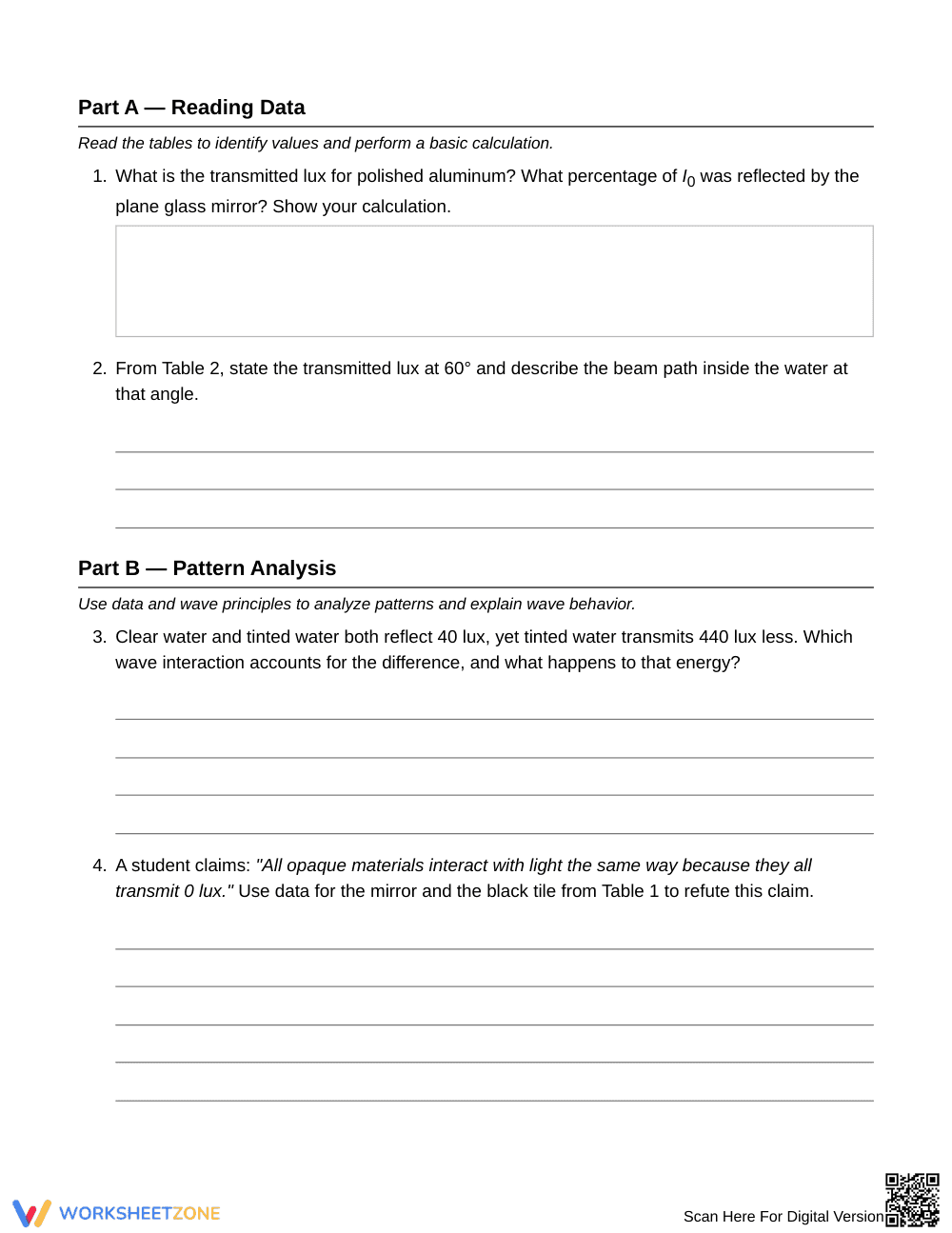
This 5-page printable resource includes synthetic experimental datasets organized into two comprehensive reference tables, 10 structured analytical questions, and a 2-page detailed answer key. Students examine light partition data (incident, transmitted, reflected, and absorbed lux) across six materials and analyze how incident angles affect light transmission through water.
The structured activities follow an explicit gradual-release sequence:
- Guided practice (Part A — Tasks 1–2): Students read data tables to locate explicit values, identify beam trajectories, and calculate reflection percentages with minimal complexity.
- Supported practice (Part B — Tasks 3–8): Students apply wave principles to compare material interactions, refute scientific misconceptions, explain refraction mechanics, and predict values using proportional reasoning.
- Independent practice (Part C — Tasks 9–10): Students independently evaluate experimental design, identifying systematic errors from ambient light and critiquing indirect mathematical calculations of energy absorption.
This scaffolded progression moves students steadily from basic data retrieval to high-level scientific evaluation.
Aligned with middle school physical science standards for wave behavior, this worksheet emphasizes developing and using models to describe how light waves interact with matter. Students investigate how light behaves when passing through transparent media, scattering in translucent substances, and transferring energy to opaque objects. These standard benchmarks can be copied directly into lesson plans, IEP goals, or district curriculum mapping tools.
Deploy this worksheet after direct instruction on wave behaviors or as a structured follow-up to a hands-on optics lab. During class, circulate during Part B to observe whether students recognize that opaque materials differ in energy absorption rather than treating them identically. The full activity requires 35 to 45 minutes of instructional time.
This resource serves general education Grade 6 science classrooms, introductory physical science units, and students requiring structured data interpretation practice. Pair this worksheet directly with an interactive ray optics simulation or physical laser-and-prism demonstration to maximize student conceptual understanding.
Scientific data literacy requires students to interpret quantitative evidence rather than rely on intuitive assumptions about physical phenomena. According to research on structured science instruction by Fisher & Frey (2014), gradual-release instructional frameworks significantly enhance middle school learners' capacity to interpret complex laboratory data tables and articulate evidence-based scientific claims. When sixth-grade students interpret light-transmission measurements, they engage directly with core physical science practices by partitioning incident light energy across transmission, reflection, and absorption pathways. Evaluating experimental limitations, such as ambient lighting interference and indirect computational methods, further strengthens student critical thinking, error analysis, and analytical rigor. Providing structured, scaffolded problem sets enables young scholars to master foundational wave behavior concepts, connect quantitative observations to physical laws, and build the disciplinary reasoning skills required for rigorous secondary coursework.


