































Essential Interacting Ideas Worksheet | Grade 10 English II

Paste this activity's link or code into your existing LMS (Google Classroom, Canvas, Teams, Schoology, Moodle, etc.).
Students can open and work on the activity right away, with no student login required.
You'll still be able to track student progress and results from your teacher account.
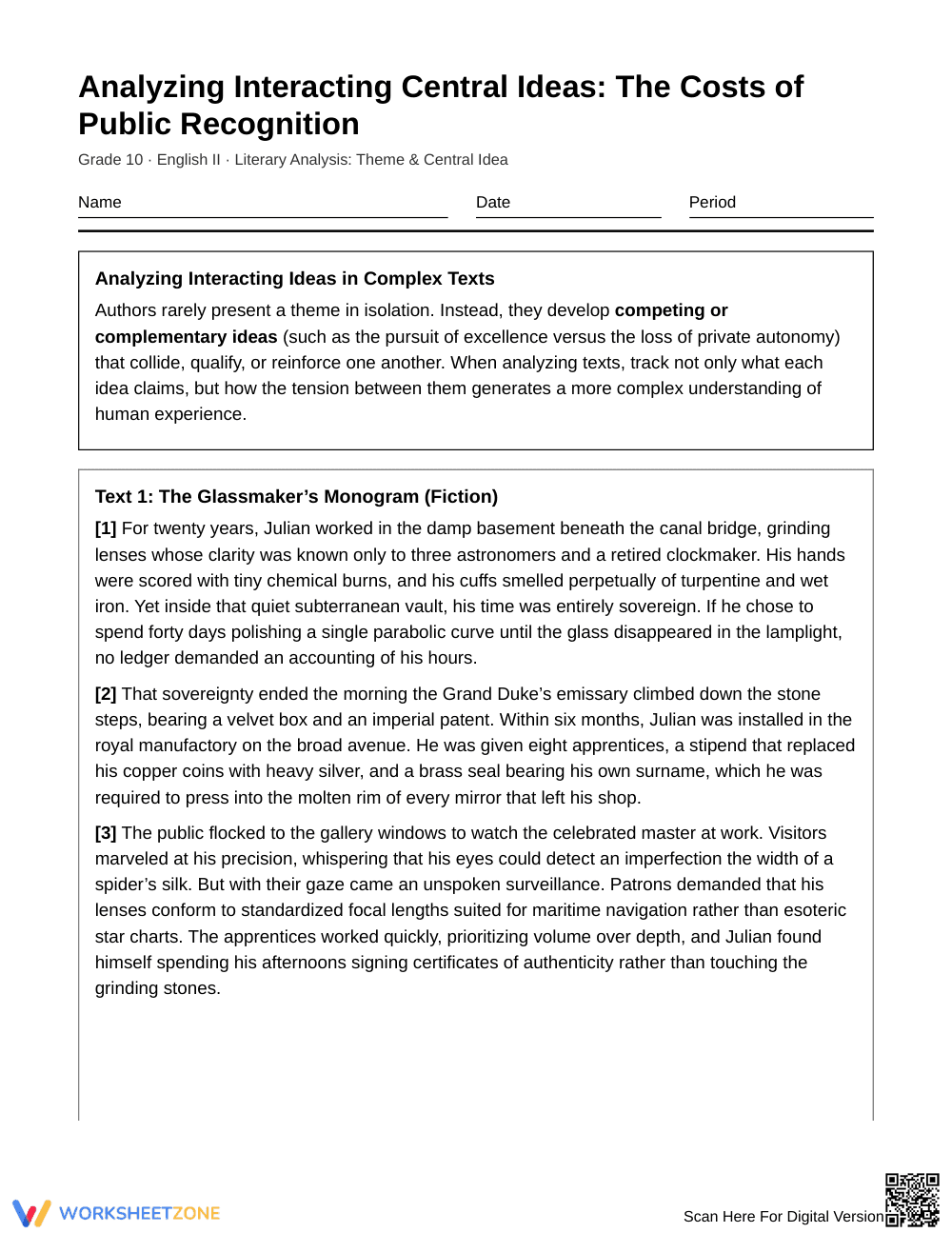
This Grade 10 English II literary analysis resource guides students to analyze how interacting central ideas develop and collide across paired fiction and informational texts. Students examine the conflict between creative autonomy and public recognition through 12 rigorous tasks, moving from textual identification to deep analytical synthesis and argumentative evaluation.
At a Glance
- Grade: 10 · Subject: English II
- Standard: Analyze how two or more central ideas interact and build over a text
- Skill Focus: Interacting Central Ideas & Theme Analysis
- Format: 6 pages · 12 problems · Answer key included · PDF
- Best For: Close reading and paired text analysis
- Time: 45–60 minutes
What's Inside
The 6-page printable worksheet includes two rich paired passages—a narrative fiction excerpt and a reflective informational essay—followed by 12 analytical tasks structured across three distinct sections. A comprehensive 3-page answer key provides complete model responses, textual evidence citations, and evaluation criteria for every open-ended synthesis prompt.
Skill Progression
- Guided Practice (Part A, 3 tasks): Students locate explicit textual evidence and identify foundational tensions, contrasting private craft with public oversight using targeted multiple-choice and short-answer prompts.
- Supported Practice (Part B, 6 tasks): Students examine how distinct central ideas interact across paragraphs, unpacking figurative language and cross-textual connections.
- Independent Practice (Part C, 3 tasks): Students construct multi-sentence analytical defenses and evaluate complex philosophical claims with paired textual evidence.
This sequence follows a gradual-release model, scaffolding students from basic text comprehension to high-level thematic synthesis.
Standards Alignment
This resource aligns with Grade 10 standards requiring students to determine central ideas of complex texts, analyze their interaction, and trace how they build on one another. It supports standard requirements for analyzing paired literary and informational passages. Both standard descriptions can be copied directly into lesson plans, IEP goals, or district curriculum mapping tools.
How to Use It
Administer this worksheet during or immediately after direct instruction on paired-text analysis. Use Part A as a formative check before releasing students to collaborate on Part B's cross-textual analysis. For a formative assessment tip, review students' answers on Part B, item 5 to verify they distinguish between surface plot details and underlying thematic interactions. Expected student completion time is 45 to 60 minutes.
Who It's For
This resource serves general education Grade 10 English II students, honors courses, and advanced reading intervention groups. Differentiate by providing graphic organizers for struggling writers or assigning Part C as an extended Socratic seminar prompt. Pair this worksheet naturally with a direct-instruction lesson on analyzing dual themes.
Analyzing how multiple central ideas interact within complex paired texts is a critical milestone for high school literacy. According to Fisher & Frey (2014), structured close reading routines that transition students from locating explicit evidence to synthesizing overlapping thematic arguments significantly boost text-dependent comprehension and analytical writing fluency. This 6-page English II resource operationalizes that progression through two rigorous paired selections and 12 tiered tasks. Students first establish literal and figurative tensions in guided tasks, examine cross-textual interactions in supported items, and ultimately defend synthesized evaluative stances in rigorous extended-response prompts. By requiring students to articulate how public recognition complicates creative autonomy across both fiction and informational discourse, this material directly reinforces rigorous secondary reading benchmarks. Teachers receive 3 full pages of detailed explanatory keys to streamline formative assessment and track student analytical growth.


