




























Views
Downloads


Essential Integumentary Word Search | Grades 4–5 Science

Paste this activity's link or code into your existing LMS (Google Classroom, Canvas, Teams, Schoology, Moodle, etc.).
Students can open and work on the activity right away, with no student login required.
You'll still be able to track student progress and results from your teacher account.
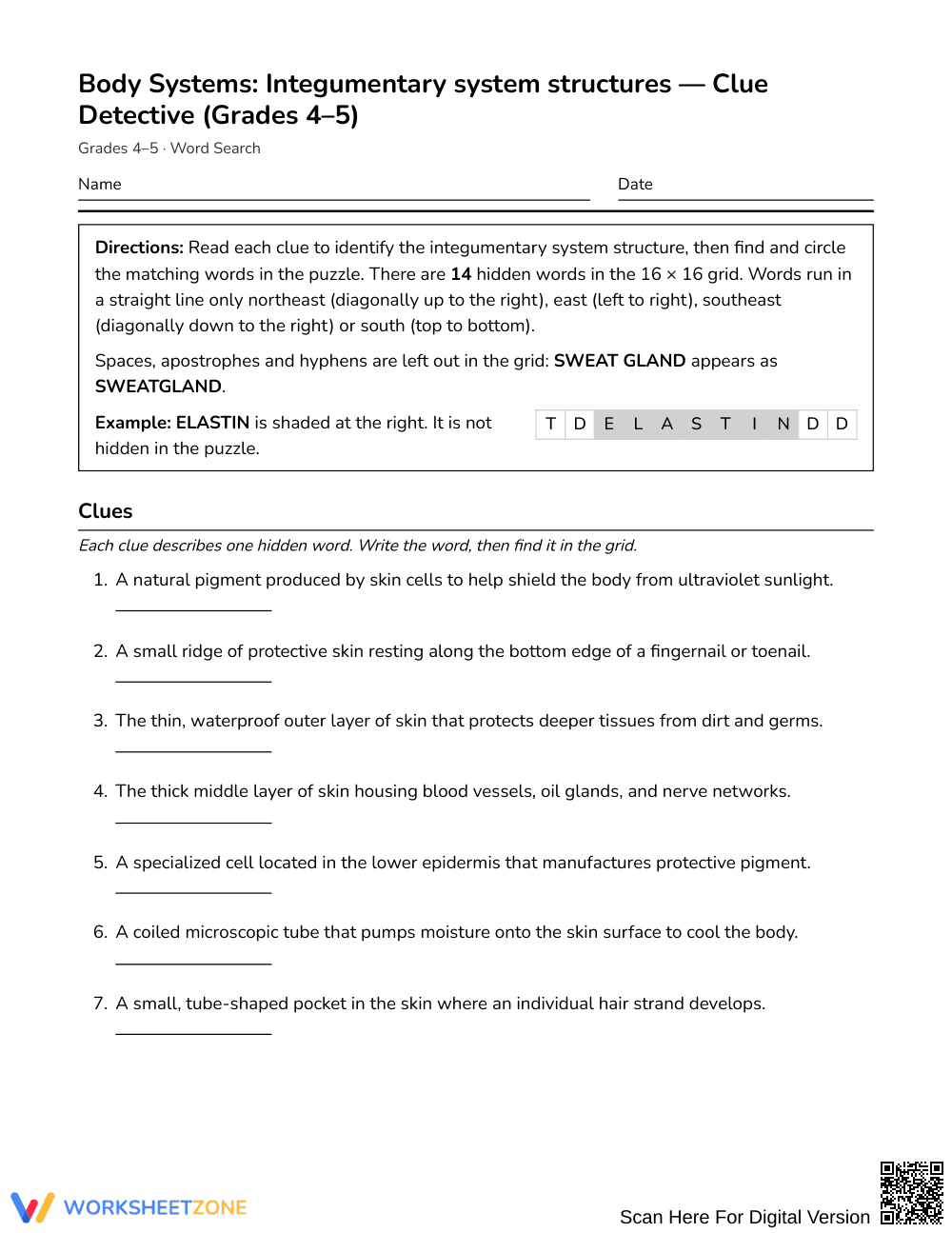
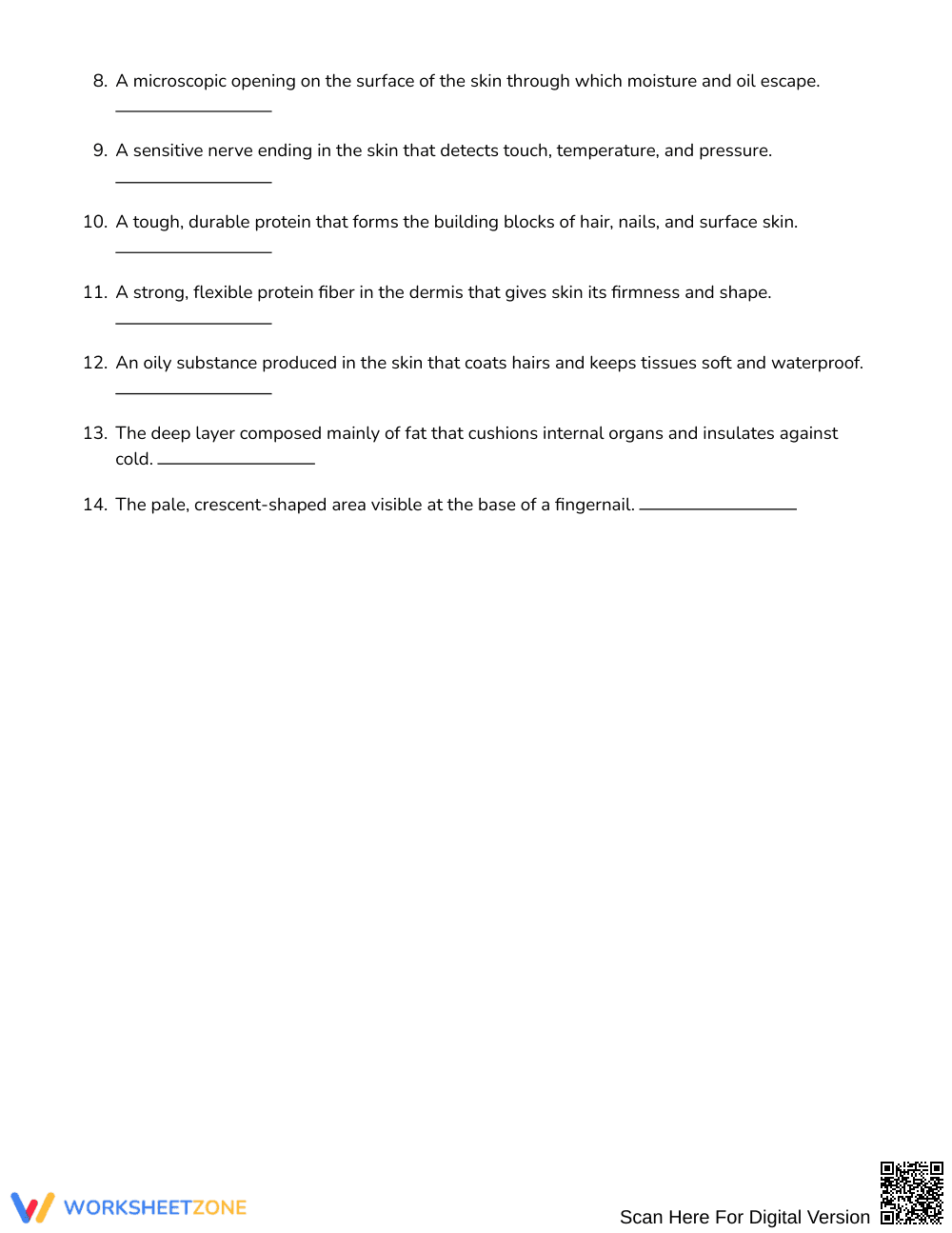
This integumentary system word search reinforces foundational human biology vocabulary for Grades 4–5. Learners read anatomical clues to identify key skin structures and find 14 specialized terms hidden across the puzzle. The activity strengthens recognition of tissue layers, protective proteins, and cellular components during science units.
At a Glance
- Grade: Grades 4–5 · Subject: Science (Life Science)
- Standard: Not standards-assessed — vocabulary enrichment
- Skill Focus: Integumentary system structures, skin layers, and cell functions
- Format: 3 pages · 14 words · Complete answer key included · Printable PDF
- Best For: Science vocabulary reinforcement and learning stations
- Time: 20–30 minutes of focused puzzle completion
What's Inside
This 3-page science resource features a student puzzle sheet paired with descriptive clue cards and a 3-page answer key. Students solve 14 clues detailing skin anatomy, consult a shuffled word bank, and locate each term within the letter grid. The thorough answer key displays complete word placements for immediate review.
Puzzle Structure and Mechanics
The word search uses a 16 x 16 letter grid calibrated for upper elementary students. The 14 vocabulary terms run in four directions: northeast (NE), east (E), southeast (SE), and south (S). Students use two key supports:
- Clue Descriptions: Fourteen science clues define structures like the epidermis, dermis, hypodermis, melanin, and keratin.
- Shuffled Word Bank: A scrambled word bank lists all 14 target terms to aid spelling and visual scanning.
Standards Alignment
This activity provides vocabulary enrichment and is not aligned to a specific standard. While elementary life science curricula address external body coverings, this resource is designed strictly for terminology reinforcement, spelling development, and conceptual review without reporting standardized assessment data.
How to Use It
This resource fits several points in an instructional sequence:
- Science Station: Place at a learning center after direct instruction on skin layers. Students match clues to vocabulary terms before searching the grid. Observe whether students identify terms independently or rely heavily on definitions to gauge conceptual retention.
- Early Finisher Practice: Assign after body systems lessons for independent review.
Students typically complete the search in 20 to 30 minutes.
Who It's For
This resource is built for Grades 4–5 students learning life science. The clue definitions support critical thinking, while the shuffled word bank assists developing readers and multilingual learners. Pair this activity with a labeled integumentary system diagram or skin anatomy anchor chart for visual reinforcement.
Designed for Grades 4–5 science classrooms, this integumentary system vocabulary enrichment word search provides non-standards-assessed practice with 14 foundational life science terms. By combining a 16 x 16 letter puzzle with descriptive anatomical clues, the activity bridges biological definitions and orthographic word recognition across key skin structures including the epidermis, dermis, hypodermis, melanin, and keratin. According to research by Fisher & Frey (2014), intentional academic vocabulary exposure paired with supportive contextual clues solidifies content-area comprehension and accelerates long-term conceptual retention during upper elementary science instruction. The puzzle format engages learners in active visual scanning across four distinct directional paths, reinforcing domain-specific terminology without requiring formal assessment scoring. Accompanied by a complete 3-page answer key, this resource offers educators an efficient, print-and-go tool for science stations, post-instructional review, and collaborative vocabulary enrichment across upper elementary life science units.


