

































Essential Heat Transfer Worksheet | Grade 6 Science

Paste this activity's link or code into your existing LMS (Google Classroom, Canvas, Teams, Schoology, Moodle, etc.).
Students can open and work on the activity right away, with no student login required.
You'll still be able to track student progress and results from your teacher account.
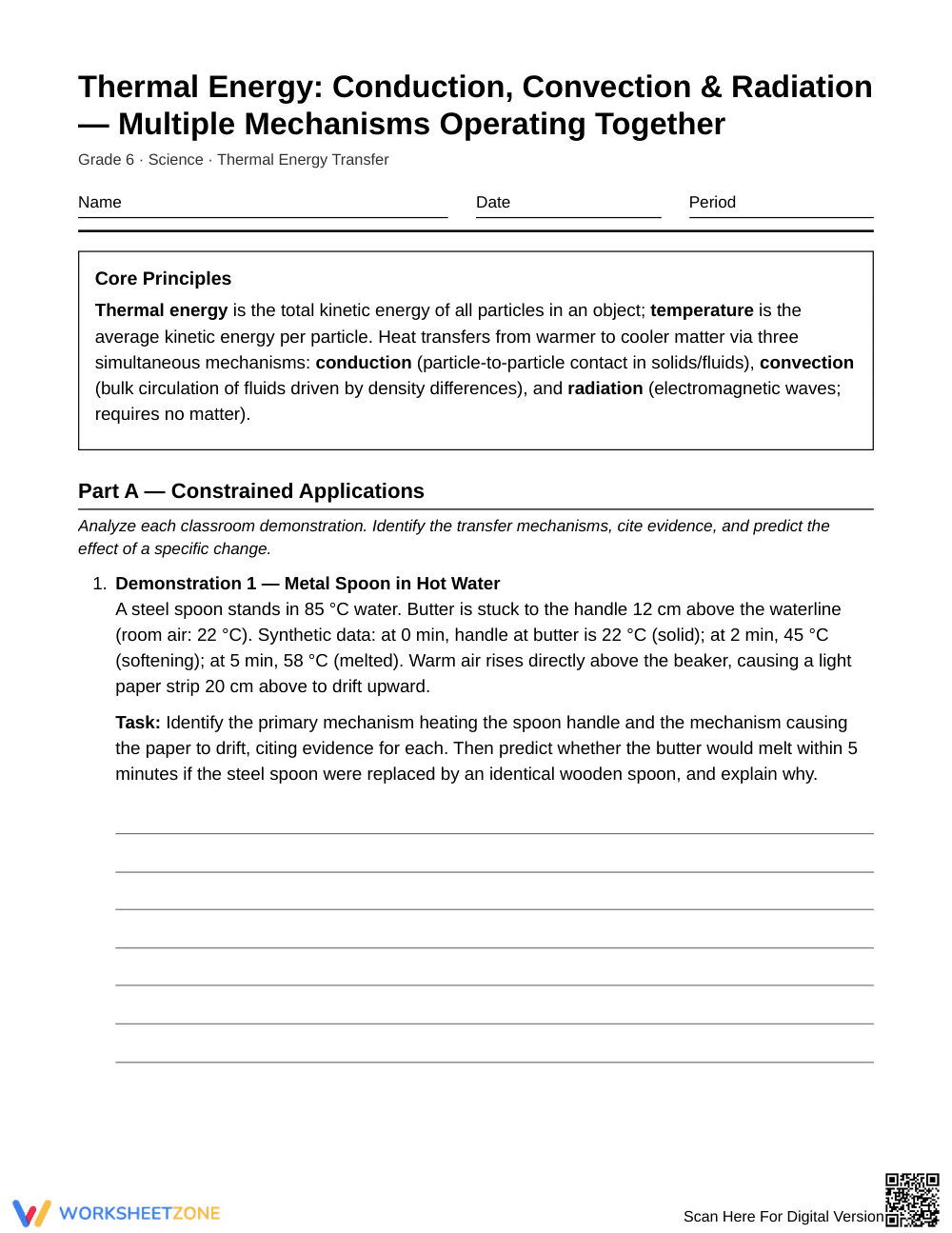
This Grade 6 science worksheet develops students' ability to explain how conduction, convection, and radiation operate simultaneously. Learners analyze real-world demonstrations, evaluate synthetic data tables, critique competing scientific claims, and construct defended explanations distinguishing thermal energy from temperature across 6 structured analytical tasks.
At a Glance
- Grade: 6 · Subject: Science
- Standard: Explain how thermal energy transfers through conduction, convection, and radiation simultaneously
- Skill Focus: Simultaneous Heat Transfer Mechanisms
- Format: 5 pages · 6 problems · Answer key included · PDF
- Best For: Mid-unit thermal physics practice
- Time: 40–50 minutes
Inside, students find a 5-page student resource accompanied by a 3-page answer key. The worksheet provides a core principles reference on kinetic energy, temperature, and heat transfer. Supports include synthetic temperature datasets, labeled physical setups, competing student dialogue models, and structured multi-part response prompts.
Skill Progression
- Guided practice (Tasks 1–2): Constrained scenarios where students analyze direct demonstrations (spoon in hot water, heat lamp), identifying mechanisms and predicting variable changes.
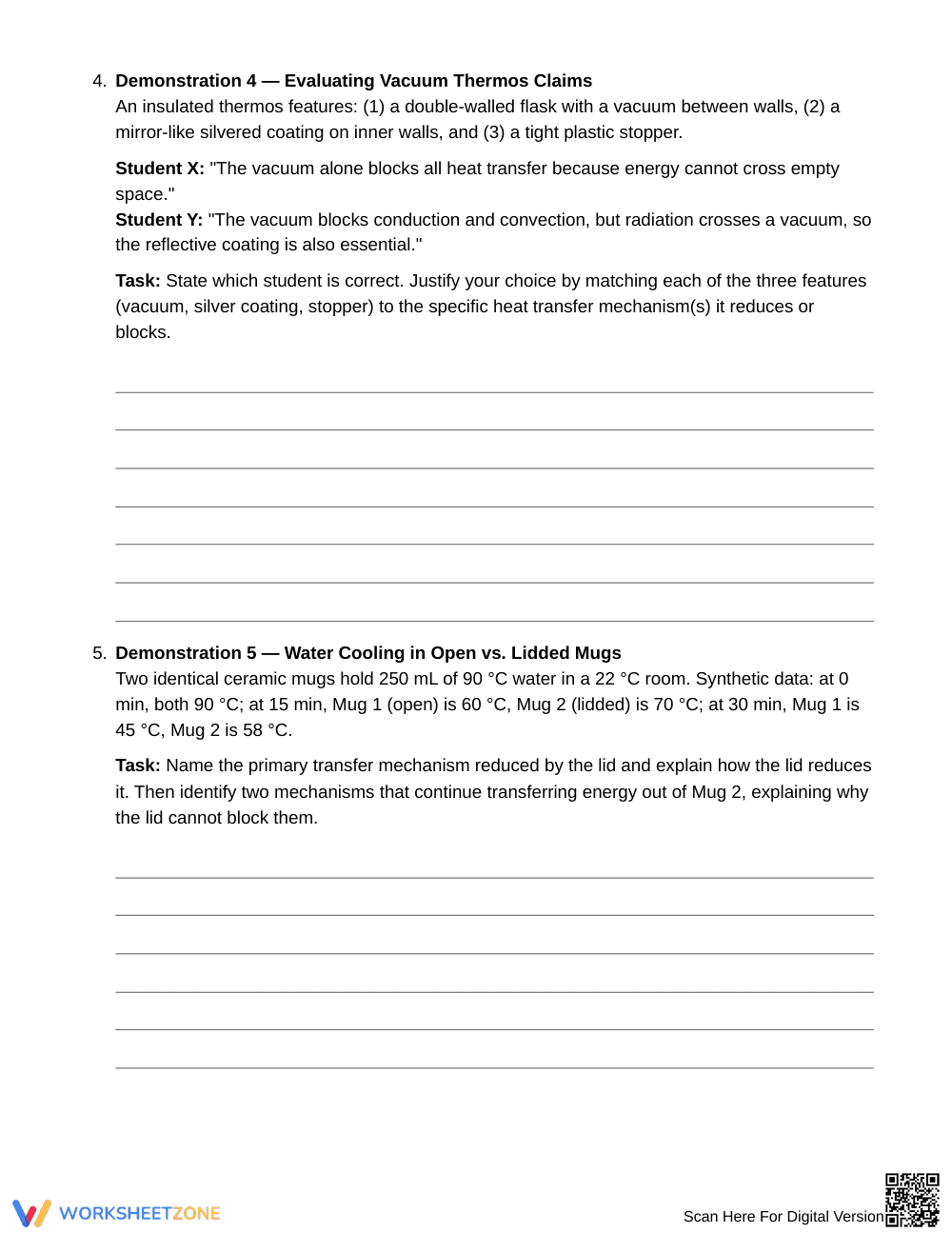
- Supported practice (Tasks 3–5): Inverse and competing-model tasks where students evaluate spatial temperature data, critique vacuum flask claims, and contrast mug cooling rates.
- Independent practice (Task 6): A defended synthesis analyzing a campfire system to map all three transfer mechanisms and contrast thermal energy with temperature.
This gradual release sequence transitions learners from basic mechanism identification to multi-variable scientific synthesis.
Standards Alignment
This resource aligns with middle school physical science standards for thermal energy transfer: students apply scientific principles to explain how energy transfers between particles via conduction, fluids via convection, and electromagnetic waves via radiation, moving from warmer regions to cooler regions across diverse physical systems.
How to Use It
Deploy this worksheet after direct instruction or as a collaborative station activity. For formative assessment, evaluate student responses on Task 4 to verify whether learners understand how vacuum layers block conduction and convection while allowing radiation. Students typically complete the 6 tasks in 40 to 50 minutes.
Who It's For
This worksheet serves Grade 6 science classrooms mastering thermal dynamics. Structured data tables support developing readers, while multi-step synthesis challenges advanced students. Pair this printable with hands-on water heating investigations or particle simulations for complete concept reinforcement.
Middle school science instruction requires structured opportunities for students to analyze complex energy transfers beyond rote terminology. According to Fisher & Frey (2014), instructional scaffolds that move from constrained identification to evaluative argument help learners integrate multiple physical mechanisms into a unified conceptual framework. This 6-problem worksheet operationalizes that progression for thermal energy transfer. Students investigate particle-to-particle conduction, fluid convection currents, and electromagnetic radiation across 6 structured demonstration scenarios. By examining synthetic temperature readings, critiquing competing claims regarding insulated flasks, and analyzing campfire dynamics, Grade 6 learners develop precise scientific reasoning that distinguishes average kinetic energy from total thermal energy. The inclusion of a 3-page teacher key supports targeted formative feedback, ensuring educators can diagnose and address persistent misconceptions surrounding simultaneous heat transfer processes during core physical science units.


