




























Views
Downloads



Essential Heat Transfer Worksheet | Grade 6 Science

Paste this activity's link or code into your existing LMS (Google Classroom, Canvas, Teams, Schoology, Moodle, etc.).
Students can open and work on the activity right away, with no student login required.
You'll still be able to track student progress and results from your teacher account.
This Grade 6 science worksheet develops student mastery of thermal energy transfer through twelve structured analytical tasks. Students investigate the distinct particle-level mechanisms of conduction, convection, and radiation while interpreting classroom laboratory demonstrations. The problem set enables middle school learners to differentiate kinetic energy from thermal energy and evaluate thermodynamic systems accurately.
At a Glance
- Grade: 6 · Subject: Science
- Standard: Thermal Transfer — Analyze how thermal energy transfers through conduction, convection, and radiation across matter
- Skill Focus: Conduction, Convection, and Radiation
- Format: 5 pages · 12 problems · Full answer key included · PDF
- Best For: Mid-unit skills assessment or collaborative guided practice
- Time: 40–50 minutes
What's Inside
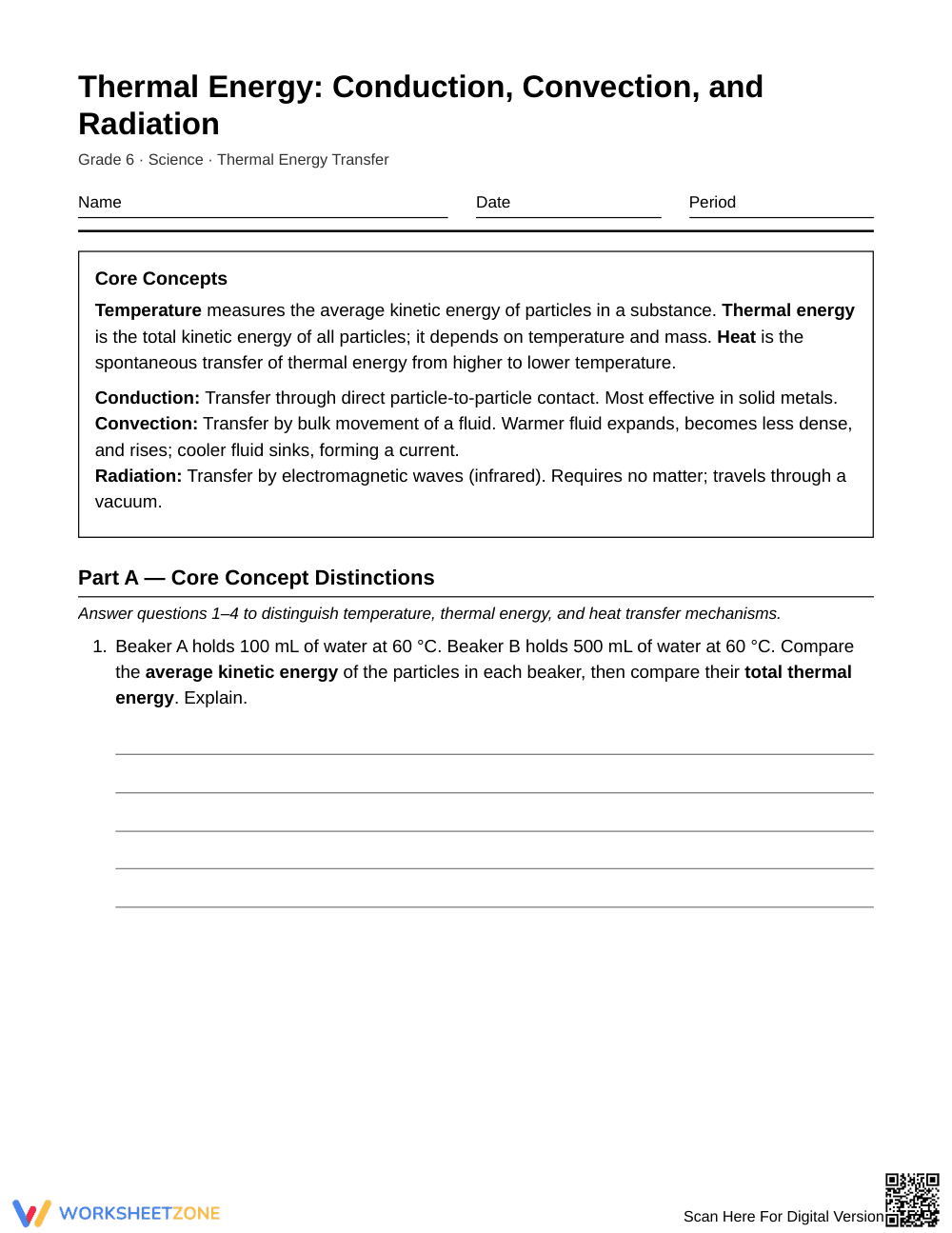
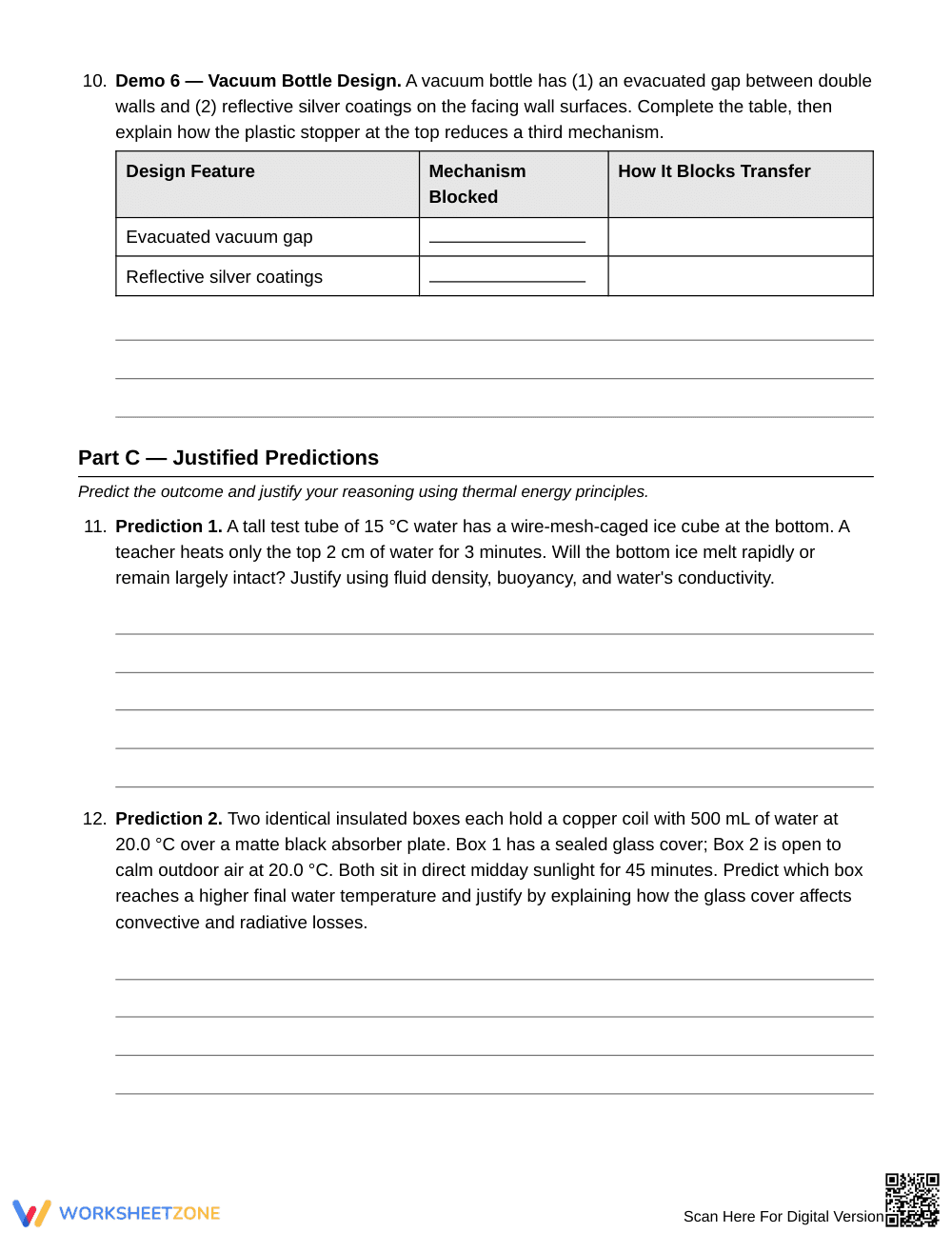
This 5-page printable resource includes a student reference box defining key thermal concepts, followed by 12 multi-part analytical problems. Part A features 4 concept-distinction questions comparing particle motion and thermal equilibrium. Part B delivers 6 demonstration scenarios with empirical data tables, fluid circulation tracking, and insulator design analyses. Part C concludes with 2 predictive reasoning prompts requiring written thermodynamic justifications. A comprehensive 3-page answer key provides complete model explanations.
Skill Progression
- Guided practice (Questions 1–4): Students establish core distinctions between particle kinetic energy and total thermal energy using the introductory reference summary.
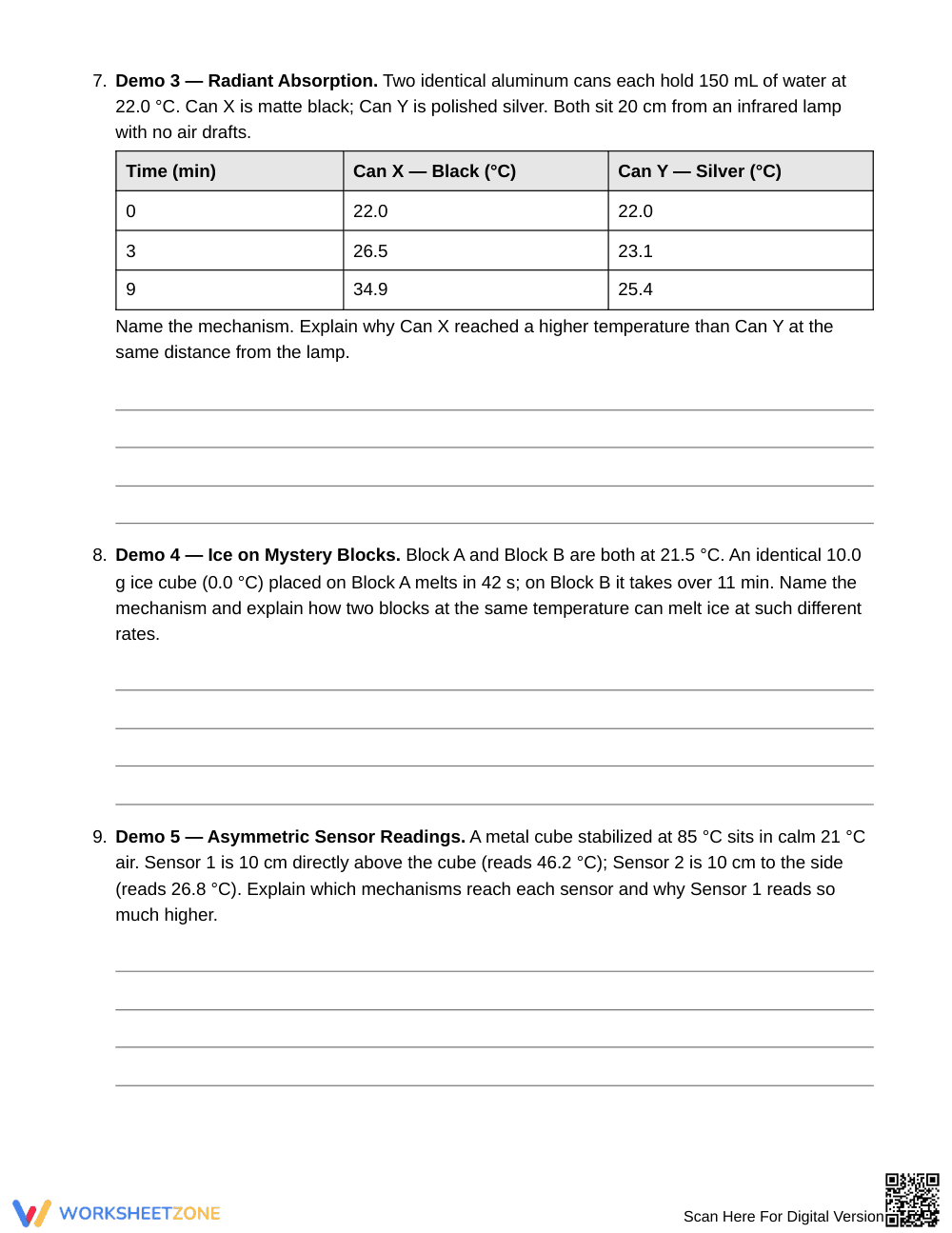
- Supported practice (Questions 5–10): Learners analyze six empirical demonstration scenarios, using data tables to identify conduction, convection, and radiation.
- Independent practice (Questions 11–12): Students resolve complex thermodynamic predictions, synthesizing fluid buoyancy and radiative shielding without scaffolds.
This gradual-release structure moves students from supported conceptual recall to independent scientific analysis using the I Do, We Do, You Do model.
Standards Alignment
This worksheet aligns with middle school physical science standards for thermal energy transfer. Students investigate particle kinetic motion and evaluate how thermal energy moves through conduction, convection, and radiation in thermodynamic systems. Both standard codes can be copied directly into lesson plans, IEP goals, or district curriculum mapping tools.
How to Use It
Deploy this worksheet after direct instruction on heat transfer mechanisms as collaborative lab-station partner work, or assign it during independent seatwork. While students evaluate the mystery block demonstration in Question 8, circulate to observe whether learners differentiate between temperature and thermal conductivity. The 12-task packet requires 40 to 50 minutes.
Who It's For
This resource is designed for Grade 6 general science classes, advanced Grade 5 physical science units, and Grade 7 review sessions. Emerging bilingual learners benefit from pairing this activity with an illustrated thermal energy anchor chart, while students needing extra time can complete Parts A and B before attempting predictions.
According to research on structured science learning from Fisher & Frey (2014), middle school students demonstrate significantly deeper conceptual retention when analytical tasks scaffold the transition from foundational vocabulary to multi-variable experimental evaluation. This Grade 6 physical science worksheet targets thermal energy transfer, guiding learners to systematically distinguish conduction, convection, and radiation across twelve structured problems. Students interpret empirical temperature data, analyze density-driven fluid currents, and evaluate engineered thermal insulation features before constructing justified thermodynamic predictions. By anchoring abstract kinetic particle theory in observable physical phenomena such as differential melting rates and radiant heat absorption, the instructional sequence provides concrete scaffolding that prevents common misconceptions regarding heat and cold. Classroom educators can utilize this standards-aligned resource for targeted skill reinforcement, laboratory synthesis, or formative evaluation, ensuring that every learner develops rigorous evidentiary reasoning in thermal physics.


