




























Views
Downloads

Essential Genetics Word Search | Grades 10–12 Science

Paste this activity's link or code into your existing LMS (Google Classroom, Canvas, Teams, Schoology, Moodle, etc.).
Students can open and work on the activity right away, with no student login required.
You'll still be able to track student progress and results from your teacher account.
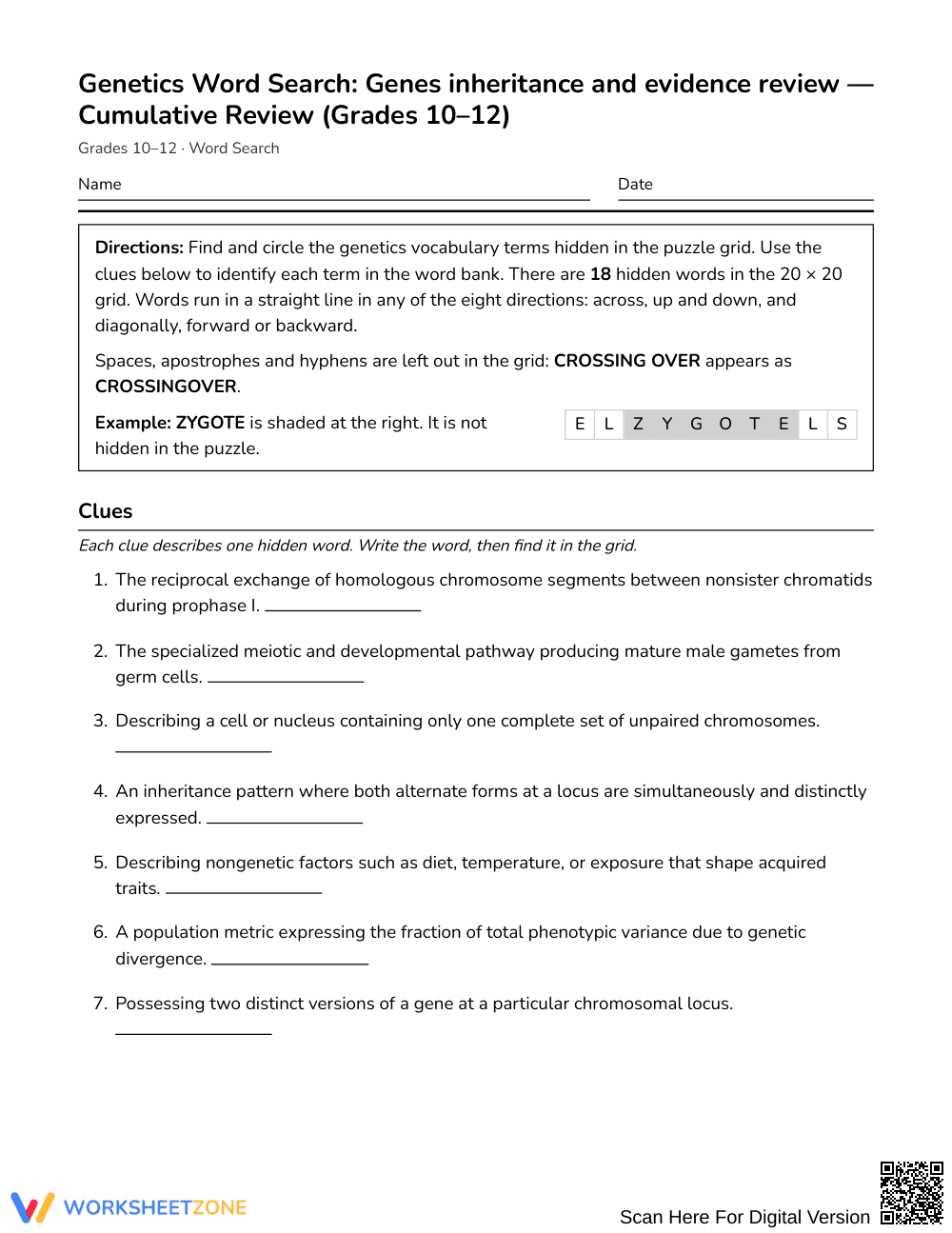
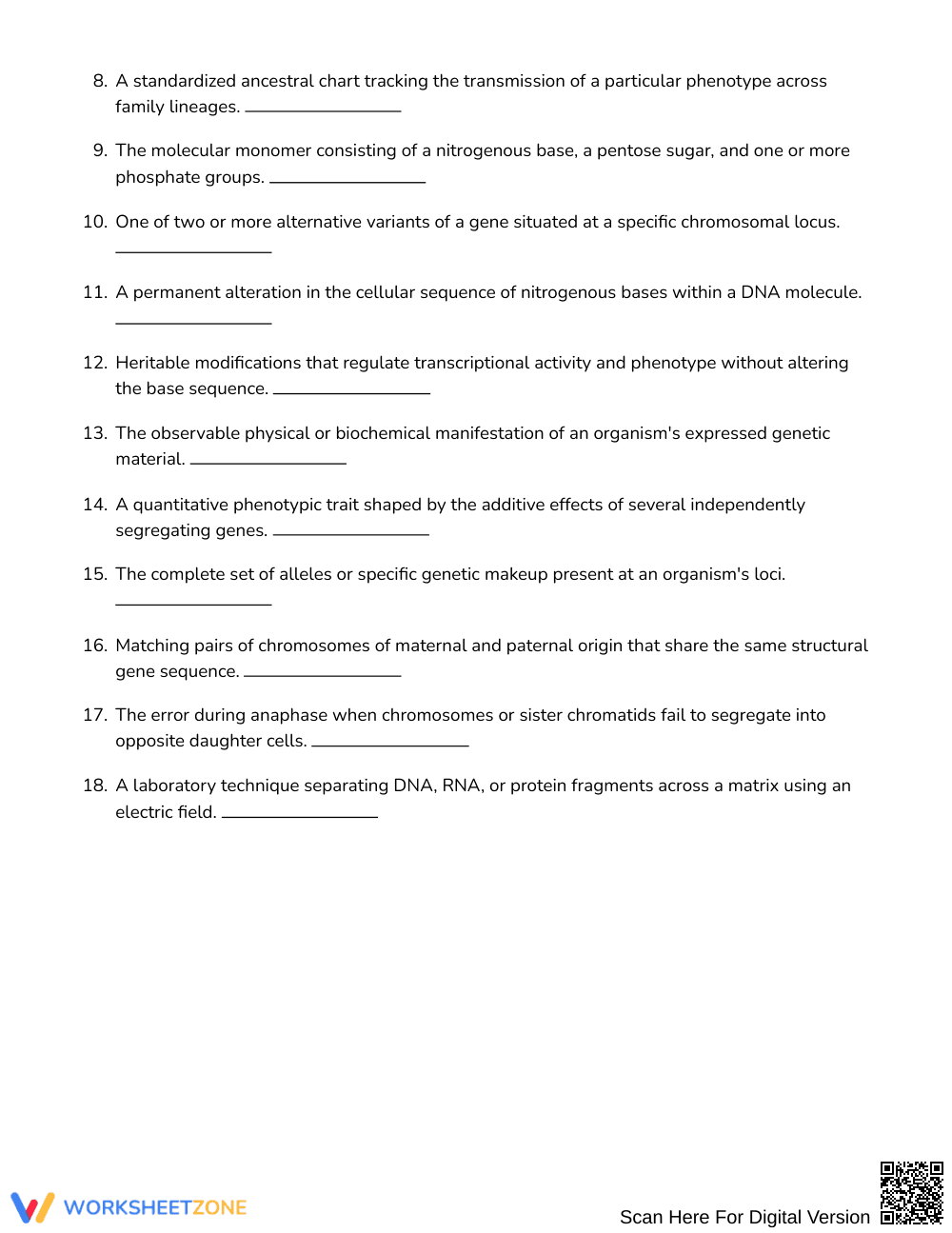
This genetics review word search provides Grades 10–12 biology students with targeted vocabulary reinforcement covering inheritance, molecular genetics, and phenotypic expression. Students examine 18 rigorous definitions to identify foundational terms before locating them within a complex grid, strengthening scientific literacy and content retention across key heredity concepts.
At a Glance
- Grade: Grades 10–12 · Subject: Science
- Standard: Not standards-assessed — vocabulary enrichment
- Skill Focus: Genes, inheritance, and evidence review
- Format: 3 pages · 18 words · Answer key included · PDF
- Best For: Unit review and vocabulary consolidation
- Time: 25–35 minutes
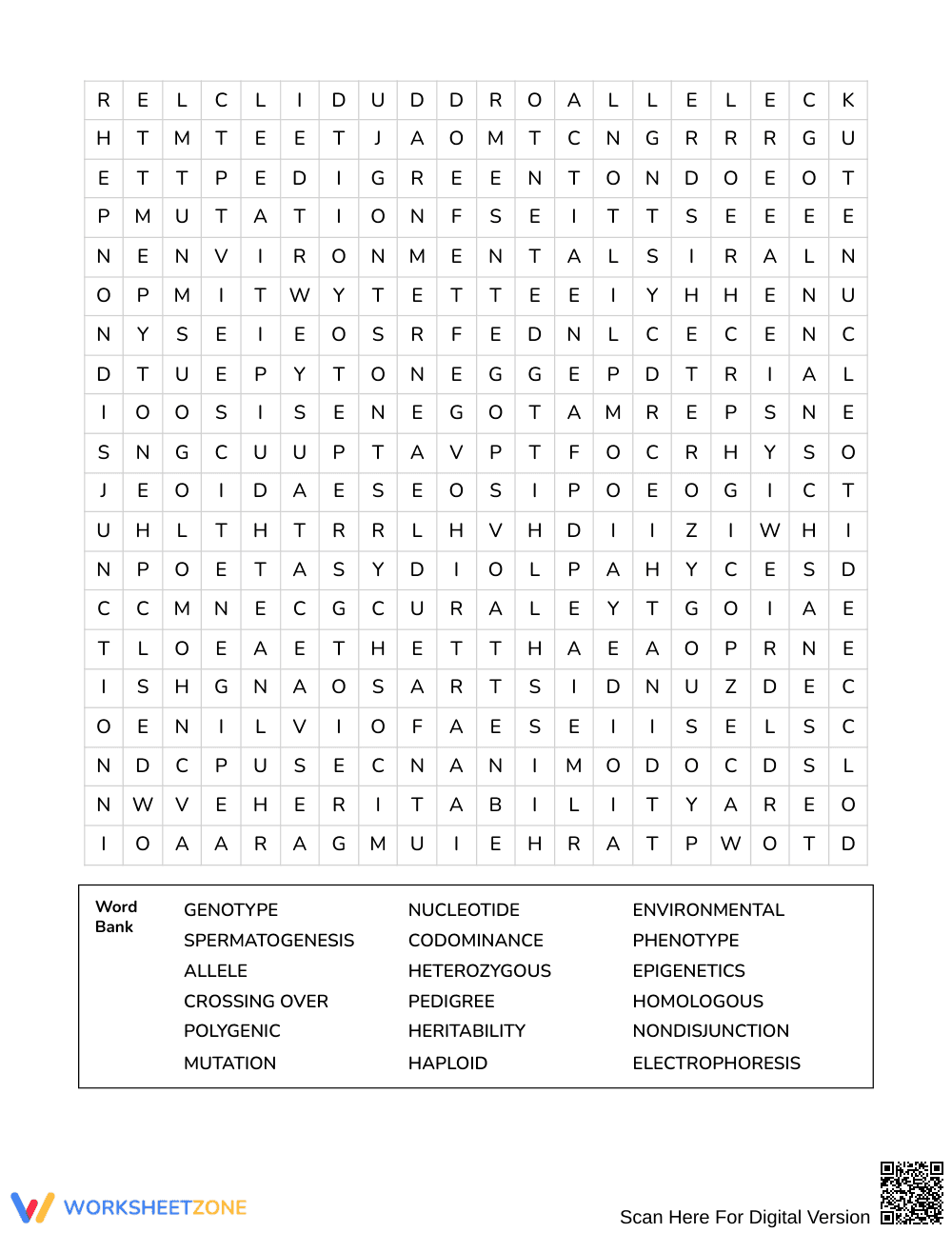
The activity spans 3 student pages accompanied by a dedicated 4-page answer key showing exact letter coordinates and paths. Rather than presenting a simple term list, the resource provides 18 academic clues defining core mechanisms such as codominance, nondisjunction, crossing over, and heritability. Students must read each functional definition, deduce the correct biological term from the shuffled word bank, and locate it within the puzzle framework.
The puzzle utilizes a dense 20 x 20 letter grid designed to challenge upper-level high school science students. Hidden terms run across all eight compass directions: north, northeast, east, southeast, south, southwest, west, and northwest. Forward, backward, and diagonal orientations ensure thorough scanning practice. Students cross-reference the clue list with the shuffled word bank to verify terminology before identifying overlapping letter strings across the grid.
This resource serves as targeted vocabulary enrichment and is not aligned to an individual state or national content standard. It reinforces the specialized scientific lexicon required for advanced coursework in genetics, molecular biology, and inheritance patterns.
Deploy this word search during the consolidation phase after direct instruction on Mendelian patterns, chromosomal errors, and molecular analysis techniques. It works effectively as an active warm-up before a cumulative exam or as structured independent seatwork during laboratory rotation transitions. For formative assessment, scan student answer sheets to determine whether students correctly link technical clues to terms like epigenetics or electrophoresis before searching the grid. Typical completion requires 25 to 35 minutes.
Designed for Grades 10–12 biology, honors biology, and introductory genetics courses, this activity supports students building fluency with technical biological terminology. For learners needing additional scaffolding, provide an un-shuffled glossary or allow peer collaboration. Pair this review puzzle with a pedigree analysis diagram or electrophoresis laboratory debrief to connect vocabulary mastery directly to empirical data interpretation.
According to Fisher & Frey (2014), intentional disciplinary vocabulary acquisition directly underpins complex reading comprehension and conceptual development in advanced secondary science classrooms. Rather than treating technical terminology as passive memorization, effective science instruction integrates definitional retrieval with structured cognitive engagement. This Grades 10–12 genetics word search reinforces 18 foundational concepts spanning genes, inheritance patterns, and cytological evidence without formal standards assessment. By requiring learners to analyze rigorous functional clues—such as differentiating codominance from polygenic inheritance or identifying nondisjunction—the activity prompts active semantic retrieval prior to spatial word search execution within the 20 x 20 grid. Educational research highlighted by Fisher & Frey demonstrates that active retrieval practice paired with orthographic recognition solidifies domain-specific language in long-term memory, enabling secondary biology students to interpret intricate heredity problems and laboratory data more fluently during subsequent summative assessments.


