


























Views
Downloads




Essential Genetic Technology Worksheet | Grade 9 Biology
Paste this activity's link or code into your existing LMS (Google Classroom, Canvas, Teams, Schoology, Moodle, etc.).
Students can open and work on the activity right away, with no student login required.
You'll still be able to track student progress and results from your teacher account.
Students evaluate real-world DNA technology applications using case data to weigh ecological, ethical, and genetic considerations. By completing these tasks, learners justify recommendations, connect molecular principles to societal impacts, and articulate evidence-based conclusions while interpreting gel electrophoresis results and calculating inheritance probabilities.
At a Glance
- Grade: 9 · Subject: Biology
- Standard: Evaluate genetic-technology applications using scientific evidence and ethical reasoning
- Skill Focus: Evaluate a Genetic-Technology Application with data analysis
- Format: 5 pages · 10 problems · Answer key included · PDF ready for printing
- Best For: Classroom labs, discussion groups, assessment preparation, and interdisciplinary projects
- Time: 45–60 minutes of focused work
- Resources: Data tables, case briefs, glossary, and figure captions
What's Inside
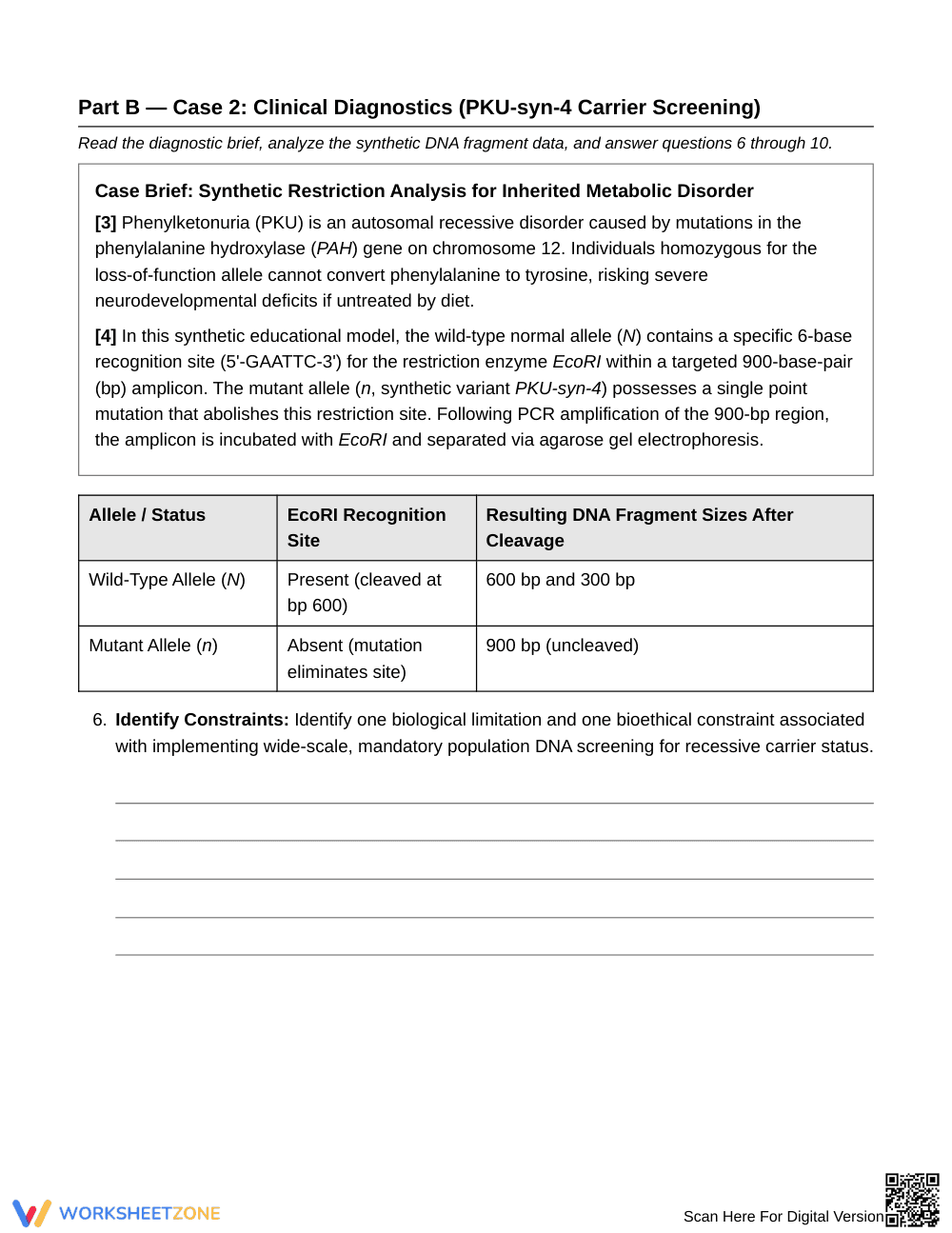
This 5-page packet contains two authentic case briefs on agricultural biotechnology and clinical diagnostics, data tables, a restriction-fragment analysis diagram, short-answer prompts, calculation tasks, and a detailed answer key. Scaffolds include a concise principle box, worked-example notes, and a vocabulary bank for scientific terminology.
Skill Progression
- Guided practice (3 problems): Students review a worked example interpreting a gel image and linking promoter specificity to ecological safety.
- Supported practice (4 problems): Students answer structured questions citing the universal genetic code, refuge strategy, and genotype probabilities with sentence frames.
- Independent practice (3 problems): Open-ended evaluation prompts ask learners to critique commercial claims and synthesize ethical arguments independently.
The sequence follows a gradual release model, ensuring students move smoothly from teacher-modeled reasoning to autonomous evaluation.
Standards Alignment
No specific state standard code is assigned to this worksheet; however, the content supports foundational secondary biology coursework in inheritance and variation of traits, alongside key science practices of analyzing empirical data. These conceptual targets can be incorporated directly into lesson plans, IEP goals, or district curriculum guides.
How to Use It
1. Before direct instruction: Distribute the case briefs for an anticipatory set where students jot initial hypotheses (5 minutes). 2. During a genetics unit: Use the guided and supported sections as in-class practice while modeling gel interpretation (15–20 minutes). 3. After instruction: Assign the independent evaluation prompts as homework or a formative quiz (10–15 minutes).
Who It's For
Designed for ninth-grade biology learners who have completed lessons on DNA structure and gene expression. The worksheet offers built-in differentiation through sentence frames and a word bank, making it suitable for mixed-ability classes and students with IEPs focused on scientific reasoning.
Educational research indicates that explicit evaluation tasks improve students' ability to transfer complex molecular concepts to broader societal issues (Fisher & Frey, 2014). When high school students critically analyze authentic bioethics scenarios, they develop durable cognitive frameworks that connect microscopic mechanisms to observable ecological outcomes. Furthermore, structured practice with authentic data tables and gel electrophoresis diagrams strengthens quantitative literacy alongside scientific argumentation. By integrating guided sentence starters and progressive problem sets, educators provide necessary scaffolding that supports diverse learners in articulating evidence based claims. This structured instructional design allows teachers to systematically monitor student mastery of fundamental genetic principles while fostering collaborative peer dialogue during lessons. Ultimately, engaging ninth grade learners in rigorous biotechnology evaluation prepares them for advanced scientific inquiry, responsible civic decision making, and informed analysis of modern biomedical innovations across diverse educational settings throughout the school year.


