































Essential Gene Expression Worksheet | Grades 8–12 Science

Paste this activity's link or code into your existing LMS (Google Classroom, Canvas, Teams, Schoology, Moodle, etc.).
Students can open and work on the activity right away, with no student login required.
You'll still be able to track student progress and results from your teacher account.
This comprehensive 4-page science worksheet guides students through scientific inquiry and molecular genetics using the classic lac operon model. Learners define testable questions, isolate variables, evaluate controls, interpret enzyme activity data, and construct rigorous claim-evidence-reasoning arguments without requiring live bacterial cultures or wet-lab equipment.
At a Glance
- Grade: 8–12 · Subject: Science / Biology
- Standard: Design scientific investigations and model how cellular feedback mechanisms control gene expression
- Skill Focus: Experimental design, variable identification, data interpretation, and molecular modeling
- Format: 4 pages · 25 problems · Answer key included · PDF
- Best For: Biology inquiry lab alternative or review
- Time: 45–60 minutes
What's Inside
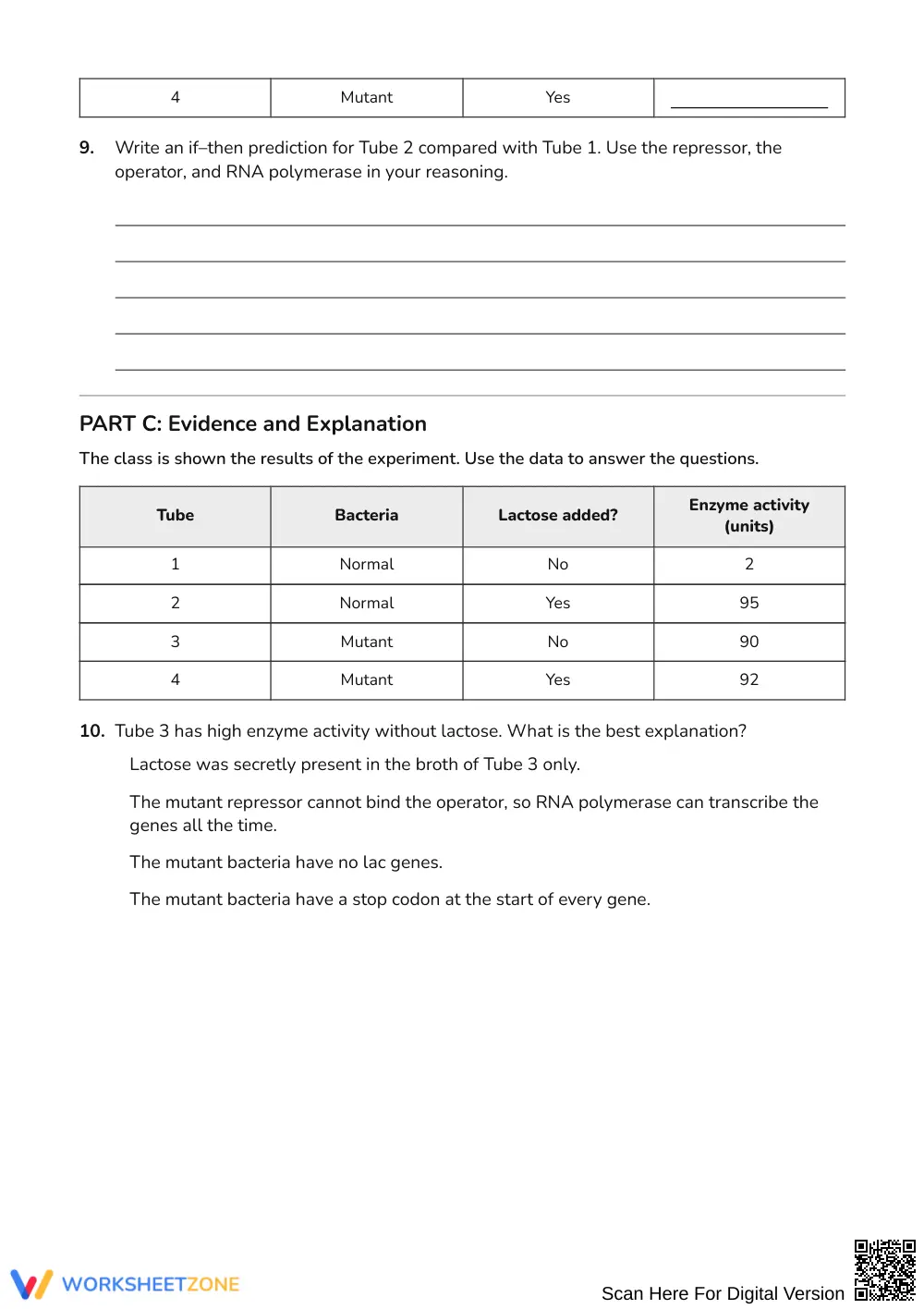
The 4-page student packet contains 25 targeted questions organized across four progressive parts. Students examine a diagram of protein synthesis, analyze a controlled 4-tube thought experiment involving wild-type and mutant E. coli, interpret numerical enzyme activity data tables, and complete a molecular pathway flowchart. A full 4-page answer key provides complete model explanations and sample claims.
Skill Progression
- Guided Practice (Part A): Students review core transcription and translation concepts, label eukaryotic cell structures, and use a codon table to establish baseline understanding.
- Supported Practice (Part B): Learners identify independent variables, dependent variables, and controlled constants across a 4-tube thought experiment, formulating an if-then hypothesis.
- Independent Practice (Parts C & D): Students analyze quantitative enzyme assay results, compose a complete Claim-Evidence-Reasoning (CER) paragraph, and predict regulatory outcomes when promoter sequences mutate.
This sequence reinforces the gradual-release model, moving students from foundational structural recall to complex experimental evaluation.
Standards Alignment
This worksheet aligns with secondary life science standards focused on cellular systems and scientific inquiry. Students construct evidence-based explanations of how environmental factors regulate protein production and analyze experimental designs to ensure valid test conditions. Teachers can copy these benchmark goals directly into lesson plans, IEP goals, or district curriculum mapping tools.
How to Use It
Implement this activity during a molecular genetics unit immediately after teaching transcription and translation. It serves as an effective dry-lab investigation when live bacterial work is impractical. During completion, monitor how students articulate the mechanistic role of the repressor protein in their CER writing. The complete activity takes 45 to 60 minutes.
Who It's For
Designed for high school biology, honors biology, or introductory AP Biology courses, this worksheet supports diverse learners through structured data tables and explicit scaffolding. Pair this resource with a visual operon animation or direct-instruction lecture on negative gene regulation to maximize student retention.
According to EdReports 2024 evaluations of science curricular rigor, secondary students demonstrate significantly stronger retention of biological mechanisms when theoretical models are paired with authentic experimental design tasks. Rather than memorizing molecular components in isolation, analyzing controlled variables and quantifiable outcomes enables learners to understand gene regulation dynamically. In this 25-task thought experiment, students evaluate how lactose induces enzyme transcription in E. coli by systematically contrasting wild-type and mutant strains across 4 testing conditions. Working through guided variable isolation, data interpretation, and evidence-based justification solidifies understanding of repressor-operator interactions. This structured practice reinforces foundational science and engineering practices, building analytical problem-solving skills measurable on standardized life science assessments.


