




























Essential Frog Dissection Worksheet | Grades 7-12 Science
Paste this activity's link or code into your existing LMS (Google Classroom, Canvas, Teams, Schoology, Moodle, etc.).
Students can open and work on the activity right away, with no student login required.
You'll still be able to track student progress and results from your teacher account.
This comprehensive science worksheet prepares students for vertebrate anatomy labs by building core anatomical terminology and physiological understanding. Students examine organ systems, analyze internal and external structures, and connect biological form to function across 38 targeted questions before beginning hands-on specimen dissection.
At a Glance
- Grade: Grades 7–12 · Subject: Science
- Standard: Relate animal anatomical structures to physiological functions across vertebrate organ systems
- Skill Focus: Frog Dissection: Foundations & Vocabulary
- Format: 4 pages · 38 problems · Answer key included · PDF
- Best For: Pre-lab preparation and anatomy review
- Time: 45–60 minutes
What's Inside
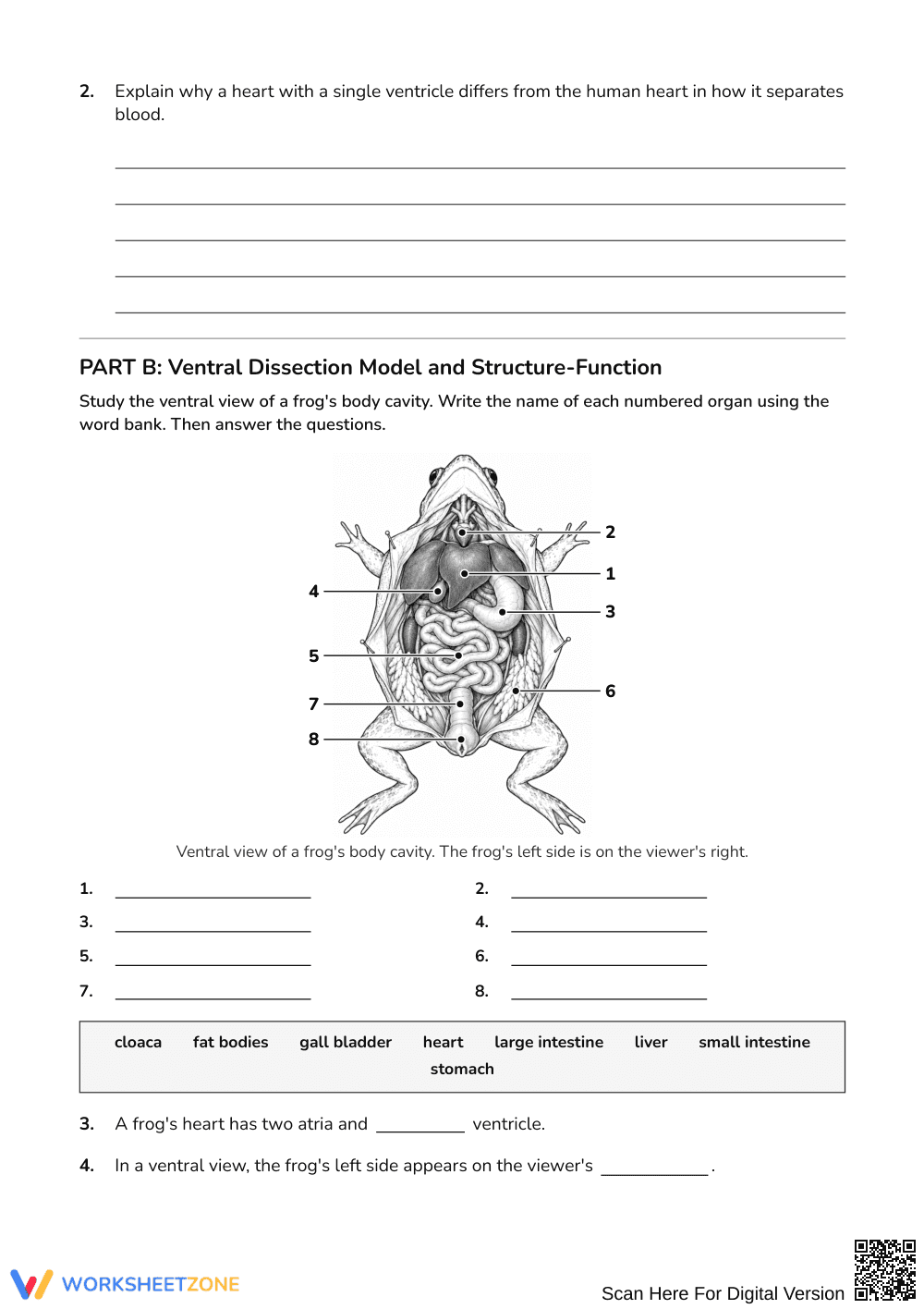
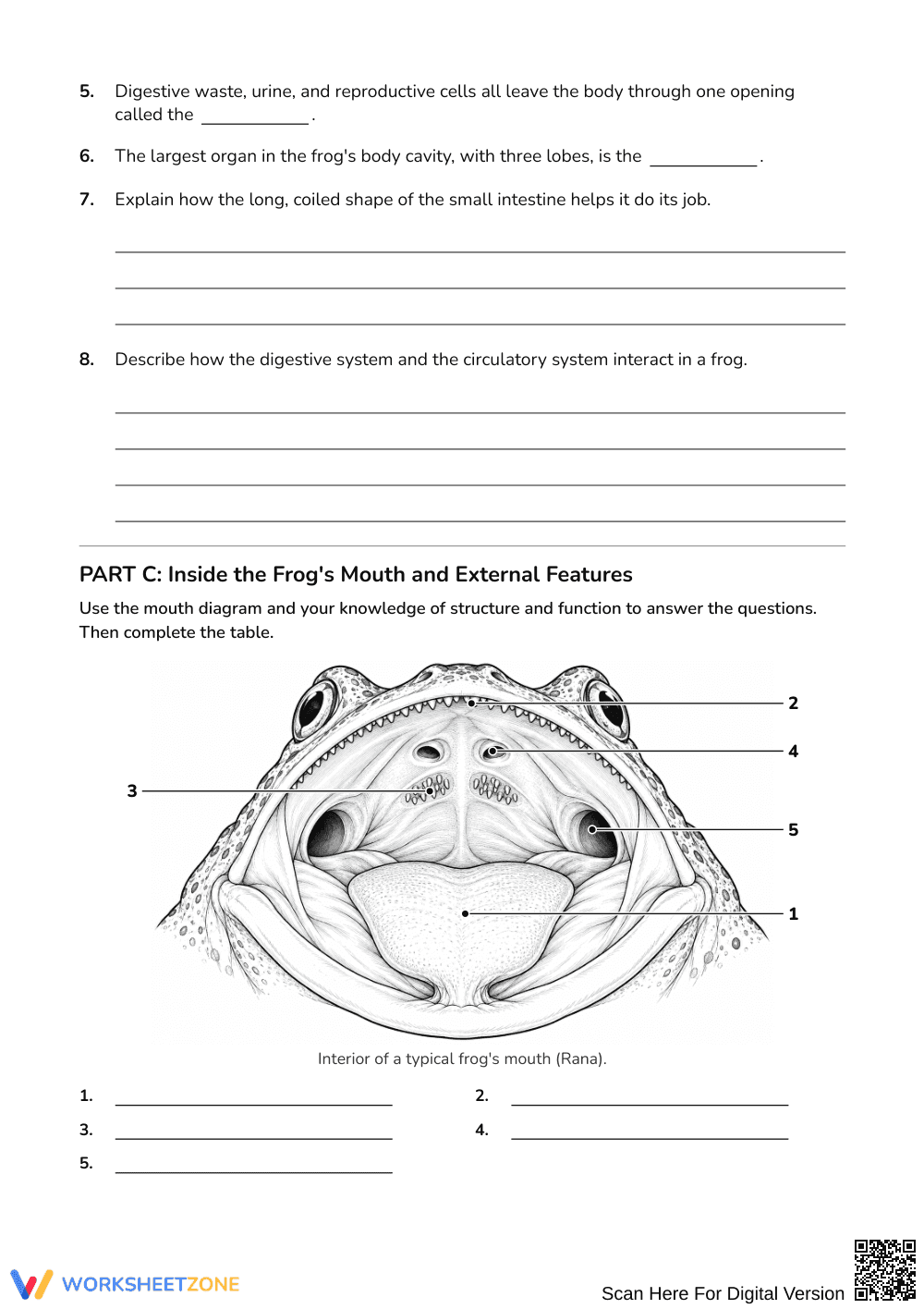
The 4-page student packet features diagram labeling, classification tasks, conceptual multiple-choice items, and open-ended explanatory prompts. It includes a directional anatomy word bank, labeled anatomical diagrams of the mouth cavity and ventral coelom, a misconception check on circulatory structures, and a structure-function reference matrix supported by a 4-page teacher answer key.
Skill Progression
- Guided practice (Part A, 12 items): Students define anatomical planes and classify representative frog structures across cellular, tissue, organ, and organ system levels with defined vocabulary prompts.
- Supported practice (Part B, 14 items): Learners label major organs using a ventral view diagram and word bank, then explain physiological adaptations like intestinal surface area and organ system coordination.
- Independent practice (Part C, 12 items): Students examine specialized head structures, interpret interior mouth features, and synthesize physiological roles in an anatomical summary table.
This sequence follows a gradual-release instructional model that moves students from foundational terminology to complex structure-function analysis.
Standards Alignment
This resource aligns with secondary life science standards emphasizing how organ systems interact to sustain life in multicellular organisms. Students investigate hierarchical biological organization and evaluate how specialized tissues and organs carry out essential life functions. Standard concepts can be copied directly into lesson plans, IEP goals, or district curriculum mapping tools.
How to Use It
Deploy this worksheet as a mandatory pre-lab assignment before physical or virtual dissection to ensure students identify organs accurately and understand specimen orientation. Alternatively, use Part B during direct instruction to walk through vertebrate body cavities. During seatwork, check student responses on the single-ventricle heart misconception prompt to identify learners confusing amphibian and mammalian circulation. Expected completion time is 45 to 60 minutes.
Who It's For
This worksheet serves general biology, life science, and introductory anatomy classes in grades 7 through 12. Pair it with an illustrated anatomical anchor chart or a digital 3D frog model to support visual learners and English language learners.
According to Fisher & Frey (2014), establishing domain-specific academic vocabulary and conceptual models prior to complex laboratory tasks significantly reduces cognitive load and improves scientific analysis during inquiry activities. This instructional resource operationalizes that research by targeting prerequisite anatomical terminology, directional planes, and physiological relationships across vertebrate organ systems. By working through 38 scaffolded prompts, secondary biology students bridge abstract cellular hierarchy with observable internal anatomy. Mastering these structural relationships enables students to interpret biological phenomena accurately, correct persistent circulatory misconceptions, and execute laboratory dissections with focused purpose and scientific precision.


