




























Essential Freshwater Scenarios Worksheet | Grade 12 Science
Paste this activity's link or code into your existing LMS (Google Classroom, Canvas, Teams, Schoology, Moodle, etc.).
Students can open and work on the activity right away, with no student login required.
You'll still be able to track student progress and results from your teacher account.
This Grade 12 Earth and Space Science worksheet trains students to quantitatively evaluate how freshwater anomalies alter thermohaline ocean circulation. Through authentic hydrographic data analysis, students calculate potential density shifts, assess vertical water column stability, and critique scientific claims regarding convective tipping points in the subpolar North Atlantic.
At a Glance
- Grade: 12 · Subject: Environmental & Earth/Space Science
- Standard: Evaluate evidence of feedbacks and dynamic shifts in Earth's ocean systems
- Skill Focus: Evaluate a Freshwater-Input Scenario
- Format: 4 pages · 10 problems · Answer key included · PDF
- Best For: Advanced oceanography units and data analysis practice
- Time: 45–60 minutes
What's Inside
This 4-page student-facing problem set contains 10 rigorous analytical and evaluative tasks anchored by a hydrographic dataset of baseline climatology and two perturbation cases. It includes complete thermodynamic reference equations, linearized density equations, and a comprehensive 3-page answer key showing full mathematical derivations and scientific critiques.
Skill Progression
- Guided Practice (Part A, Problems 1–2): Students define governing hydrodynamic boundary conditions and apply mass conservation principles to closed meridional overturning cells.
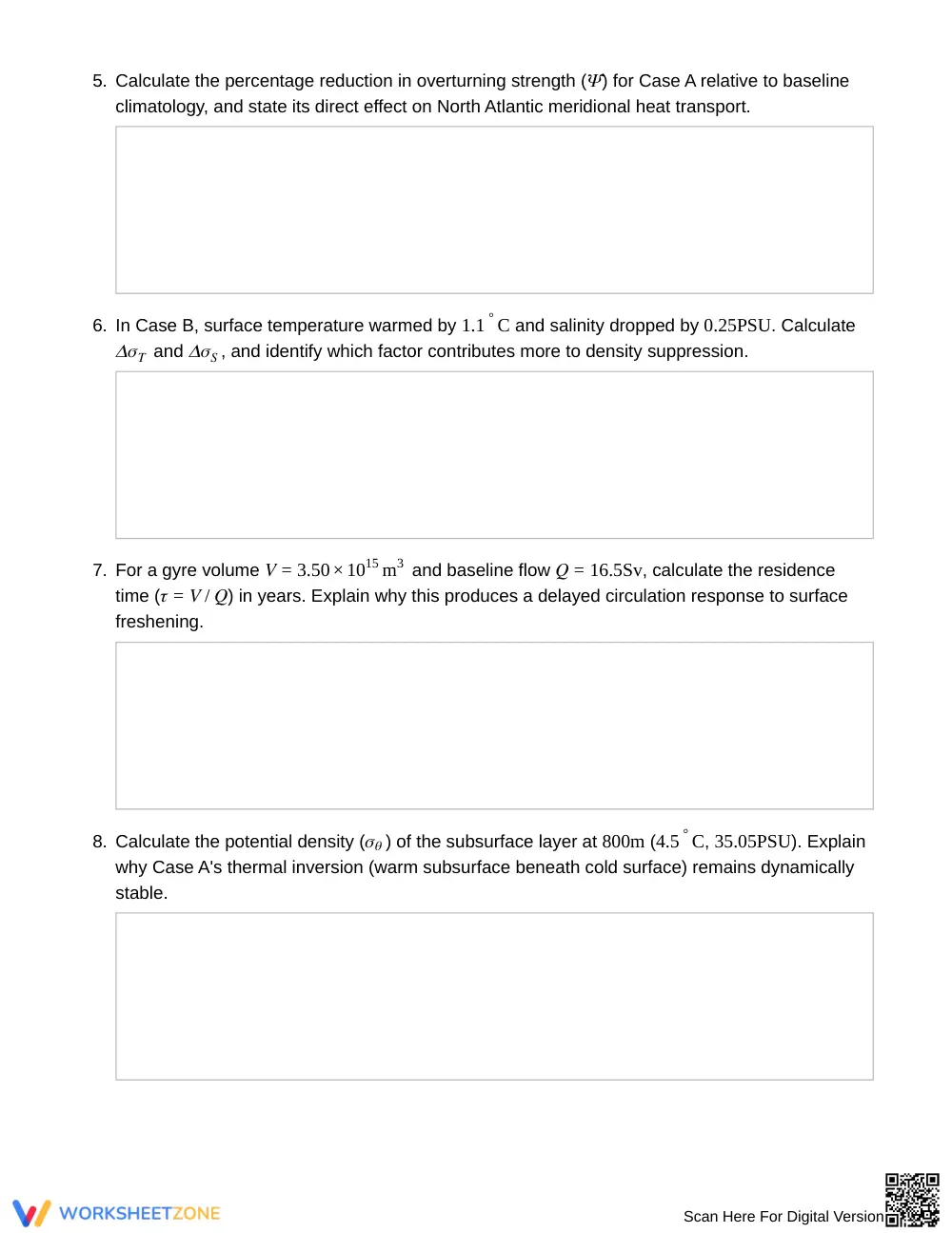
- Supported Practice (Part B, Problems 3–8): Students execute quantitative calculations using the linearized equation of state, determining density anomalies, mixed-layer shoaling, residence times, and thermal inversion stability.
- Independent Practice (Part C, Problems 9–10): Students critically evaluate policy briefs and scientific memos, identifying flawed assumptions and stabilizing feedbacks in ocean tipping-point arguments.
This structured progression reflects an explicit gradual-release model, advancing from fundamental conservation physics to sophisticated quantitative claim evaluation.
Standards Alignment
This worksheet supports advanced Earth and space science standards focused on modeling feedbacks and energy transport in geosystems. Students analyze thermodynamic data to evaluate how changes in surface salinity disrupt open-ocean deep convection and global heat transport. Curriculum requirements and conceptual goals can be integrated directly into district curriculum mapping tools, advanced course frameworks, or syllabus pacing guides.
How to Use It
Deploy this resource during the direct instruction sequence on thermohaline circulation or as a high-level summative checkpoint following lectures on density-driven fluid dynamics. For formative assessment, examine student work on Part B to ensure learners correctly weigh salinity coefficients against thermal expansion coefficients before critiquing claims in Part C. Expected completion time is 45 to 60 minutes.
Who It's For
This activity is designed for Grade 12 Earth Science, AP Environmental Science, or introductory oceanography students. Pair this worksheet directly with physical gyre circulation diagrams or climate modeling simulations to reinforce theoretical concepts with empirical calculations.
According to research by Fisher & Frey (2014) on structured cognitive apprenticeship, guiding high school students through progressive problem tiers significantly enhances their capacity to evaluate complex geoscience claims. When students transition from basic physical constraints to multi-step quantitative calculations, they internalize the mathematical mechanisms underlying ocean convective stability. This worksheet applies that instructional design by presenting hydrographic data sets alongside precise thermodynamic equations, requiring students to compute density changes before evaluating qualitative claims about overturning circulation collapse. By grounding science practices in real-world numerical constraints, educators help learners build transferable critical-thinking skills for advanced STEM coursework and data-driven scientific literacy.


