




























Views
Downloads


Essential Form & Wording Purpose Worksheet | Grade 6 ELA

Paste this activity's link or code into your existing LMS (Google Classroom, Canvas, Teams, Schoology, Moodle, etc.).
Students can open and work on the activity right away, with no student login required.
You'll still be able to track student progress and results from your teacher account.
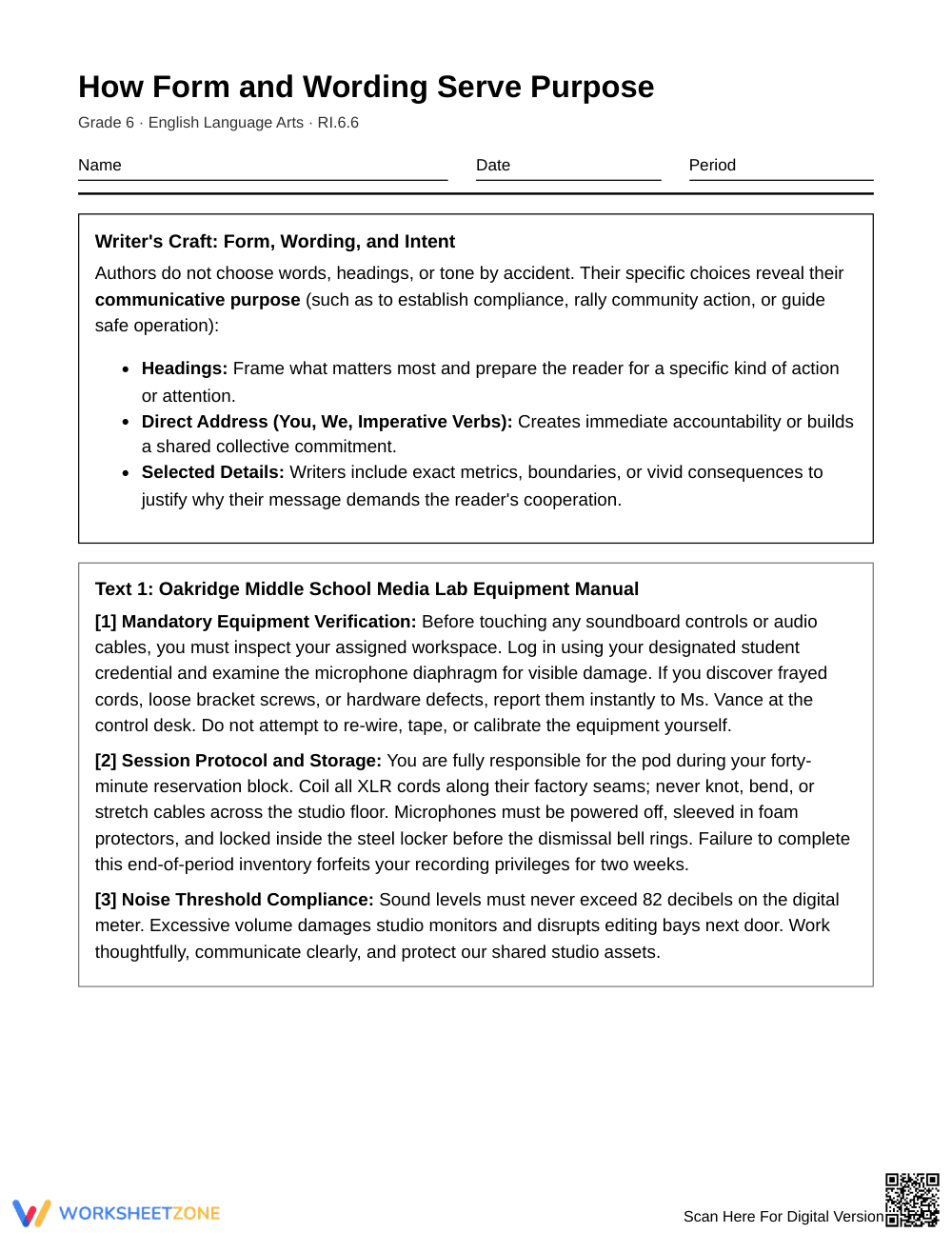
This Grade 6 informational text worksheet builds student capacity to analyze how authors use structural forms, headings, direct address, and specific wording to convey communicative intent. Working across two contrasting non-fiction passages, students evaluate stylistic choices and propose purposeful revisions to master author's craft.
At a Glance
- Grade: 6 · Subject: ELA
- Standard:
RI.6.6— Determine author purpose and explain how form and wording convey intent- Skill Focus: How Form and Wording Serve Purpose
- Format: 5 pages · 12 problems · Answer key included · PDF
- Best For: Close reading and rhetorical analysis
- Time: 40–50 minutes
The activity provides an anchor craft box followed by two contrasting passages: a lab manual and a student newsletter. Across 5 pages, students complete 12 analytical tasks organized into three parts, supported by a 3-page answer key with exemplar responses.
Skill Progression
- Guided Practice (Part A, 3 tasks): Students identify target audiences, primary purposes, and author-reader relationships across both texts.
- Supported Practice (Part B, 6 tasks): Learners analyze text features, including imperative verbs, formal headings, specific consequences, inclusive pronouns, and quantitative metrics.
- Independent Application (Part C, 3 tasks): Students evaluate proposed changes and draft purpose-preserving revisions for new audiences.
This sequence implements the gradual release model, advancing students from comprehension to rhetorical evaluation.
Standards Alignment
This worksheet aligns directly to `RI.6.6`: Determine an author's point of view or purpose in a text and explain how it is conveyed in the text. Students analyze how diction and organization establish purpose. Both standard codes can be copied directly into lesson plans, IEP goals, or district curriculum mapping tools.
How to Use It
Use this worksheet during guided practice or following direct instruction on author's craft. For formative assessment, observe whether students differentiate the authoritative tone in Text 1 from the collaborative tone in Text 2 during Part A discussions. Most sixth graders complete the 12 problems in 40 to 50 minutes.
Who It's For
This resource serves general education Grade 6 ELA classes, advanced Grade 5 readers, and targeted intervention groups. Differentiate by providing sentence frames for Part C revisions, and pair this worksheet with an anchor chart on author's purpose.
Mastering standard RI.6.6 requires middle school students to determine an author's purpose and explain how form and wording convey intent. Research by Fisher & Frey (2014) demonstrates that close reading routines focused on micro-level text features—such as pronoun shifts, heading structures, and precise word choices—substantially strengthen adolescent reading comprehension and analytical writing. By analyzing contrasting informational texts that establish compliance versus collective motivation, learners develop critical rhetorical awareness. This 12-task worksheet operationalizes standard RI.6.6 by guiding sixth graders through text-dependent analysis and purpose-driven rewriting exercises. The structured progression ensures students not only identify communicative goals but also explain how structural and lexical choices achieve those goals across diverse non-fiction formats.


