




























Essential Food Texture Word Search | Grades 6–7 ELA
Paste this activity's link or code into your existing LMS (Google Classroom, Canvas, Teams, Schoology, Moodle, etc.).
Students can open and work on the activity right away, with no student login required.
You'll still be able to track student progress and results from your teacher account.
Strengthen middle school sensory descriptive writing with this targeted word search focused on food texture vocabulary. Designed for Grades 6–7 ELA classrooms, this 16-word activity challenges students to analyze sensory clues and identify nuanced culinary descriptors, promoting precision in narrative prose and descriptive essay drafting.
At a Glance
- Grade: Grades 6–7 · Subject: ELA
- Standard: Not standards-assessed — vocabulary enrichment
- Skill Focus: Food texture vocabulary
- Format: 3 pages · 16 words · Answer key included · PDF
- Best For: Descriptive writing stations and sensory vocabulary enrichment
- Time: 25–35 minutes
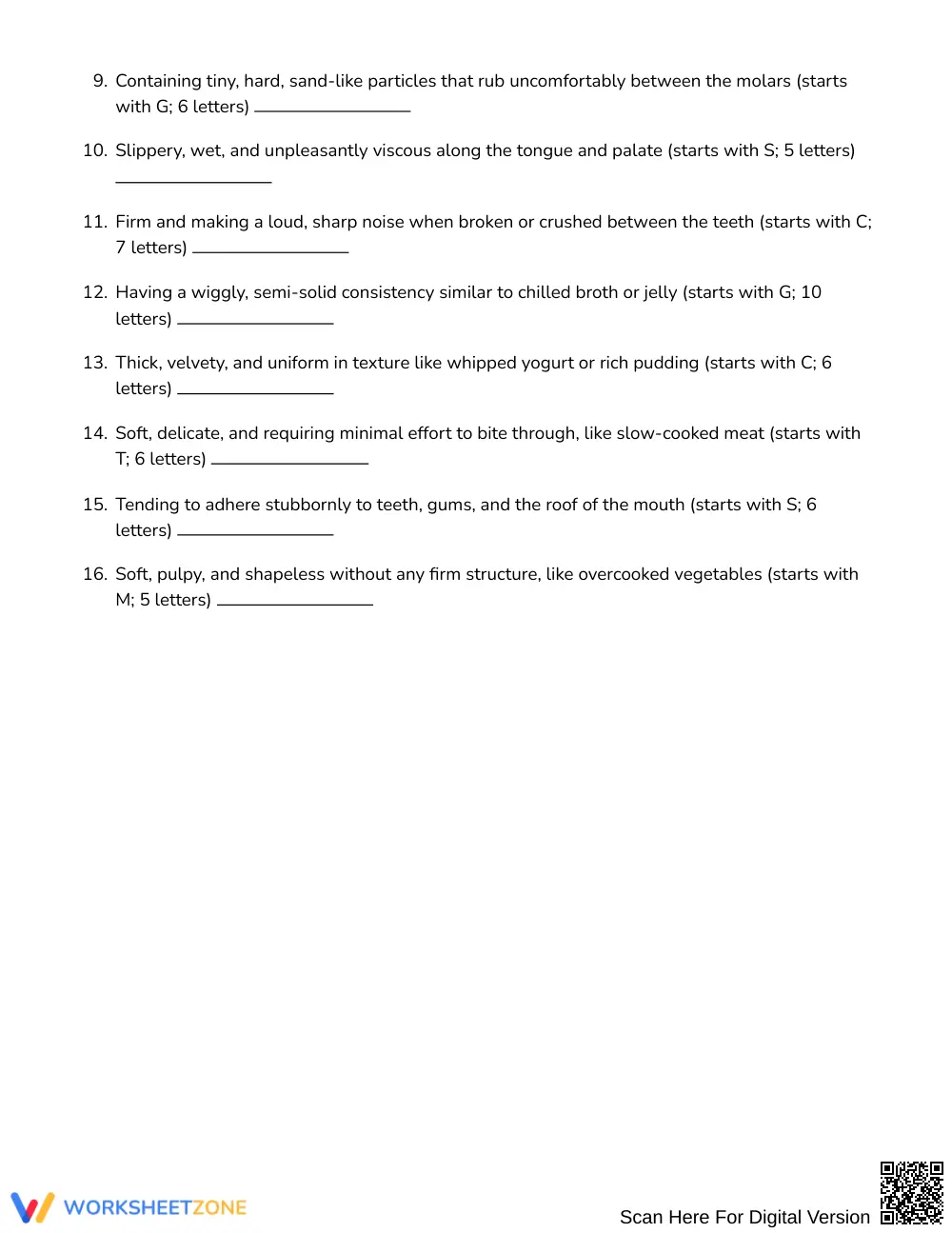
This 3-page printable PDF features an advanced clue-driven puzzle format without an exposed word bank, accompanied by a 3-page full-size answer key. Instead of scanning a simple list, students read 16 rigorous sensory clues defining distinct mouthfeel properties—such as crispy, fibrous, gelatinous, and flaky—before locating the terms within the puzzle grid.
Puzzle Structure and Mechanics
This word search operates on an expansive 18 x 18 grid designed to promote sustained visual scanning and semantic retrieval. Rather than relying on a visible word bank, students must first decode 16 contextual definitions to deduce each target texture term. Words run in all 8 compass directions: north, northeast, east, southeast, south, southwest, west, and northwest, providing an engaging cognitive challenge for upper elementary and intermediate readers.
Standards Alignment
This resource serves as targeted vocabulary enrichment and is not aligned to a formal state or national standard. It functions as a direct supplement to descriptive writing units, sensory imagery lessons, and word-choice workshops where students transition away from basic adjectives toward specific, sensory-rich vocabulary.
How to Use It
Integrate this puzzle directly after introducing sensory language in a narrative writing unit, or utilize it as a focused anchor task during creative writing rotations. For an effective formative-assessment checkpoint, circulate while students read the clues to observe whether they deduce words like fibrous or gelatinous independently or require peer discussion to analyze the anatomical descriptions. Most learners complete the full search within 25 to 35 minutes.
Who It's For
This activity is built for Grades 6–7 ELA students refining their diction for personal narratives, descriptive essays, and literary analysis. For students needing support, allow partner collaboration or encourage annotating key descriptor words in each clue before grid searching. Pair this exercise naturally with a sensory details anchor chart or a descriptive food critique writing assignment.
Academic research highlights the critical importance of domain-specific sensory vocabulary in secondary literacy development. According to Fisher & Frey (2014), intentional word-learning tasks that require students to retrieve definitions from context clues significantly improve deep lexical retention compared to rote memorization lists. By engaging with 16 descriptive food texture terms through detailed physical and culinary definitions, students build mental models that bridge sensory perception and written expression. Solving puzzles without a visible word bank activates active retrieval pathways, forcing learners to synthesize descriptive attributes—such as elasticity, moisture, and sound—before conducting visual searches across an 18 x 18 matrix. This dual-processing mechanism reinforces semantic connections, equipping middle-grade writers with the exact sensory adjectives required to craft vivid narrative imagery and articulate analytical critiques. Consequently, structured vocabulary puzzles serve as high-yield instructional tools for linguistic precision and expressive writing mastery.


