


























Views
Downloads



Essential Focus, Epicenter & Seismic Waves Worksheet
Paste this activity's link or code into your existing LMS (Google Classroom, Canvas, Teams, Schoology, Moodle, etc.).
Students can open and work on the activity right away, with no student login required.
You'll still be able to track student progress and results from your teacher account.
This five-page worksheet builds Grade 8 students' understanding of earthquake mechanics, focus versus epicenter geometry, P-wave and S-wave propagation, and surface-wave damage potential through 12 scaffolded problems that move from conceptual distinctions to quantitative seismic data analysis and justified Earth-structure predictions. A complete answer key is included for efficient grading.
At a Glance
- Grade: 8 · Subject: Science
- Skill Focus: Focus, Epicenter, and Seismic Waves
- Format: 5 pages · 12 problems · Answer key included · PDF
- Best For: Post-instruction practice or formative review
- Time: 35–50 minutes
What’s Inside
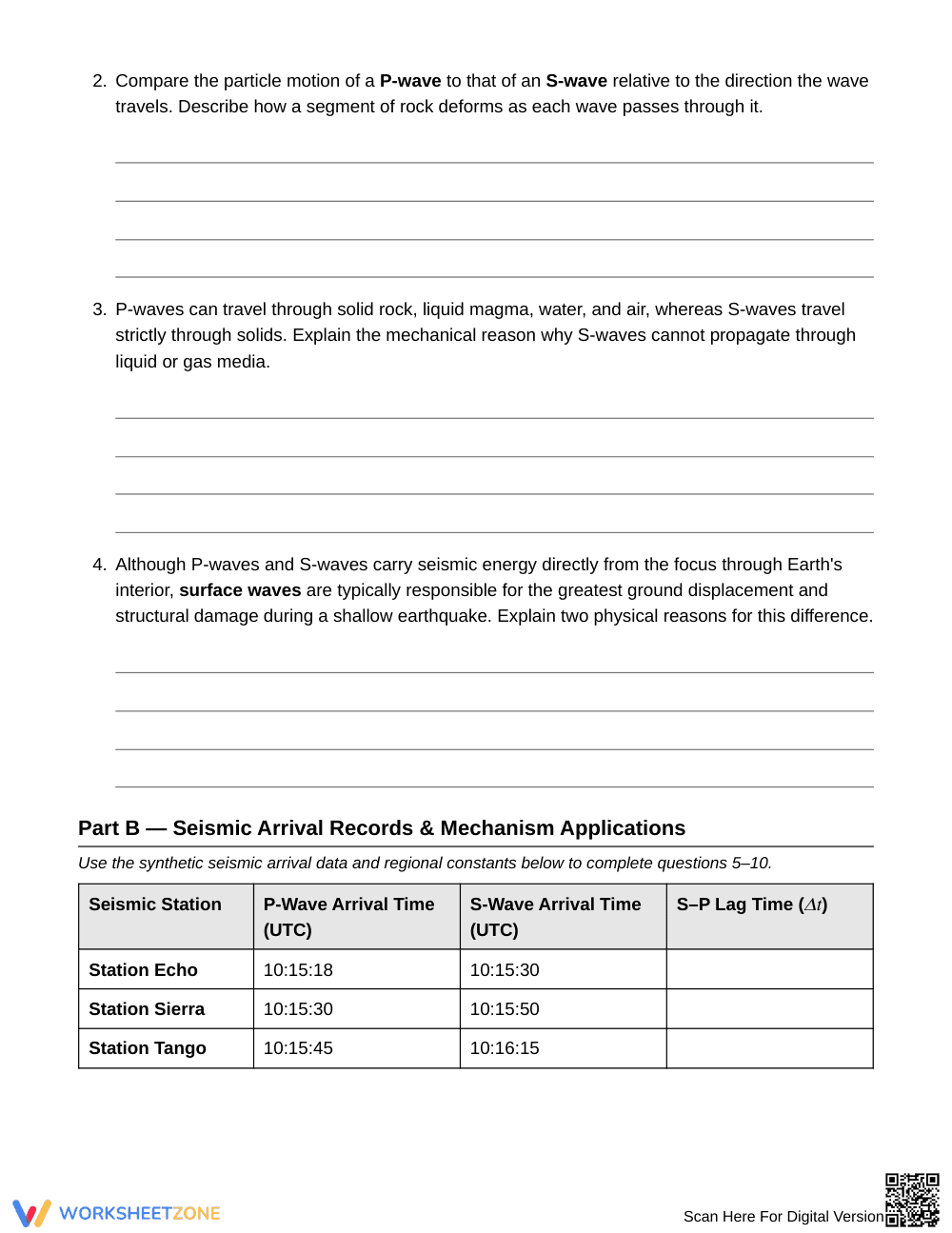
The worksheet opens with a reference box defining focus, epicenter, P-waves, S-waves, surface waves, and the S-P lag-time formula. Part A targets conceptual wave mechanics with 4 open-response questions. Part B provides 6 data-driven problems using synthetic arrival tables for distance calculations and sensor analysis. Part C presents 2 scenario-based predictions regarding Earth’s outer-core state and sediment amplification. A multi-page answer key provides complete worked solutions.
Skill Progression
- Guided practice (Problems 1–4): Students apply definitions and wave-propagation principles directly from the reference box to contrast particle motion and explain why S-waves cannot cross liquids.
- Supported practice (Problems 5–10): Students calculate epicentral distances using lag-time data, determine origin times, and analyze sensor orientation.
- Independent practice (Problems 11–12): Students analyze the S-wave shadow zone and sediment amplification to construct scientific predictions.
How to Use It
Assign this worksheet following direct instruction on seismic wave types and earthquake anatomy. Students can work through Parts A and B in collaborative pairs while you check S-P lag-time calculations for immediate formative feedback. Part C functions well as an independent exit ticket or homework assignment. The entire activity takes approximately 35 to 50 minutes.
Who It’s For
This activity is designed for Grade 8 science students learning Earth systems and natural hazards. The structured reference box supports emerging readers and English learners by pre-teaching essential terminology. Visual learners benefit from pairing these problems with cross-section diagrams of Earth’s interior.
This Grade 8 science resource builds critical scientific literacy by asking students to analyze seismic wave data, including primary and secondary arrival times, focal depth comparisons, and shadow-zone evidence, to construct explanations about earthquake mechanics and internal planetary structure. According to the 2024 NAEP science framework, only 34 percent of eighth-grade students demonstrate proficient reasoning with geoscience data, underscoring the urgent need for structured practice that connects wave physics to real observational evidence. The 12-problem set moves smoothly from fundamental vocabulary recall through quantitative lag-time calculations to complex scenario-based predictions requiring multi-step scientific justification, a pedagogical progression consistent with research on the gradual release of responsibility (Fisher & Frey, 2014). Teachers can use the included comprehensive answer key for immediate scoring and progress monitoring in any gradebook. The worksheet is printable, self-contained, and ready for immediate classroom distribution.


