




























Views
Downloads


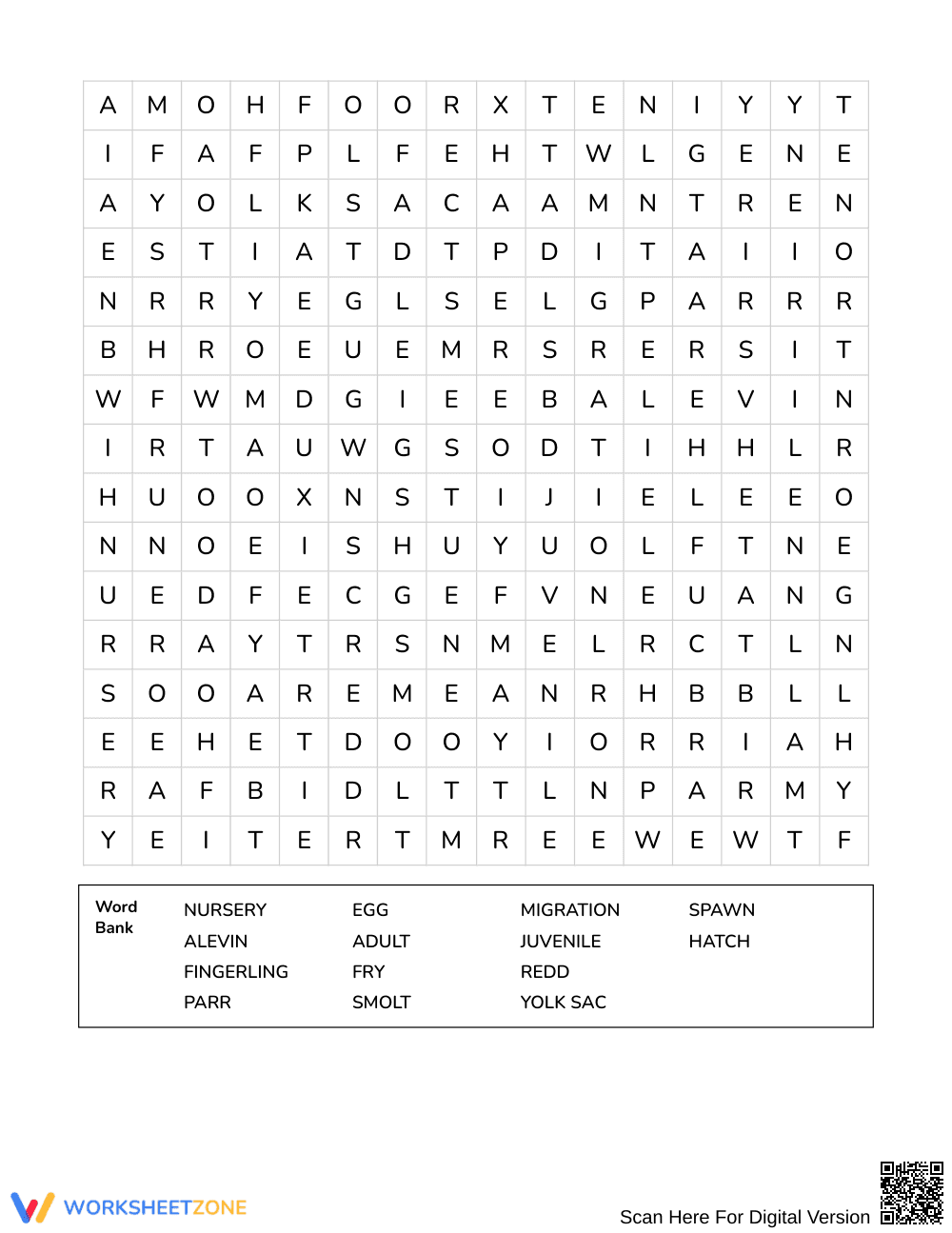

Essential Fish Life Cycle Word Search | Grades 4–5 Science

Paste this activity's link or code into your existing LMS (Google Classroom, Canvas, Teams, Schoology, Moodle, etc.).
Students can open and work on the activity right away, with no student login required.
You'll still be able to track student progress and results from your teacher account.
Reinforce essential aquatic biology terminology with this focused fish life cycle word search for Grades 4–5 science students. Learners identify key developmental stages from egg to adult by reading descriptive science clues, strengthening reading comprehension and domain-specific vocabulary retention through an engaging clue-based detective format.
At a Glance
- Grade: Grades 4–5 · Subject: Science
- Standard: Not standards-assessed — vocabulary enrichment
- Skill Focus: Fish life cycle stages and terminology
- Format: 3 pages · 14 words · Answer key included · PDF
- Best For: Vocabulary review and science center stations
- Time: 20–30 minutes
This 3-page printable science resource includes a student activity sheet containing 14 vocabulary terms embedded within a dense letter array, an accompanying definition clue bank, and a comprehensive 3-page full-size answer key. Instead of a basic list, each term features an informative clue explaining structures like the yolk sac, stages such as alevin, fry, parr, and smolt, and environmental concepts like redds and migration.
The puzzle challenges students within a clear 16 x 16 letter grid where terms run in four distinct directional orientations: northeast, east, southeast, and south. Rather than simply scanning for pre-listed letter strings, learners read detailed life-cycle clues to determine the correct vocabulary word before locating it in the letter matrix. This detective structure ensures students actively connect biological definitions to scientific terms before searching.
This resource serves as targeted vocabulary enrichment designed to support general upper elementary life science curriculum units on growth, development, and animal adaptations. Because this activity focuses purely on contextual vocabulary exposure and morphological recognition rather than formal benchmark testing, it is not aligned to a specific state or national standard.
Deploy this activity after direct instruction on vertebrate life stages to consolidate specialized salmonid and freshwater fish terms. It works exceptionally well as an independent science center station or as an engaging sponge activity for early finishers during a multi-day ecology unit. During completion, circulate to observe whether students use the contextual clues or require assistance identifying specialized terms like alevin and smolt. Students typically finish within 20 to 30 minutes.
Designed for Grades 4–5 general education students, this puzzle also supports English language learners and students requiring tier-1 vocabulary scaffolds through descriptive context clues. Pair this word search directly with a freshwater fish diagram or an introductory reading passage detailing salmon migration rivers for maximum conceptual integration.
Explicit vocabulary instruction plays a pivotal role in elementary science mastery, particularly when upper elementary students encounter specialized domain terms such as alevin, fry, smolt, and redd. According to research on disciplinary literacy by Fisher & Frey (2014), students require repeated, deliberate interactions with academic language across multiple instructional contexts to transfer technical terminology into long-term working memory. Clue-based word searches provide contextualized retrieval practice by linking precise conceptual definitions to corresponding orthographic word forms. In this Grades 4–5 fish life cycle activity, matching 14 clues to developmental milestones encourages active semantic processing rather than passive letter scanning. By engaging with clues defining anatomical structures like the yolk sac and reproductive behaviors like spawning, elementary learners establish foundational schema that support subsequent scientific reading comprehension, peer discourse, and written explanations of diverse animal life cycles.


