




























Views
Downloads



Essential Facts & Reasons Worksheet | Grade 7 ELA

Paste this activity's link or code into your existing LMS (Google Classroom, Canvas, Teams, Schoology, Moodle, etc.).
Students can open and work on the activity right away, with no student login required.
You'll still be able to track student progress and results from your teacher account.
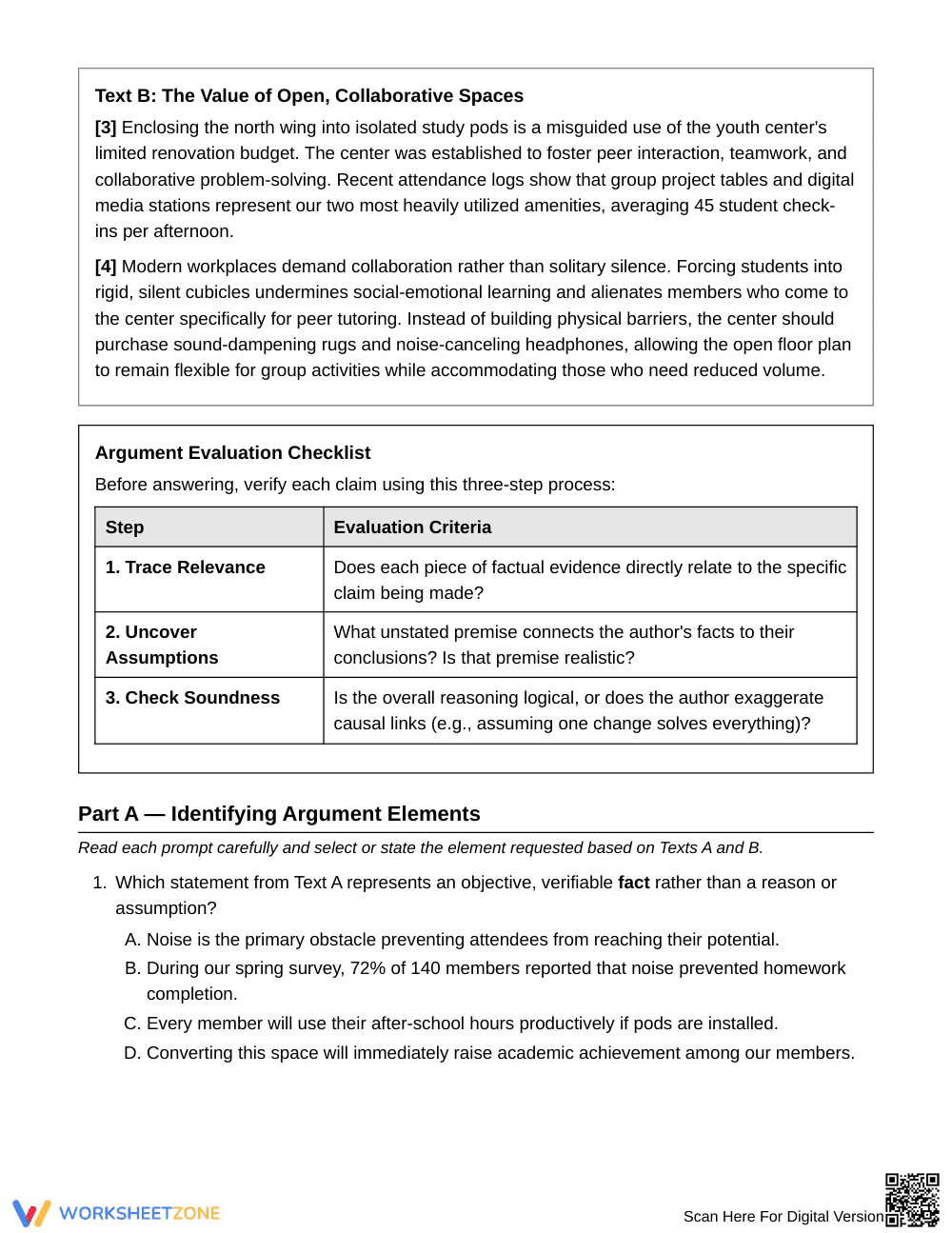
This Grade 7 ELA worksheet equips students to evaluate arguments by separating verifiable facts, supporting reasons, and unstated assumptions across competing viewpoints. Working with two paired texts on youth center design, learners analyze evidence, examine logical soundness, and identify unstated premises to master critical evaluation.
At a Glance
- Grade: 7 · Subject: ELA
- Standard:
RI.7.8— Trace and evaluate arguments, assessing whether reasoning is sound and evidence is sufficient- Skill Focus: Separate Facts, Reasons, and Assumptions
- Format: 5 pages · 12 problems · Answer key included · PDF
- Best For: Argumentative text evaluation
- Time: 45–60 minutes
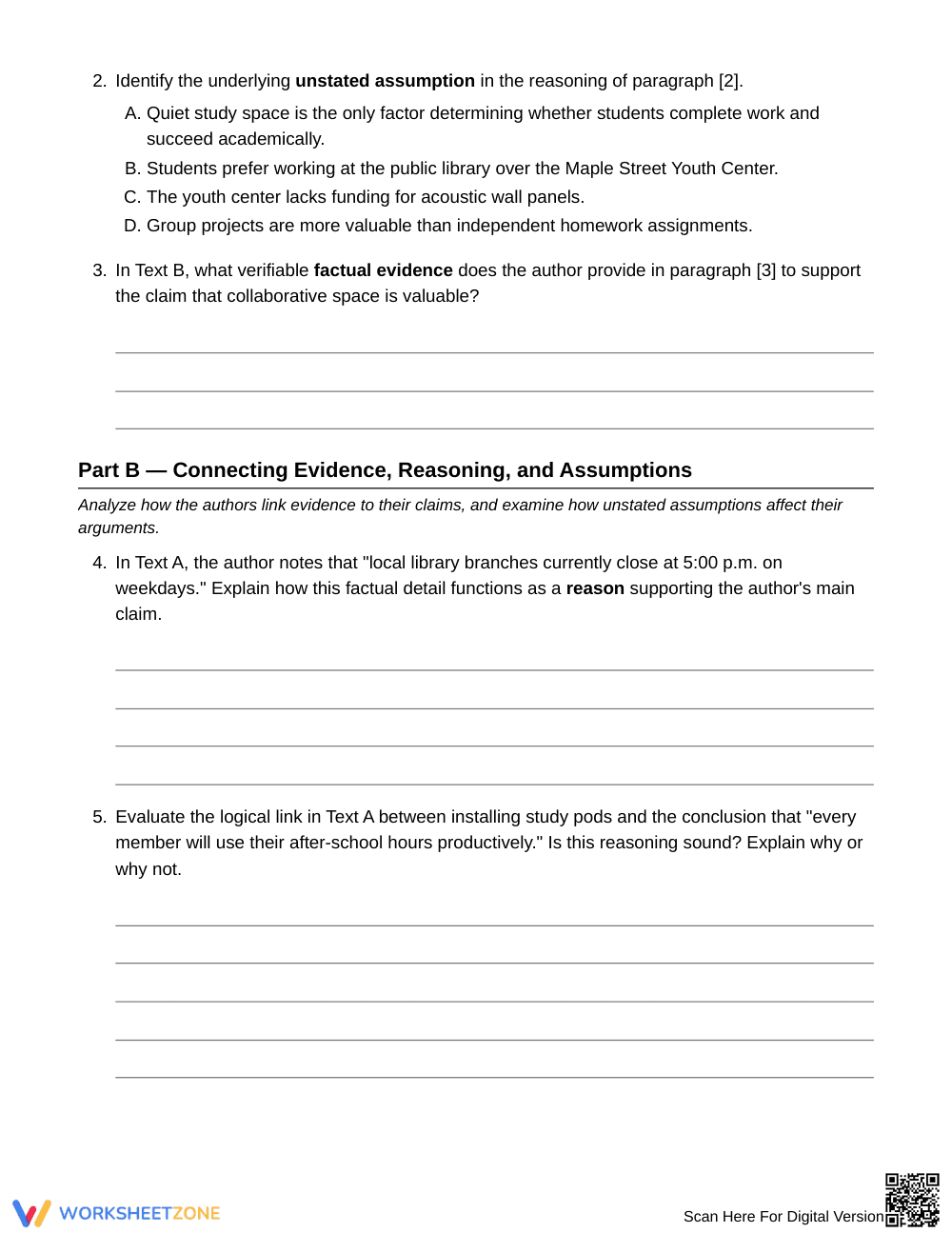
The 5-page worksheet includes two paired persuasive texts, an argument reference chart with test questions, and a 3-step evaluation checklist. Across 12 structured tasks, students complete multiple-choice identification, an evidence comparison table, and analytical responses, supported by a 4-page answer key with exemplar student explanations.
Skill Progression
- Guided Practice (Tasks 1–3): Students use the reference table to identify objective facts and unstated assumptions in multiple-choice questions.
- Supported Practice (Tasks 4–9): Learners complete an evidence comparison table and examine logical links connecting facts to claims.
- Independent Practice (Tasks 10–12): Students evaluate whole-text soundness, assess evidence sufficiency, and justify which author built a stronger argument.
This gradual release sequence moves students systematically from element identification to independent argumentative analysis.
Standards Alignment
This resource directly targets `RI.7.8`: "Trace and evaluate the argument and specific claims in a text, assessing whether the reasoning is sound and the evidence is relevant and sufficient to support the claims." It also supports `RI.7.1` by requiring explicit text evidence. Both standard codes can be copied directly into lesson plans, IEP goals, or district curriculum mapping tools.
How to Use It
Use this worksheet after direct instruction on argument elements. In a paired-reading format, have students read both texts and complete Parts A and B together (25 minutes). For formative assessment, check whether students distinguish facts from assumptions in Part A before they proceed. Assign Part C as an independent evaluative check (20 minutes). Total estimated completion time is 45–60 minutes.
Who It's For
Designed for Grade 7 ELA classes, this worksheet also supports Grade 8 intervention groups and advanced Grade 6 readers. Built-in test questions and comparison tables scaffold English language learners. Pair this resource with a direct instruction mini-lesson on logical fallacies or argument writing mentor texts.
According to Fisher & Frey (2014), evaluating arguments requires moving adolescent readers beyond surface-level comprehension toward analyzing the logical integrity of underlying premises. Standard RI.7.8 asks seventh graders to trace claims and distinguish sound reasoning from unsupported assumptions. When students evaluate conflicting informational texts, they must actively separate objective data from implicit author biases. This 12-task worksheet operationalizes that research by providing concrete evaluative criteria alongside paired arguments. Students do not simply identify an author's point of view; they dissect the architecture of persuasion by testing facts for verifiability, validating explanatory reasons, and surfacing hidden assumptions that weaken overall argument validity. Structured analysis scaffolds bridge the critical gap between initial reading comprehension and rigorous evaluative writing, preparing middle school learners for complex text scrutiny across core academic disciplines throughout secondary education.


