





























Essential Explanatory Thesis Worksheet | Grade 9 English I
Paste this activity's link or code into your existing LMS (Google Classroom, Canvas, Teams, Schoology, Moodle, etc.).
Students can open and work on the activity right away, with no student login required.
You'll still be able to track student progress and results from your teacher account.
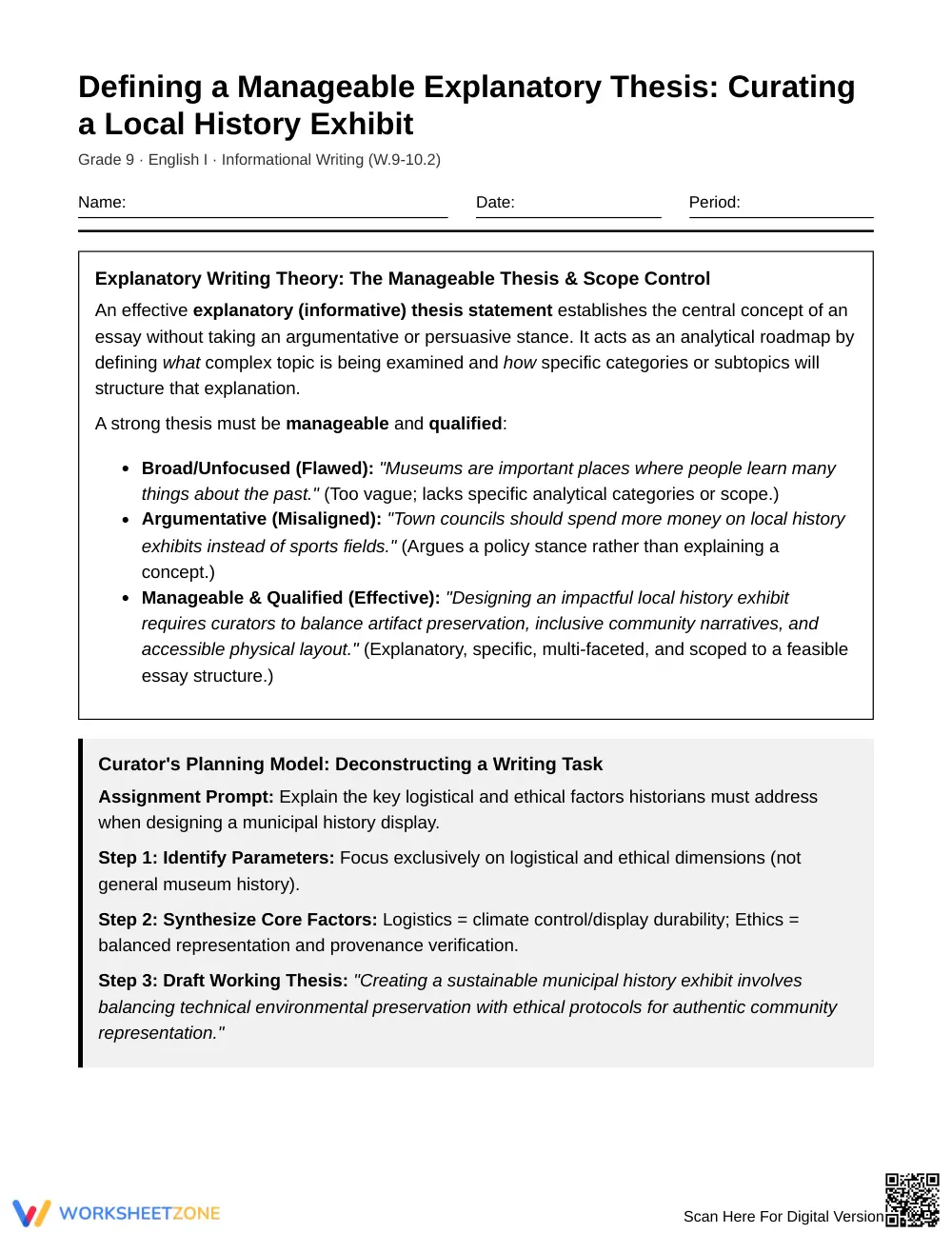
This Grade 9 informational writing resource develops students' ability to formulate focused, qualified thesis statements for analytical essays. High school writers evaluate flawed claims, analyze source materials on museum curation, extract structured textual evidence, and draft a complete multi-paragraph explanatory composition with targeted self-revisions.
At a Glance
- Grade: 9 · Subject: English I
- Standard:
W.9-10.2— Write informative and explanatory texts to examine and convey complex ideas clearly.- Skill Focus: Manageable Explanatory Thesis Statements
- Format: 6 pages · 8 problems · Answer key included · PDF
- Best For: Informational essay unit direct practice
- Time: 45–60 minutes
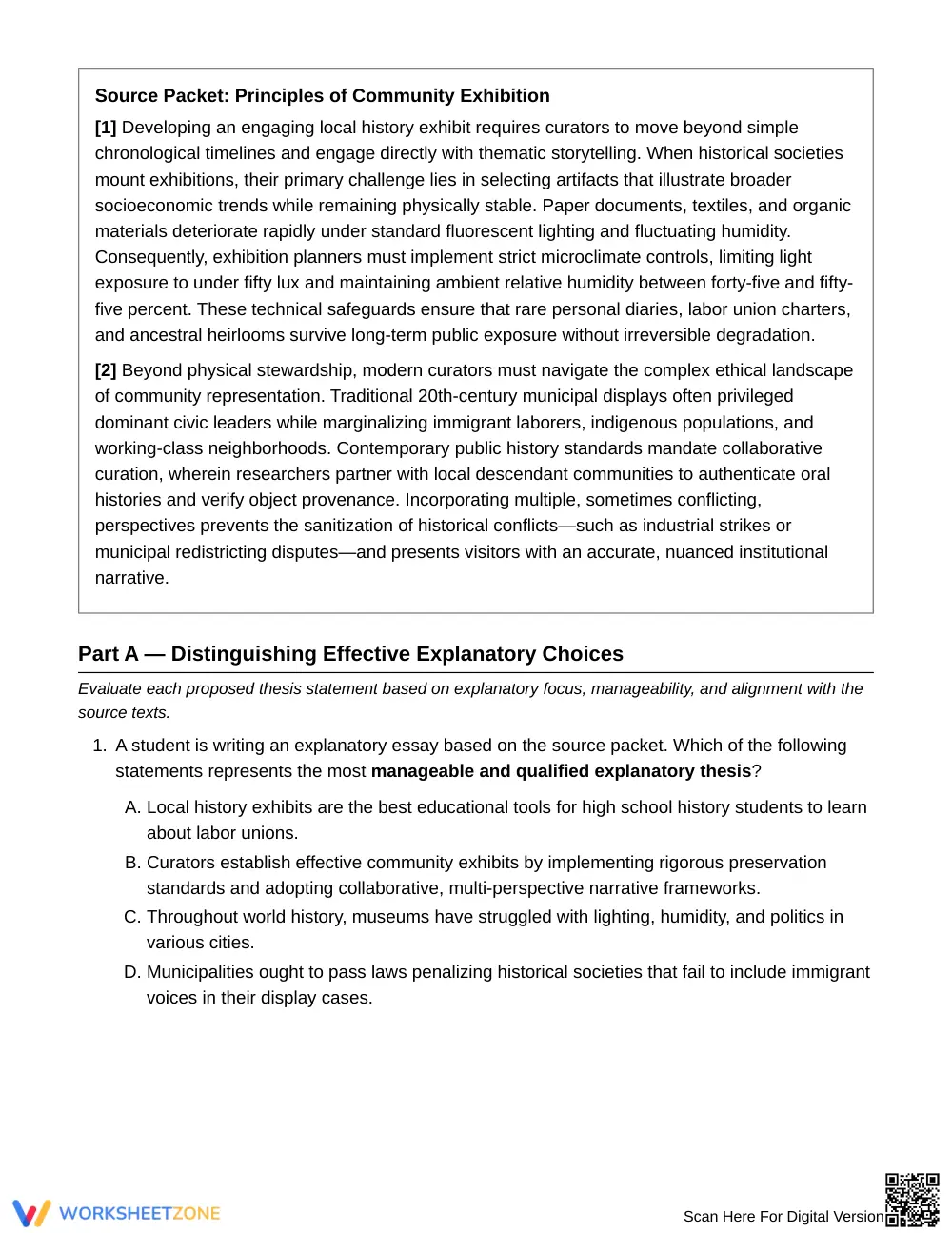
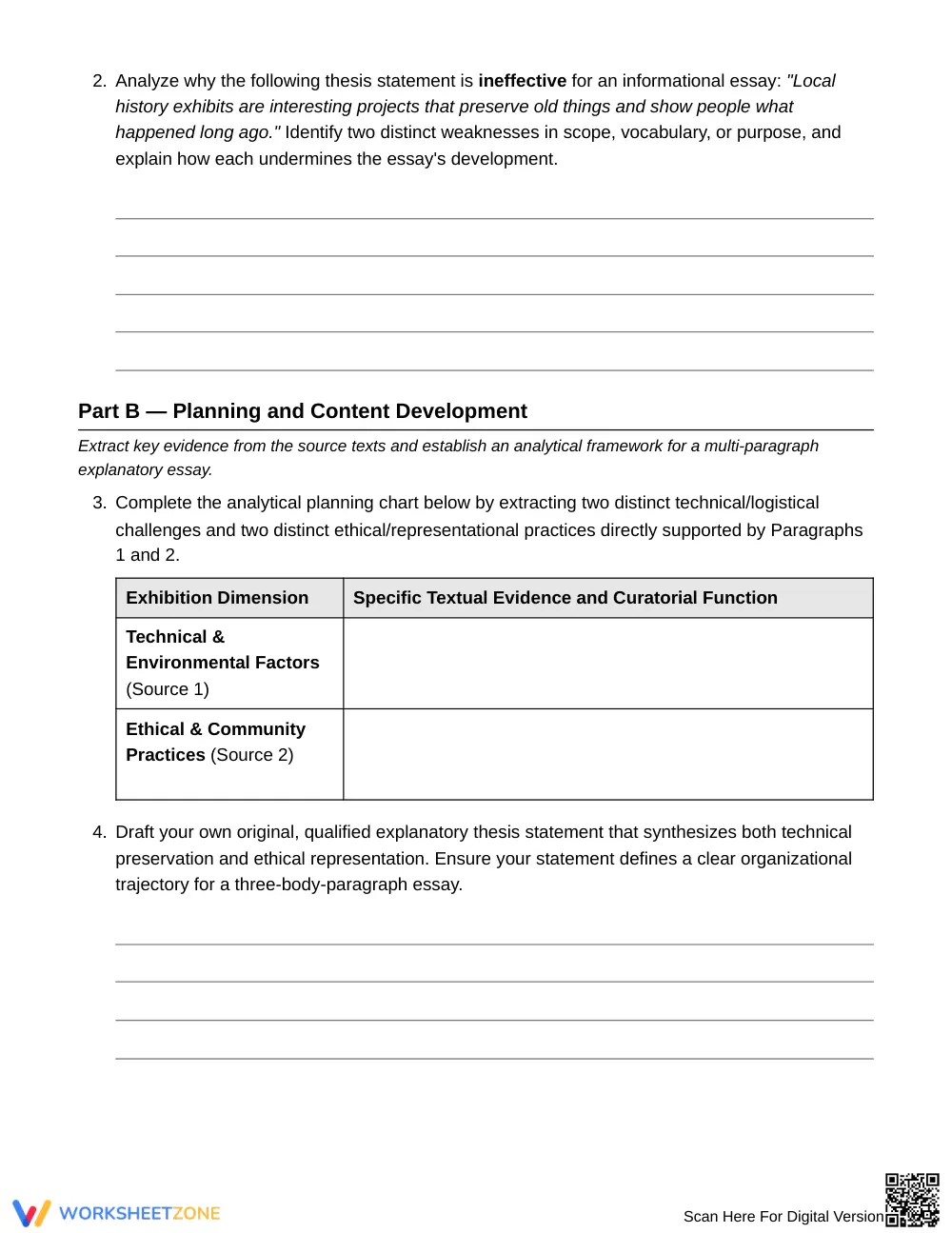
Inside, students work through 8 rigorous tasks distributed across 6 instructional pages, backed by a 4-page comprehensive reference key. The material opens with an explanatory writing theory anchor chart contrasting vague, argumentative, and qualified statements, followed by a curated informational text on exhibition stewardship. Activities include multiple-choice claim evaluation, open-ended analytical critique, structured graphic organizers, outline sequences, evidence integration practice, and full draft execution.
Skill Progression
- Guided Practice: Items 1 and 2 present curated examples where students evaluate thesis statements and critique weak claims lacking academic scope or neutrality.
- Supported Practice: Items 3 through 6 provide structured graphic organizers and outline templates for extracting logistical evidence and drafting thesis statements before writing.
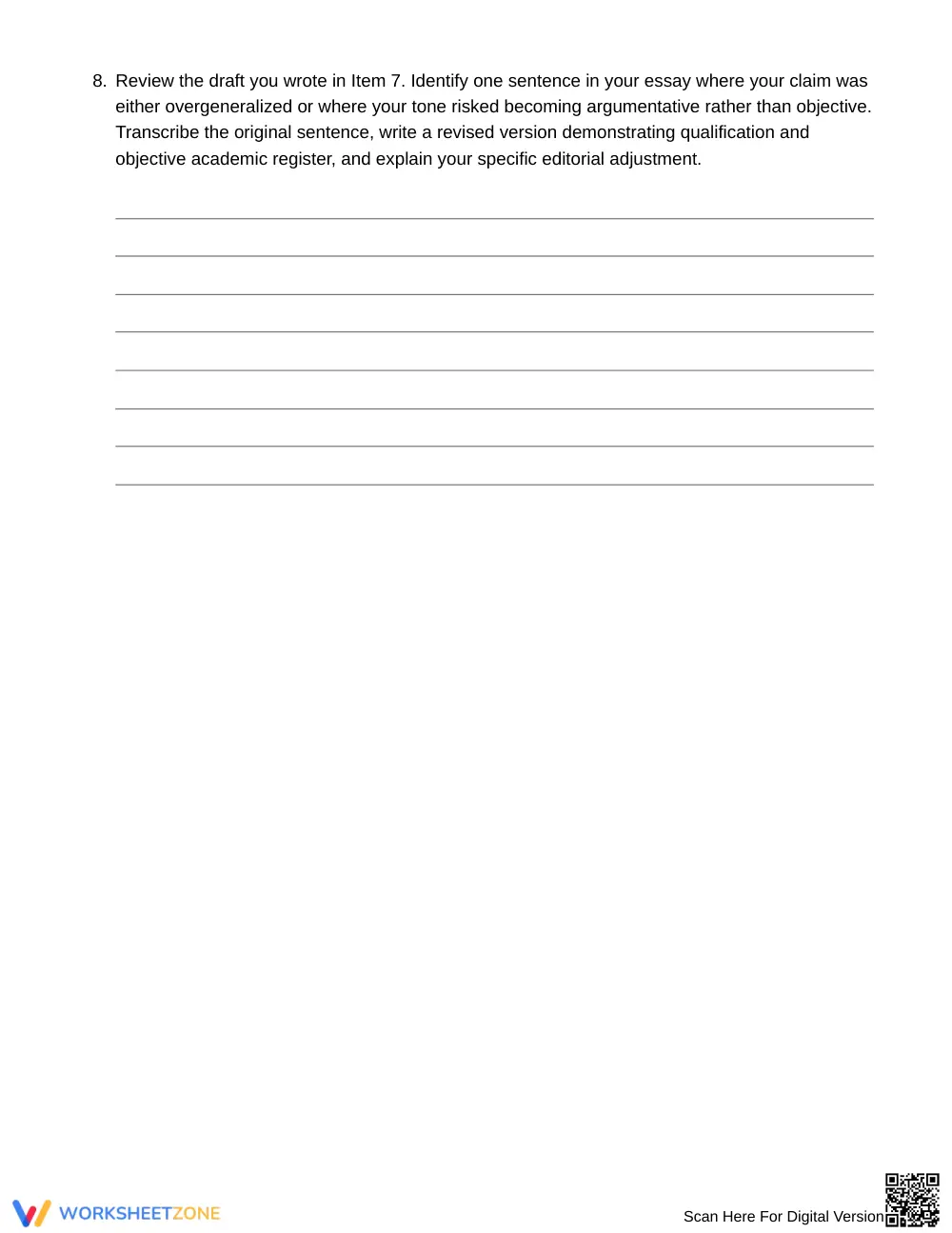
- Independent Practice: Items 7 and 8 require students to draft a complete 300-to-400-word explanatory essay and perform self-directed revisions targeting tone and qualification.
This sequence follows a gradual-release model, moving writers systematically from analytical evaluation to independent text synthesis.
Standards Alignment
This resource directly targets W.9-10.2, which requires students to write informative and explanatory texts to examine and convey complex ideas, concepts, and information clearly and accurately through the effective selection, organization, and analysis of content. Additionally, it reinforces W.9-10.5 by requiring structured drafting and sentence-level revisions. Both standard codes can be copied directly into lesson plans, IEP goals, or district curriculum mapping tools.
How to Use It
Deploy this activity during the planning phase of an informational writing unit, immediately following direct instruction on scope control and objective register. It functions effectively as paired workshop practice or as an independent diagnostic assessment across a 45-to-60-minute block. During work time, review students' Item 4 thesis drafts formatively to verify that their claims balance multiple subtopics before they proceed to essay drafting.
Who It's For
This lesson is designed for Grade 9 English I students building foundational expository composition skills. Scaffolding supports emerging writers through explicit non-examples, while rigorous revision prompts challenge advanced learners. Pair this printable with an anchor chart on formal signal phrases or a mini-lesson on synthesizing nonfiction source packets.
According to research by Fisher & Frey (2014), explicit instruction in thesis construction and text modeling significantly strengthens high school students' ability to produce coherent explanatory compositions. Standard W.9-10.2 emphasizes defining a manageable scope, organizing complex concepts, and integrating textual details into structured informational texts. This 6-page instructional package operationalizes those empirical principles by guiding Grade 9 English I learners through 8 systematic tasks. Writers begin by analyzing non-examples of argumentative drift and overbroad claims, advance through structured outline development, and culminate in an authentic evidence-based essay. The scaffolded architecture ensures students learn to define qualified analytical trajectories, balance multifaceted subtopics, and execute targeted revisions. Educators can reliably utilize this standards-aligned material to reinforce evidence integration and monitor student progress toward secondary writing proficiency benchmarks.


