
































Essential Evaluating Materials Worksheet | Grade 7 Science

Paste this activity's link or code into your existing LMS (Google Classroom, Canvas, Teams, Schoology, Moodle, etc.).
Students can open and work on the activity right away, with no student login required.
You'll still be able to track student progress and results from your teacher account.
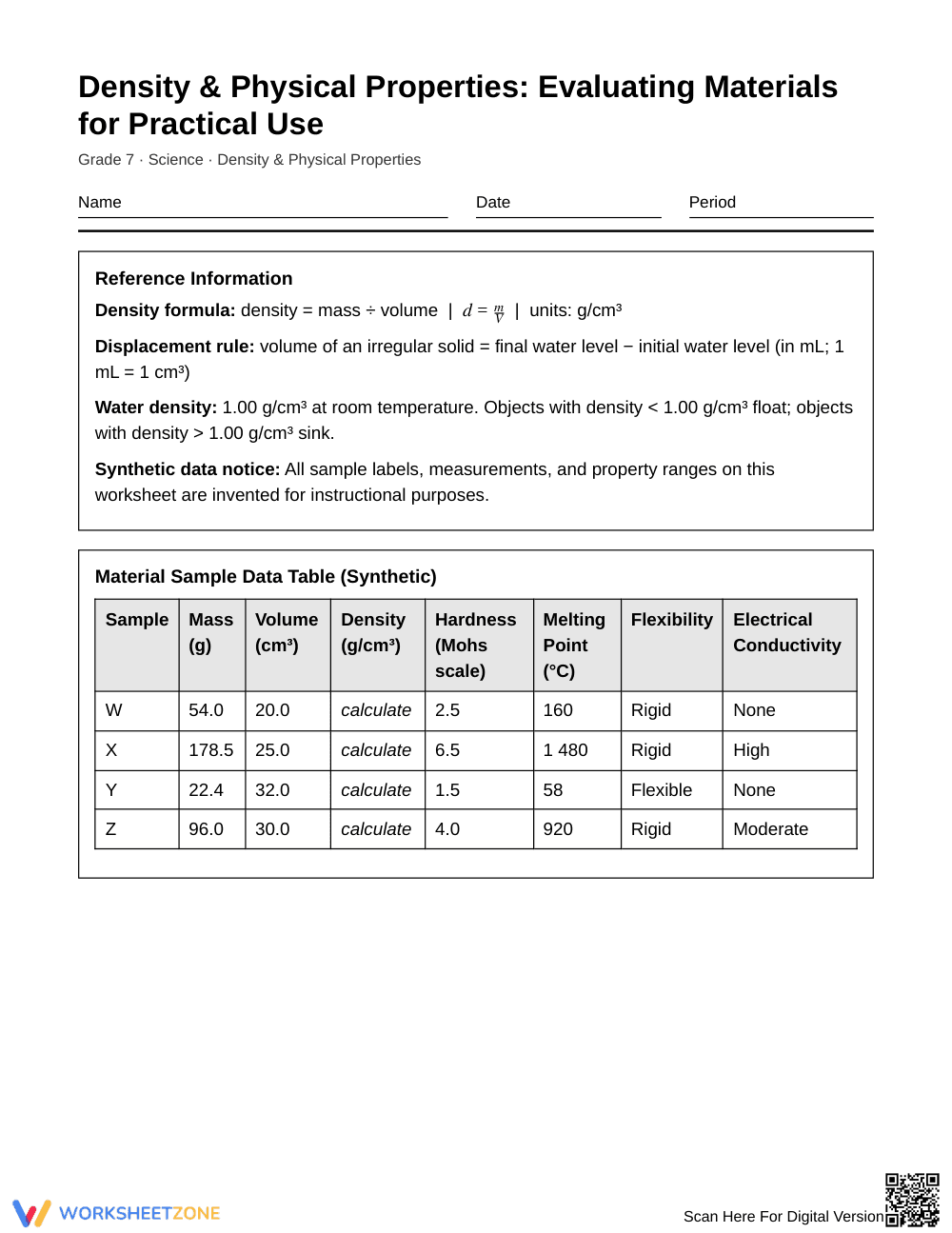
This Grade 7 physical science worksheet teaches students how to evaluate materials for practical engineering applications using density and characteristic physical properties. Students analyze synthetic material data, calculate densities, identify engineering constraints, and make evidence-based design recommendations across 10 rigorous, multi-part analytical tasks designed for middle school mastery.
At a Glance
- Grade: 7 · Subject: Science
- Standard: Analyze and interpret data on the properties of substances before and after substances interact
- Skill Focus: Evaluate a Material for a Practical Use
- Format: 5 pages · 10 problems · Answer key included · PDF
- Best For: Post-instruction application and design evaluation
- Time: 40–50 minutes
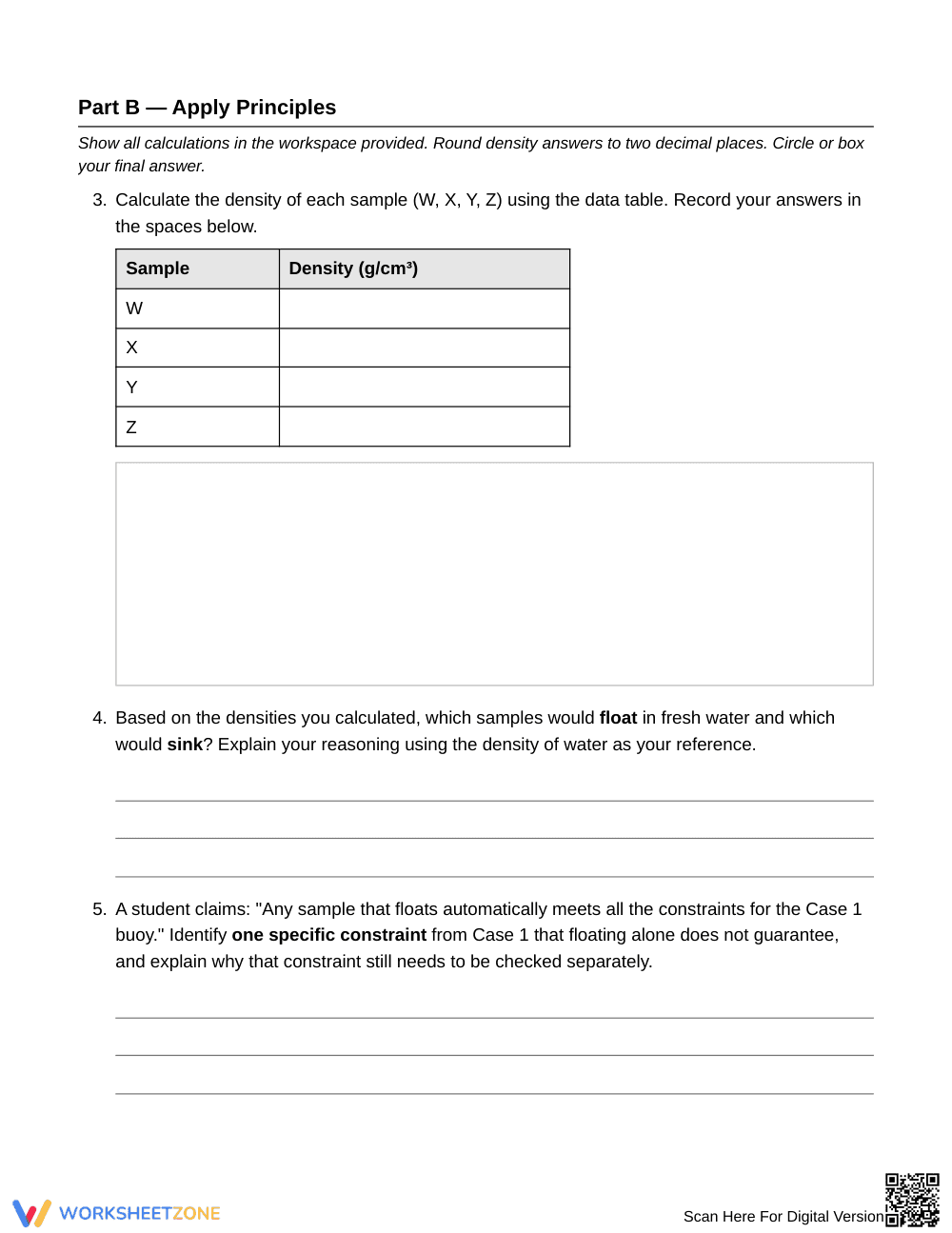
This 5-page printable resource includes reference formulas for density and displacement, a synthetic material data table with 4 distinct samples, and two engineering case studies (a floating dock buoy and an electrical contact pin). Across 10 structured items, students move from constraint identification to multi-step calculations, data-driven elimination, and evidence-based recommendation writing, accompanied by a 4-page detailed answer key.
Skill Progression
- Guided practice (Part A, 2 tasks): Students identify explicit physical properties and performance constraints from realistic engineering briefs with structured sentence stems.
- Supported practice (Part B, 6 tasks): Learners calculate density values (g/cm³), evaluate buoyancy claims, compute hollowed volume modifications, and execute systematic multi-criteria sample elimination.
- Independent practice (Part C, 2 tasks): Students critically evaluate flawed project conclusions and craft comprehensive written engineering justifications addressing trade-offs.
This intentional progression follows the gradual release of responsibility model, guiding learners from basic property identification to independent engineering evaluation.
Standards Alignment
This resource aligns with middle school physical science standards requiring students to analyze and interpret data on the physical and chemical properties of materials to determine appropriate uses. It reinforces density calculations, measurement uncertainty, and criteria-driven engineering design. The alignment details can be copied directly into lesson plans, IEP goals, or district curriculum mapping tools.
How to Use It
Use this worksheet after direct instruction on density calculations and characteristic physical properties. In a mid-unit application lab, students can work in pairs to analyze the buoy and contact pin cases during a 45-minute block. Alternatively, assign it as an independent summative performance task. During work time, formatively assess whether students check all constraints in Part C rather than stopping at buoyancy alone.
Who It's For
This activity is designed for Grade 7 general science and physical science students developing data analysis and engineering literacy. Scaffolded reference tables support emerging learners, while open-ended constraint evaluations challenge advanced students. Pair this worksheet with a hands-on water displacement lab or an anchor chart on characteristic physical properties.
According to research by Fisher & Frey (2014) on the gradual release of responsibility, structured transitions from guided constraint identification to independent scientific argumentation significantly enhance middle school students' data literacy and conceptual retention. This 5-page worksheet implements this evidence-based framework through 10 scaffolded tasks centered on evaluating materials for practical engineering use using density and physical properties. Students begin by extracting explicit operational requirements from technical briefs, progress through quantitative density computations and multi-variable elimination matrices, and culminate in complex written evaluations that weigh material trade-offs. By grounding abstract physical properties in concrete engineering scenarios such as flotation buoys and electrical contact pins, the resource builds rigorous analytical reasoning. Middle school educators can utilize this 40 to 50 minute instructional tool to measure student mastery of physical property evaluation and criteria-based decision making with complete confidence.


