































Essential Equivalent Fractions and Decimals: Patterns

Paste this activity's link or code into your existing LMS (Google Classroom, Canvas, Teams, Schoology, Moodle, etc.).
Students can open and work on the activity right away, with no student login required.
You'll still be able to track student progress and results from your teacher account.
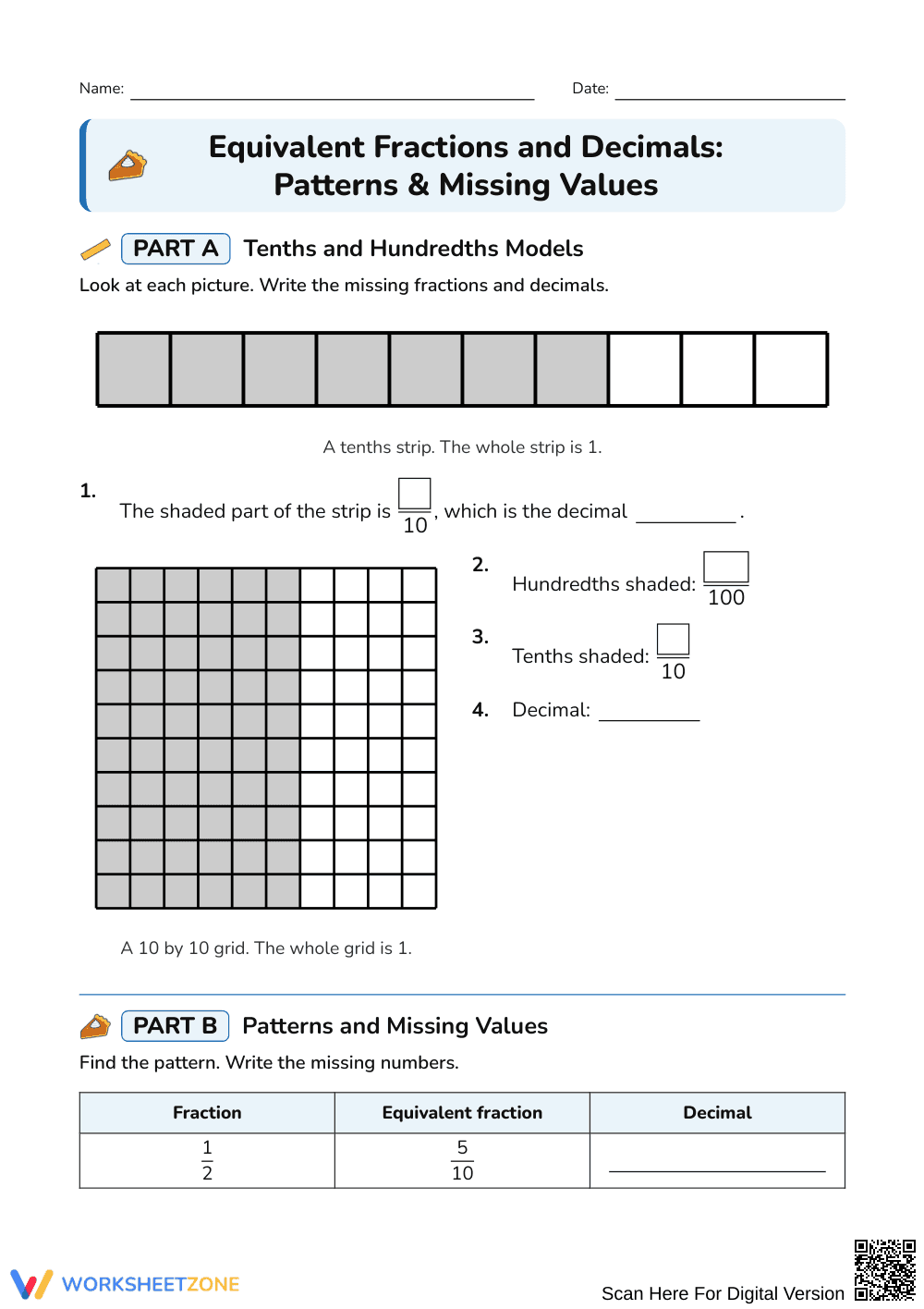
This Grade 4 math worksheet builds conceptual understanding of decimal notation and equivalent fractions through visual models and completion tasks. Students solve 18 targeted problems linking tenths and hundredths, transitioning from area grids to numerical conversions and written explanations to demonstrate mathematical equivalence.
At a Glance
- Grade: 4 · Subject: Math
- Standard:
4.NF.C.6— Use decimal notation for fractions with denominators 10 or 100- Skill Focus: Connecting equivalent fractions and decimals through missing values
- Format: 2 student pages · 18 problems · Answer key included · PDF
- Best For: Small-group practice and conceptual skill consolidation
- Time: 25–35 instructional minutes
What's Inside
This 2-page worksheet includes 18 tasks across three parts. Part A uses shaded tenths strips and hundredths grids to connect fractions and decimals. Part B presents completion tables, equivalent ratios, and number sequences. Part C prompts students to evaluate mathematical reasoning, compare distances, and explain equivalent decimals. A 2-page answer key provides complete solutions.
Skill Progression
- Guided Practice (Part A, 4 tasks): Students inspect area models to connect shaded tenths and hundredths to decimal values.
- Supported Practice (Part B, 11 tasks): Learners complete pattern tables, find equivalent fractions, and extend decimal sequences.
- Independent Practice (Part C, 3 tasks): Students evaluate claims, compare fractions to decimals, and justify answers in writing.
This sequence reflects the gradual release of responsibility model, guiding learners from visual scaffolds to independent justification.
Standards Alignment
This worksheet aligns to primary standard `4.NF.C.6`: Use decimal notation for fractions with denominators 10 or 100. It also reinforces supporting standard `4.NF.C.5` by requiring students to convert tenths to hundredths before comparing representations. Both standard codes can be copied directly into lesson plans, IEP goals, or district curriculum mapping tools.
How to Use It
Use this resource during small-group instruction immediately after teaching decimal equivalents, or assign it as an independent practice checkpoint before an assessment. While students work, verify whether they recognize 0.5 and 0.50 as equal amounts rather than viewing 0.50 as greater. Students typically complete all 18 tasks in 25 to 35 minutes.
Who It's For
This worksheet is ideal for Grade 4 general education classrooms, math intervention groups, and fifth-grade review. Pair it with a visual hundredths grid anchor chart for students requiring ongoing pictorial support.
Aligned to standard 4.NF.C.6, this Grade 4 worksheet develops student proficiency in expressing fractions with denominators 10 and 100 as decimals using visual models, equivalent pattern chains, and written mathematical justifications. Grounded in the gradual release framework described by Fisher & Frey (2014), the structured transition from concrete area models to abstract numerical conversions guides learners toward durable conceptual understanding. By prompting students to analyze place-value equivalence, complete missing ratios, and explain why values like 0.5 and 0.50 represent equal amounts, the 18 problems address persistent decimal misconceptions identified in national assessments. Educators can deploy the two-page document during tier-one core instruction, targeted small-group intervention, or formative review sessions to verify that students bridge the critical gap between rational fractions and base-ten decimal notation before tackling complex decimal operations in subsequent upper-elementary mathematics units.


