




























Views
Downloads



Essential Equal-Volume Prisms Worksheet | Grade 6 Math

Paste this activity's link or code into your existing LMS (Google Classroom, Canvas, Teams, Schoology, Moodle, etc.).
Students can open and work on the activity right away, with no student login required.
You'll still be able to track student progress and results from your teacher account.
This Grade 6 geometry worksheet helps students explore the relationship between surface area and volume across 12 structured problems. Learners use 2D nets to calculate surface area, compare rectangular prisms with equal volumes, and analyze packaging efficiency to build deep conceptual measurement understanding.
At a Glance
- Grade: 6 · Subject: Math
- Standard:
6.G.A.4— Use nets to find surface areas of 3D figures- Skill Focus: Compare surface areas of equal-volume rectangular prisms
- Format: 5 pages · 12 problems · Answer key included · PDF
- Best For: Geometry practice and conceptual optimization tasks
- Time: 40–50 minutes
What's Inside
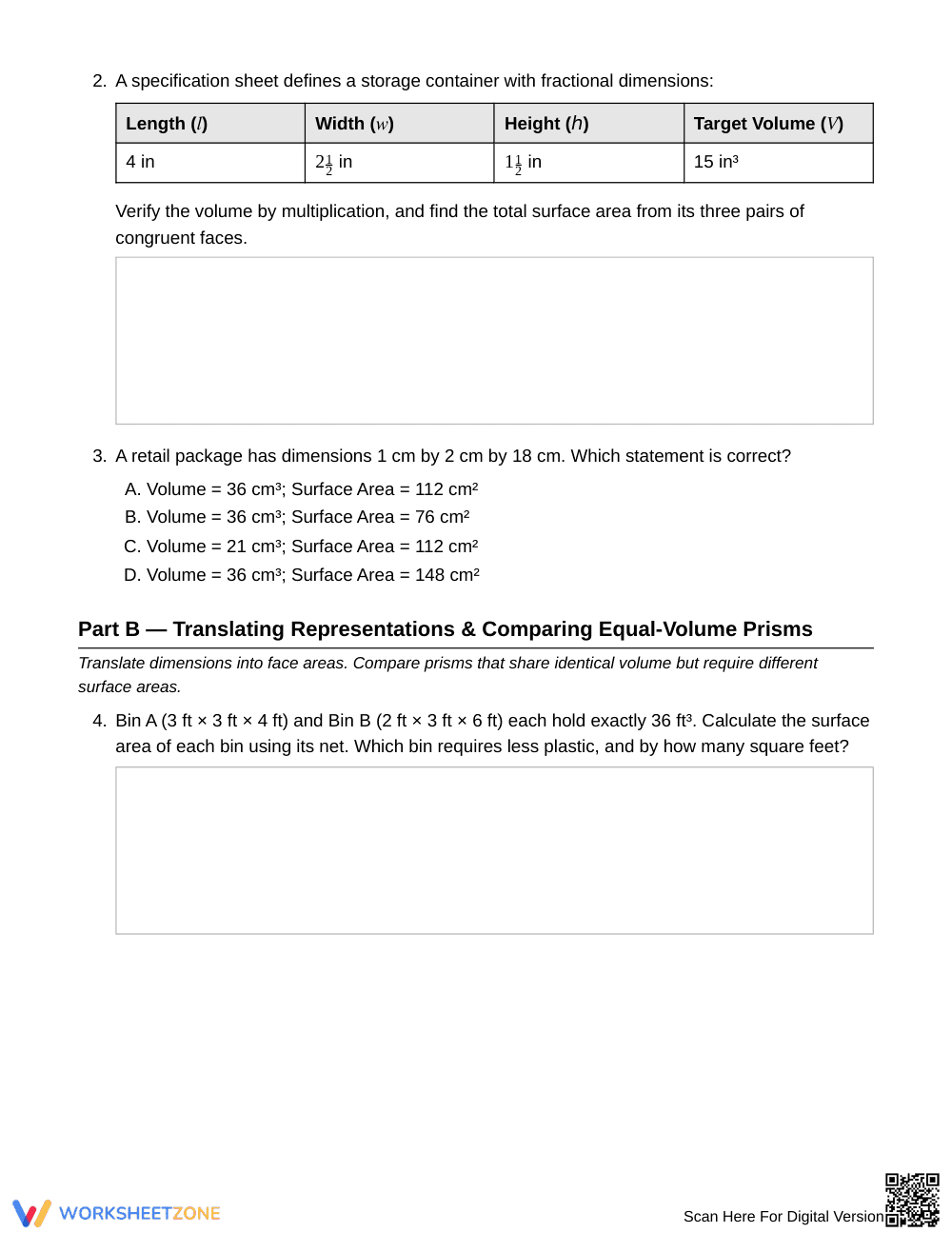
This 5-page printable geometry resource features 12 multi-step problems. Students analyze net diagrams, complete calculation tables with fractional dimensions, and answer written explanation prompts. A 2-page answer key provides step-by-step surface area calculations and complete explanations for every task.
Skill Progression
- Guided practice (Problems 1–3): Students read net diagrams and verify volumes with fractional dimensions using visual scaffolds.
- Supported practice (Problems 4–9): Students complete structured tables and compare surface areas of equal-volume prisms.
- Independent practice (Problems 10–12): Students analyze student errors and explain why compact shapes minimize surface area.
This structure follows a gradual-release model, moving students from basic net calculations to higher-order geometric reasoning.
Standards Alignment
This worksheet aligns with 6.G.A.4: Represent three-dimensional figures using nets to find surface area in mathematical and real-world contexts. It also supports 6.G.A.2 by applying fractional side lengths to compute prism volume. Both standard codes can be copied directly into lesson plans, IEP goals, or district curriculum mapping tools.
How to Use It
Use this worksheet after direct instruction on surface area nets. Assign Part B for partner collaboration to compare how dimensions alter material efficiency. During work time, observe whether students confuse base area with total surface area in Problem 11. Completion takes 40 to 50 minutes.
Who It's For
This resource serves Grade 6 math students, geometry intervention groups, and accelerated learners. Visual nets support spatial thinkers, while packaging prompts offer rigorous extension. Pair this activity with folding paper nets during initial direct instruction.
According to Fisher & Frey (2014), structured progression through guided, collaborative, and independent phases significantly deepens conceptual understanding in middle school mathematics. This Grade 6 geometry resource directly supports standard 6.G.A.4 by requiring students to calculate surface area from nets and evaluate equal-volume rectangular prisms. Rather than treating surface area and volume as isolated formulaic procedures, the 12 targeted tasks prompt learners to examine how dimensional variations alter material requirements while internal capacity remains fixed. Through guided net interpretation, tabular comparisons, and written justification tasks, students bridge procedural computation and conceptual spatial reasoning. Research demonstrates that confronting common geometric misconceptions—such as assuming equivalent volumes produce identical surface areas—builds durable problem-solving schema. Teachers can reliably utilize this resource to reinforce standards-based spatial measurement skills, monitor individual student mastery, and facilitate rigorous classroom discourse around mathematical optimization principles.


