


























Views
Downloads



Essential Epicenter Location Worksheet | Grade 8 Science
Paste this activity's link or code into your existing LMS (Google Classroom, Canvas, Teams, Schoology, Moodle, etc.).
Students can open and work on the activity right away, with no student login required.
You'll still be able to track student progress and results from your teacher account.
This Earth science worksheet enables Grade 8 students to analyze seismic travel-time data and explain why a single station cannot identify a unique earthquake epicenter. Across 10 analytical problems, students calculate epicentral distance from S−P lag times, map distance boundaries, and justify three-station triangulation.
At a Glance
- Grade: 8 · Subject: Science
- Standard: Earth & Space Science — Analyze seismic wave data to explain epicenter location mechanics
- Skill Focus: Single-station epicenter ambiguity and triangulation
- Format: 5 pages · 10 problems · Answer key included · PDF
- Best For: Earthquake wave unit practice
- Time: 45–60 minutes
This 5-page worksheet includes a calibrated travel-time reference table, single-station computational scenarios, coordinate-plane fault intersections, and multi-model hypothesis evaluations. A complete 4-page answer key provides step-by-step mathematical calculations and complete scientific explanations.
Skill Progression
- Guided practice (Problems 1–4): Students calculate S−P lag times using the reference table and describe the circular geometric ambiguity of single-station data.
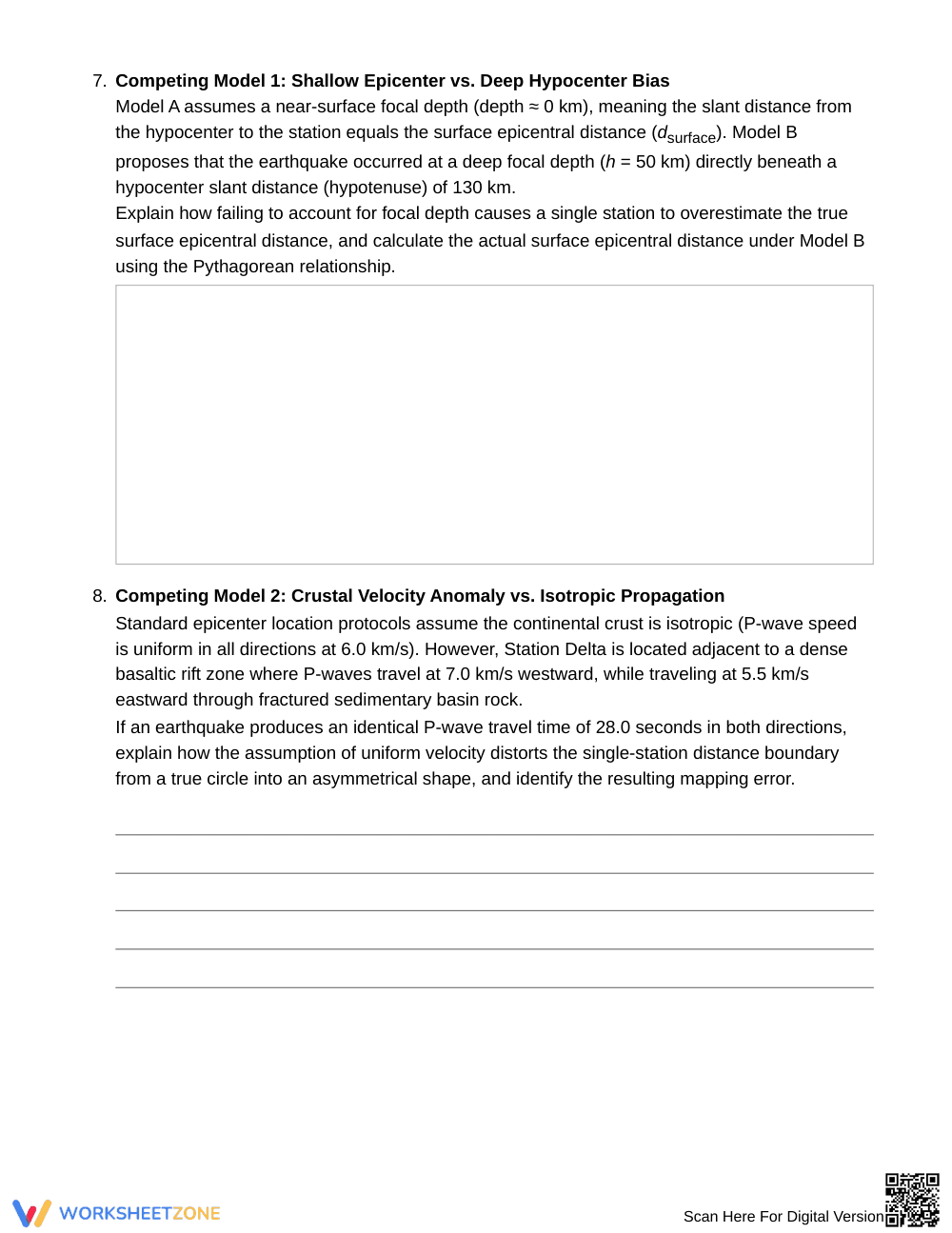
- Supported practice (Problems 5–8): Learners intersect distance circles with fault lines, analyze coordinate hazards, and calculate focal depth distortions.
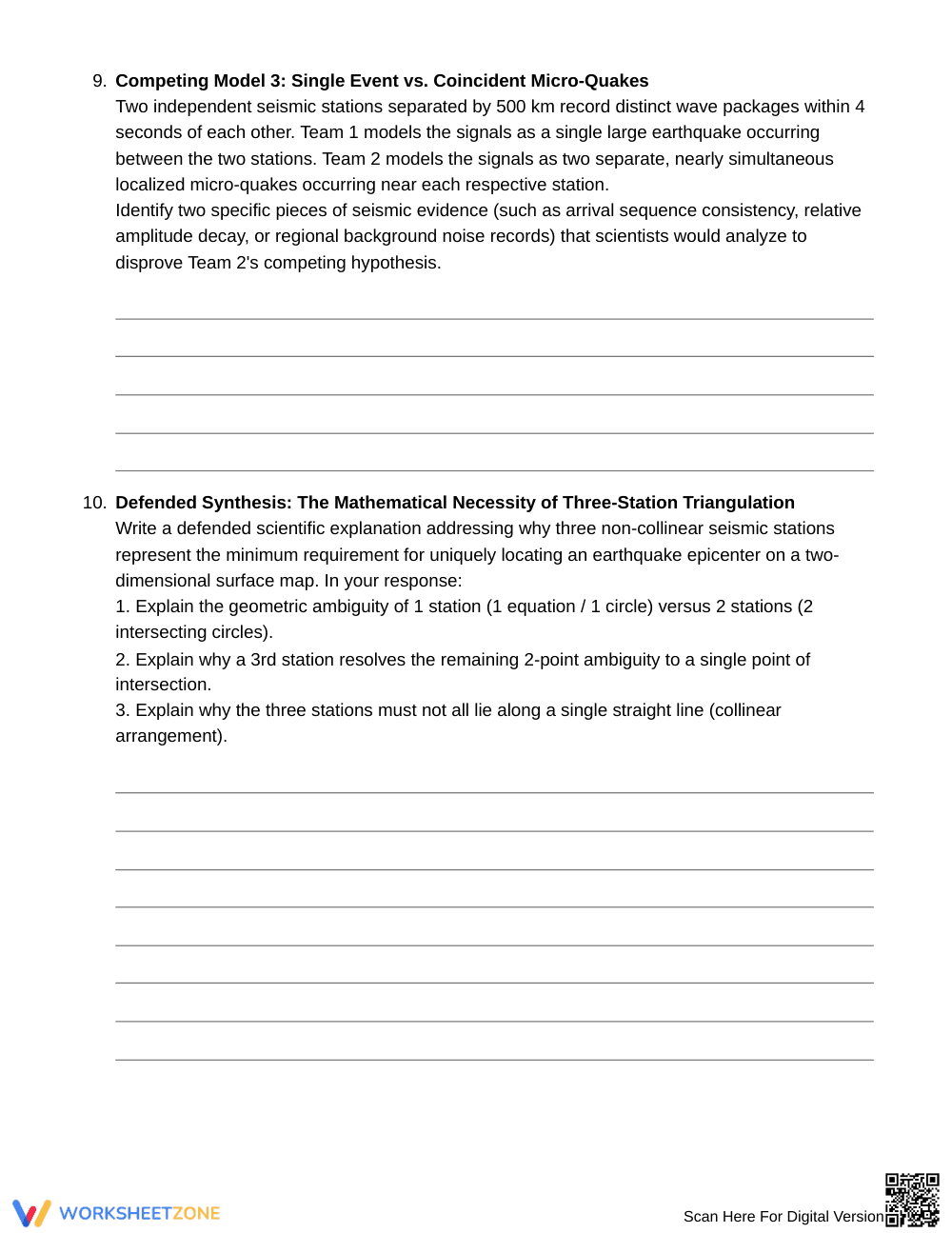
- Independent practice (Problems 9–10): Students evaluate competing micro-quake hypotheses and defend the necessity of three-station triangulation.
This sequence implements a gradual-release model moving from computational data extraction to rigorous spatial synthesis.
Standards Alignment
This worksheet aligns with middle school Earth and Space Science standards on seismic wave propagation and epicenter location geometry. Supporting physical science concepts include calculating wave speed and distance. Both standard concepts can be copied directly into lesson plans, IEP goals, or district curriculum mapping tools.
How to Use It
Assign after direct instruction on seismic body waves or use Part B as a collaborative partner activity. For formative assessment, inspect Problem 2 to verify students understand that one station yields a distance radius rather than a direction. Expected completion time is 45 to 60 minutes.
Who It's For
Designed for Grade 8 Earth science and introductory physical science students. Built-in reference data supports developing learners, while coordinate geometry challenges advanced students. Pair with a hands-on compass triangulation mapping lab.
According to research highlighted by Fisher & Frey (2014), structured problem progressions with explicit data reference tables significantly enhance middle school students' ability to transfer abstract physical principles to authentic analytical tasks. When eighth-grade science learners investigate seismic wave mechanics, conceptualizing the S-P lag time as a non-directional distance radius requires coordinating multiple mathematical and spatial representations. This 10-problem Earth science worksheet scaffolds the transition from basic travel-time interpretation to complex multi-station geometric modeling, directly addressing persistent student misconceptions regarding single-station directionality. By requiring learners to calculate distance circles, evaluate focal depth biases, and justify the mathematical necessity of three non-collinear seismograph stations, the resource builds rigorous scientific argumentation skills. Educational evaluation data demonstrate that systematic scaffolded practice in geoscience data analysis promotes deeper conceptual retention, preparing students for advanced secondary Earth systems investigations.


