


























Views
Downloads




Essential Epicenter-Distance Inference Worksheet | Grade 8
Paste this activity's link or code into your existing LMS (Google Classroom, Canvas, Teams, Schoology, Moodle, etc.).
Students can open and work on the activity right away, with no student login required.
You'll still be able to track student progress and results from your teacher account.
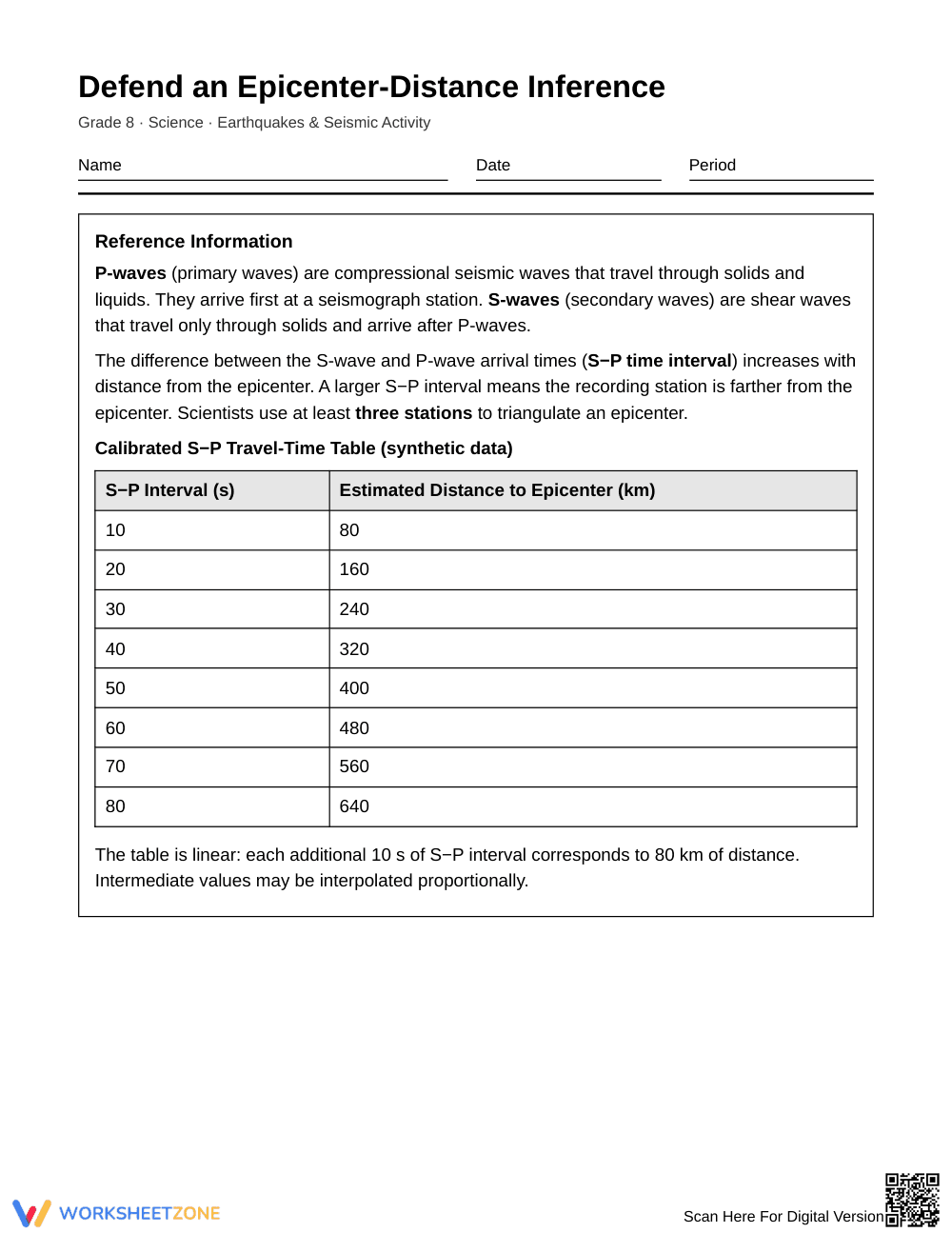
This Grade 8 Science worksheet builds students' ability to defend an epicenter-distance inference using seismic wave data. Across 8 carefully sequenced tasks, students analyze synthetic seismograph records, calculate epicenter distances from S−P time intervals, and construct evidence-based arguments about which fault zone produced an earthquake. By the final task, students can evaluate competing scientific claims and identify reasoning flaws—core skills for middle-school earth science.
At a Glance
- Grade: 8 · Subject: Science
- Skill Focus: Defend an epicenter-distance inference
- Format: 5 pages · 8 problems · Answer key included · PDF
- Best For: Practice after seismic-wave direct instruction
- Time: 30–45 minutes
What's Inside
The worksheet opens with a reference box defining P-waves and S-waves, followed by a calibrated S−P travel-time table students use throughout. A synthetic seismic-arrival scenario provides data from three stations recording the same earthquake. Tasks span three parts across 5 pages: evidence identification with a data table to complete, evidence-to-mechanism explanations written in complete sentences, and competing-claim evaluations requiring multi-station reasoning. A 4-page answer key supplies model responses for every item.
Skill Progression
- Guided practice (Items 1–2): Students identify quantitative evidence from arrival records and use the provided travel-time table to calculate distances.
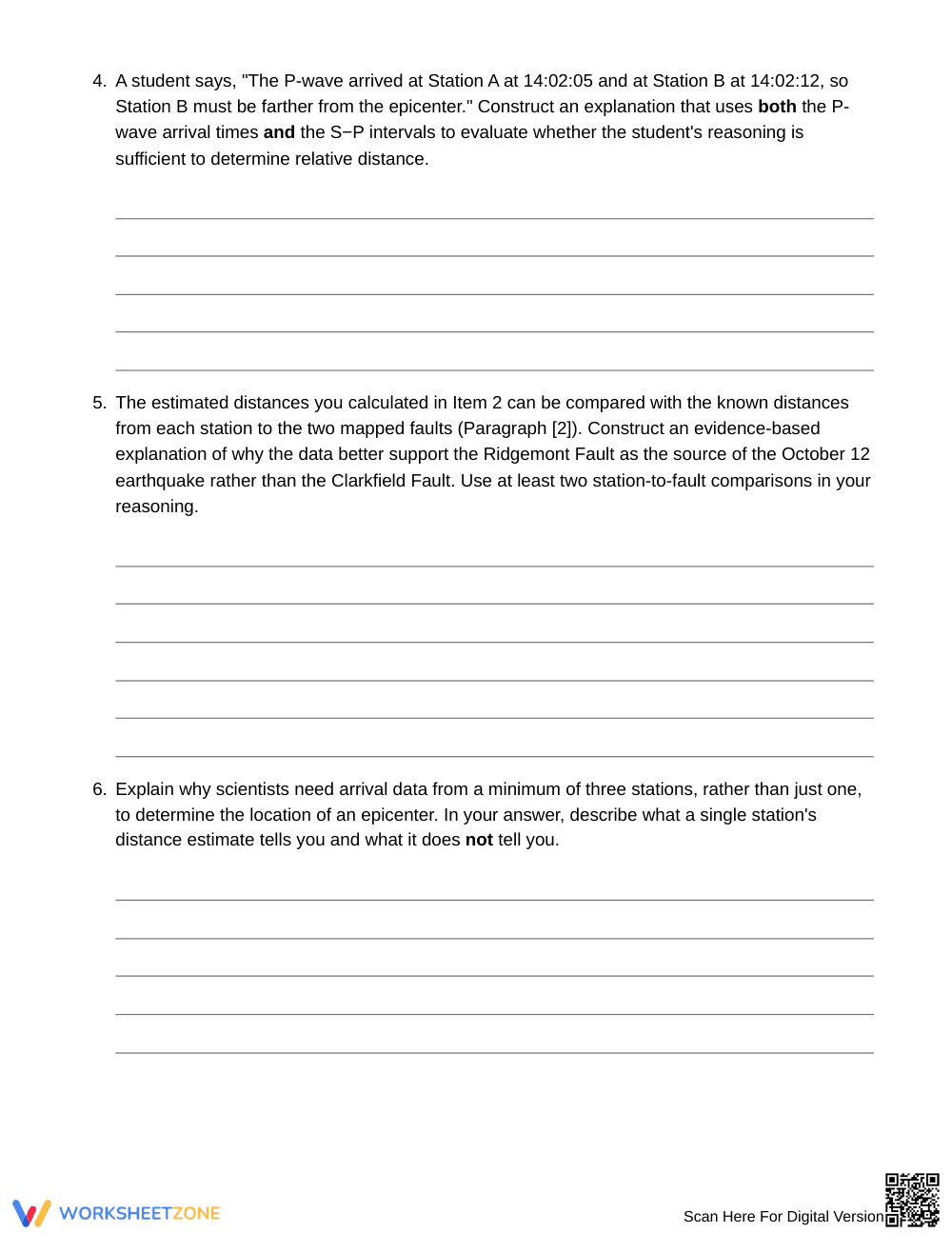
- Supported practice (Items 3–6): Students write multi-sentence explanations connecting wave-speed differences to S−P intervals, evaluate a peer's incomplete reasoning about P-wave arrivals, compare station-to-fault distances to defend one fault over another, and explain why triangulation requires three stations.
- Independent practice (Items 7–8): Students evaluate two pairs of competing scientist claims, defend the stronger claim with evidence from all three stations, and identify the specific flaw in the weaker claim.
How to Use It
Assign the worksheet after direct instruction on seismic waves and triangulation. Students who complete Part A during guided practice can move into Parts B and C independently or in pairs. Use Item 5 (the fault-comparison explanation) as a formative check: if a student references only one station, prompt them to incorporate a second comparison before moving on. Expected completion time is 30–45 minutes for most eighth graders.
Who It's For
Designed for on-grade-level eighth-grade science students studying earthquakes and seismic activity. The reference box and travel-time table provide built-in support for students who need vocabulary reinforcement or computational scaffolding. Pair this worksheet with an anchor chart showing P-wave and S-wave motion diagrams to strengthen conceptual transfer for visual learners.
This five-page science worksheet asks eighth-grade students to defend an epicenter-distance inference by analyzing seismic intervals, calculating distances, and evaluating competing scientific claims. Research from the RAND AIRS 2024 report highlights that middle-school students demonstrate stronger reasoning skills when instructional tasks require them to construct and critique arguments using quantitative evidence rather than simply memorizing definitions. The eight-task sequence moves deliberately from guided data extraction through multi-station comparison to independent claim evaluation, reinforcing the gradual-release framework that enhances conceptual understanding in science classrooms. With an included answer key spanning four pages, educators can deploy this resource for focused independent practice, targeted formative assessment, or structured peer review sessions. The activity is entirely printable, requires zero digital devices, and fits neatly within a single 45-minute class period, making it a reliable option for both regular instruction and emergency substitute plans.


