































Essential Energy Diagram Worksheet | Grade 8-12 Science

Paste this activity's link or code into your existing LMS (Google Classroom, Canvas, Teams, Schoology, Moodle, etc.).
Students can open and work on the activity right away, with no student login required.
You'll still be able to track student progress and results from your teacher account.
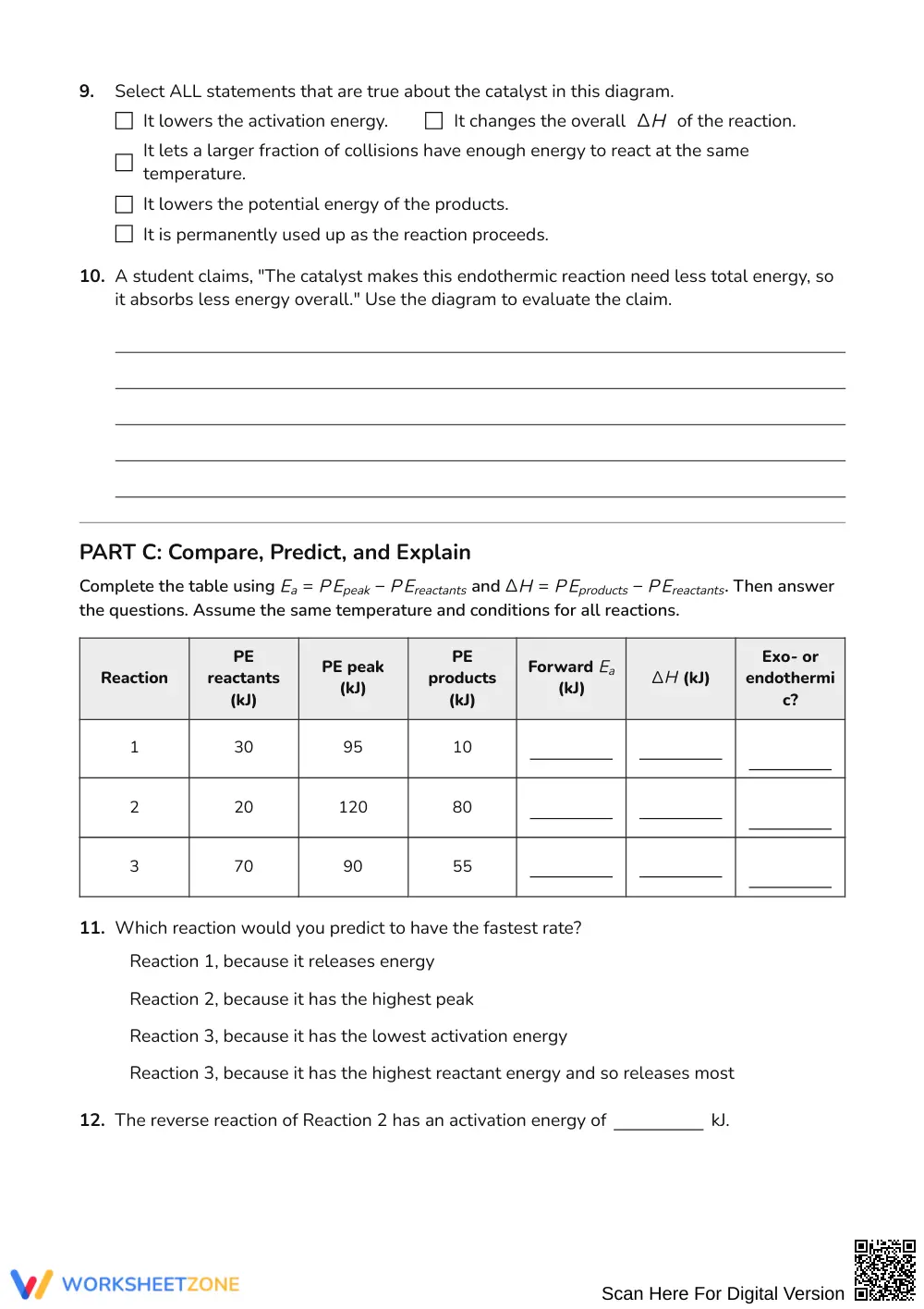
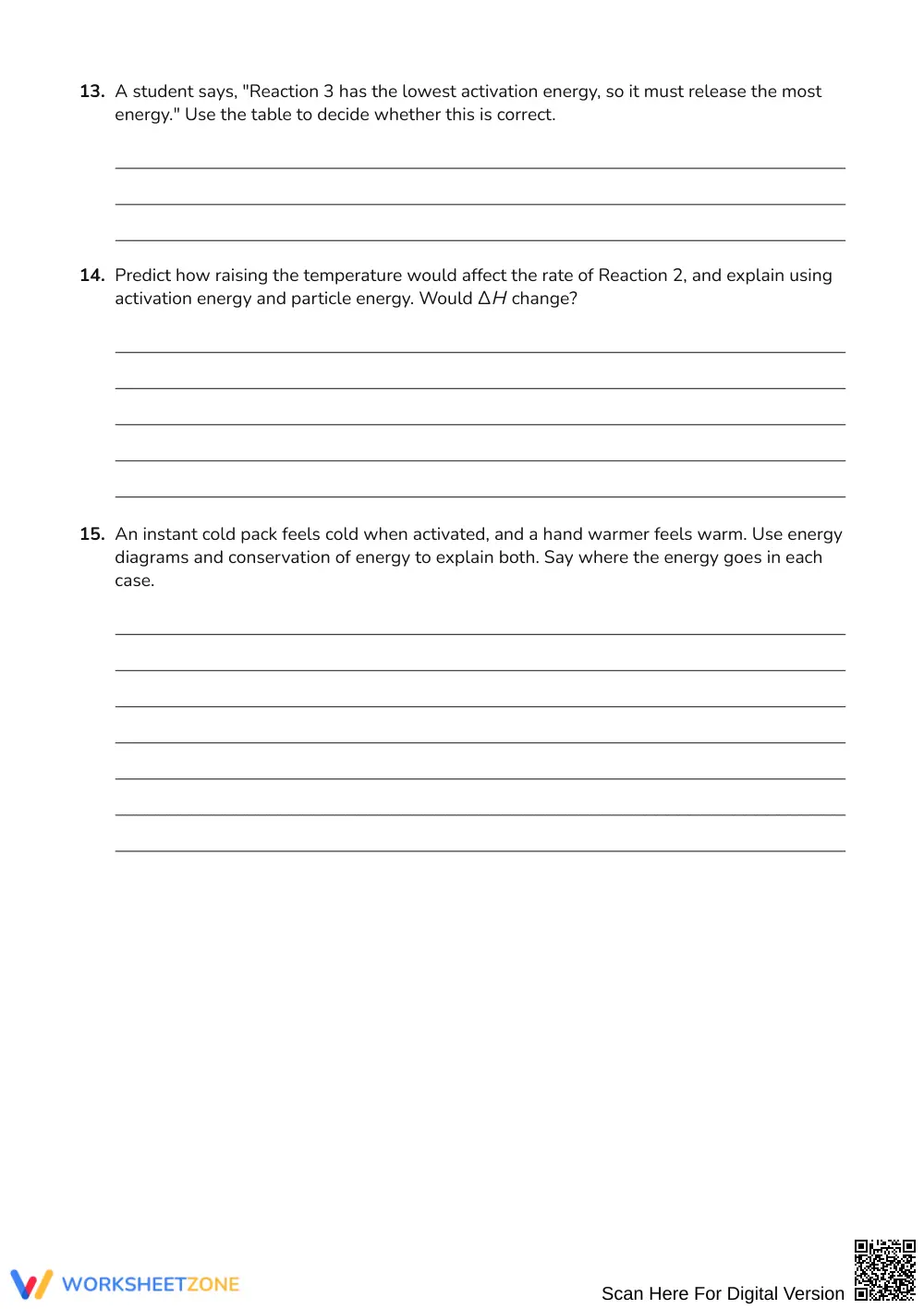
This comprehensive potential energy diagram worksheet provides secondary science students with systematic practice reading reaction coordinate graphs, calculating activation energy, and determining enthalpy changes. Through quantitative analysis and model interpretation, learners connect thermodynamic values to reaction kinetics and real-world phenomena like chemical cold packs and hand warmers.
At a Glance
- Grade: Grades 8–12 · Subject: Physical Science & Chemistry
- Standard: Interpret chemical reaction energy profiles and calculate activation energy and overall reaction enthalpy
- Skill Focus: Reaction progress curves, catalyst mechanisms, and thermochemical calculations
- Format: 4 pages · 27 problems · Answer key included · PDF
- Best For: End-of-unit review or cumulative assessment
- Time: 45–60 minutes
What's Inside
Across four rigorous pages, students encounter 27 targeted tasks spanning graphic data extraction, multi-step barrier math, and qualitative reasoning. The resource features clear coordinate graphs, comparative catalyzed reaction paths, data synthesis tables, and authentic application scenarios. A complete four-page teacher answer key provides full computational steps and conceptual explanations for every prompt.
Skill Progression
- Guided Practice: Part A establishes foundational graph reading with 8 tasks where students identify reactant, product, and peak energies, calculate forward and reverse activation energy, and evaluate enthalpy change.
- Supported Practice: Part B challenges learners with 9 tasks comparing catalyzed versus uncatalyzed curves to analyze kinetic energy barriers without altering net energy release.
- Independent Practice: Part C delivers 10 synthesis problems requiring students to complete reaction parameter tables, rank relative reaction rates, and justify heat transfer in commercial packs.
This sequence mirrors the gradual-release model, moving from structured graph extraction toward unassisted conceptual synthesis.
Standards Alignment
This worksheet aligns with national physical science standards focusing on chemical reactions and conservation of energy. Students develop models to illustrate how energy changes during chemical bond breaking and formation, calculating differences between initial states, activated complexes, and final product yields. Both standard codes can be copied directly into lesson plans, IEP goals, or district curriculum mapping tools.
How to Use It
Deploy this assessment after completing direct instruction on chemical kinetics and thermochemistry. During class, monitor student work during Part B to check for the common misconception that catalysts lower the enthalpy of reaction rather than the activation energy barrier. Plan for a 45- to 60-minute testing block or split the material across two targeted remediation periods.
Who It's For
Designed for high school chemistry, physical science, and introductory AP Chemistry courses. The clear coordinate markings support visual learners and striving readers, while Part C offers rigorous conceptual extensions for advanced students. Pair this printable with a laboratory investigation measuring temperature shifts in exothermic and endothermic dissolution reactions.
According to Fisher & Frey (2014), intentional scaffolding within structured science tasks accelerates student mastery of complex graphic models and quantitative reasoning. This 4-page reaction coordinate resource engages learners in evaluating 27 targeted prompts that bridge abstract particle kinetics with observable thermodynamic data. By systematically disentangling activation energy thresholds from net enthalpy values, the worksheet targets persistent misconceptions regarding catalyst functions and collision theory. Secondary science students practice precise mathematical calculations, calculate forward and reverse reaction barriers, and articulate the law of conservation of energy across diverse chemical systems. Independent research confirms that paired numerical tables and visual graph analysis substantially improve conceptual retention on standardized physical science assessments. The accompanying answer key provides precise explanations that assist educators in identifying specific learning gaps during formative assessments and cumulative summative reviews.


