































Essential Electronegativity Worksheet | Grades 8-12 Science

Paste this activity's link or code into your existing LMS (Google Classroom, Canvas, Teams, Schoology, Moodle, etc.).
Students can open and work on the activity right away, with no student login required.
You'll still be able to track student progress and results from your teacher account.
This comprehensive chemistry worksheet provides students with focused practice analyzing electronegativity trends and classifying chemical bond polarity. Across four structured pages, learners evaluate periodic table patterns, calculate electronegativity differences, and predict molecular properties. The resource delivers a dependable measure of student mastery following direct instruction in atomic structure and bonding.
At a Glance
- Grade: Grades 8–12 · Subject: Science
- Standard: Analyze periodic electronegativity trends and predict covalent, polar, and ionic bond types
- Skill Focus: Electronegativity Trends, Bond Polarity, and Molecular Dipoles
- Format: 4 pages · 23 problems · Answer key included · PDF
- Best For: Cumulative chemistry assessment and unit exam review
- Time: 45–60 minutes
What's Inside
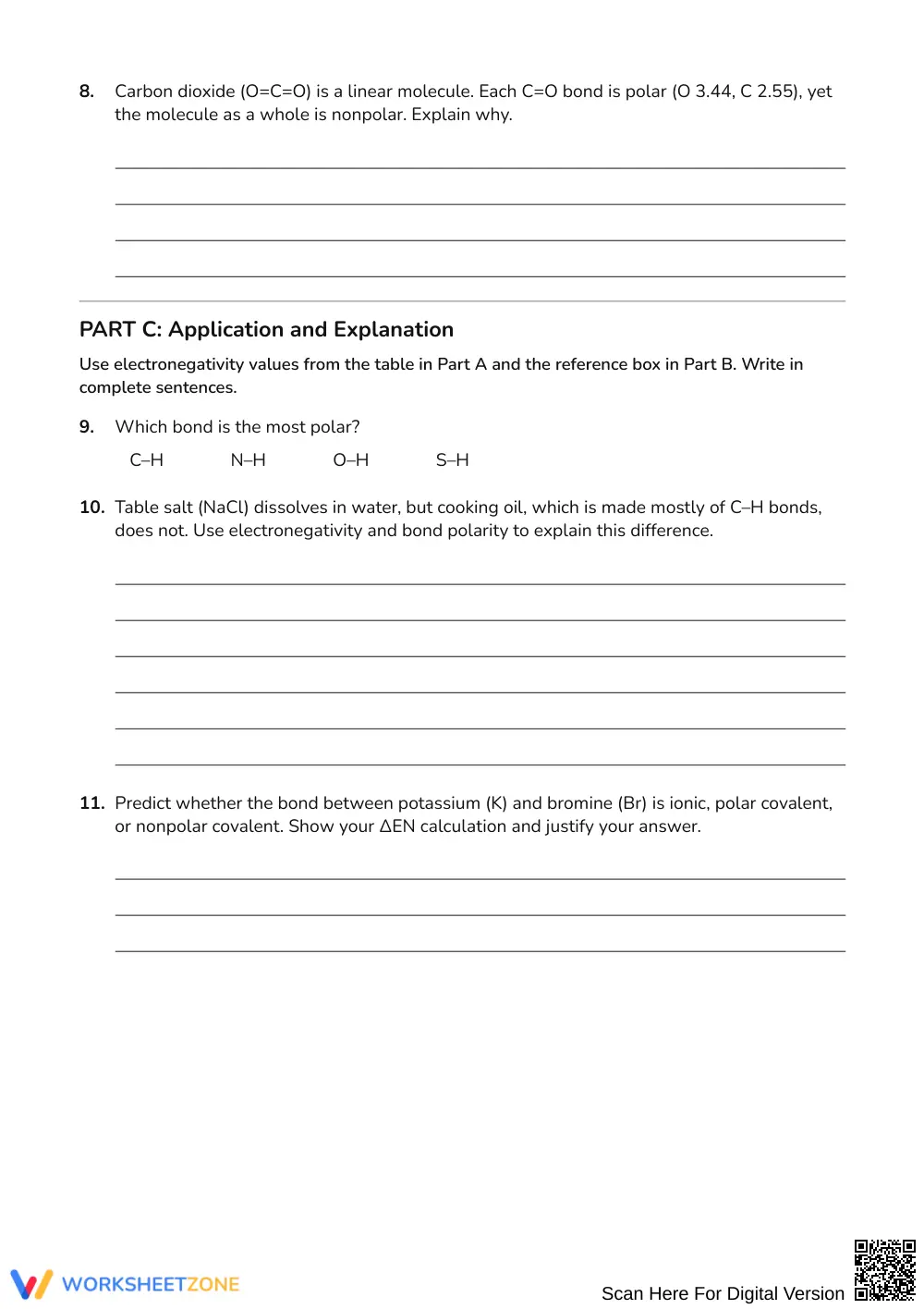
This 4-page assessment contains 23 problems across three distinct sections. Part A features a Pauling scale reference table for Periods 2 through 4 with questions on periodic trends. Part B includes an electron-cloud diagram of hydrogen chloride, a bond-type reference guide, and calculation tables. Part C delivers multi-step prompts on solubility, bond prediction, and misconception analysis, accompanied by a 4-page answer key.
Skill Progression
- Guided practice (Tasks 1–5): Students examine the Pauling electronegativity table to identify trends across periods and down groups using structured multiple-choice items.
- Supported practice (Tasks 6–18): Learners use an electron-cloud model and reference thresholds to calculate electronegativity differences and identify bond types.
- Independent practice (Tasks 19–23): Students independently explain solubility using bond polarity, predict unknown bond classifications, and evaluate student claims using structural data.
This gradual-release progression (I Do, We Do, You Do) scaffolds conceptual difficulty from data interpretation to independent evaluation.
Standards Alignment
This resource aligns with high school physical science standards requiring students to use the periodic table as a model to predict element properties based on outer electron patterns. Supporting standards address explaining macroscopic properties through molecular polarity. Both standard codes can be copied directly into lesson plans, IEP goals, or district curriculum mapping tools.
How to Use It
Administer this 4-page worksheet immediately following direct instruction on periodic trends and bond types. Use it as a 45- to 60-minute summative exam, or divide it across two days for focused review. During independent work, observe whether students account for linear symmetry in carbon dioxide; confusing polar bonds with polar molecules indicates a need for targeted geometry review.
Who It's For
This practice is suited for high school chemistry and physical science students in grades 8 through 12. Embedded reference boxes and Pauling values support learners needing memory scaffolds. Pair this assessment with an introductory chemical bonding lecture or an interactive periodic table model to consolidate core ideas.
Mastering electronegativity trends and bond polarity requires students to connect atomic structure directly to measurable chemical properties. According to Fisher & Frey (2014), structured scaffolds that transition from data analysis to independent scientific explanation significantly improve conceptual retention in secondary science classrooms. This four-page cumulative assessment reinforces core periodic trends across periods and down groups through 23 targeted tasks, requiring learners to calculate electronegativity differences, model electron density distributions, and determine molecular dipole cancellation. By evaluating student claims and justifying solubility phenomena using bond polarity principles, students build rigorous analytical habits that bridge atomic structure and molecular interactions. The complete four-page answer key provides full explanations and worked calculations, ensuring rapid diagnostic feedback for teachers. Consequently, this resource serves as an evidence-based tool for evaluating student mastery in introductory and advanced high school chemistry units.


