




























Views
Downloads



Essential Electronegativity Worksheet | Grades 8-12 Science

Paste this activity's link or code into your existing LMS (Google Classroom, Canvas, Teams, Schoology, Moodle, etc.).
Students can open and work on the activity right away, with no student login required.
You'll still be able to track student progress and results from your teacher account.
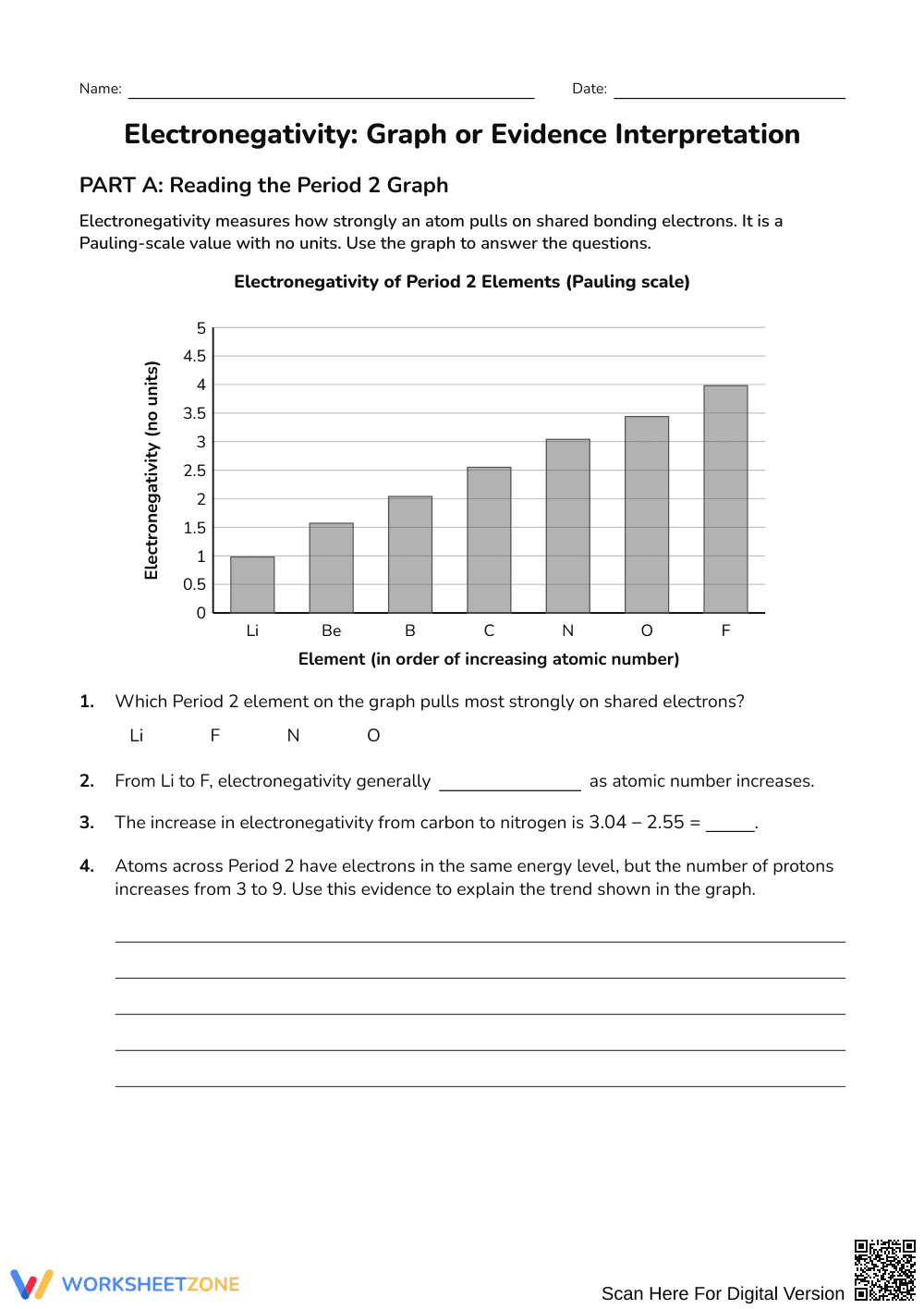
This science worksheet helps secondary students analyze periodic trends and chemical bonding through authentic data interpretation. Learners evaluate electronegativity values across periods and down groups, calculate differences to predict bond character, and construct scientific arguments using atomic structure evidence across 26 structured tasks.
At a Glance
- Grade: 8–12 · Subject: Science
- Standard: Relate periodic trends and atomic structure to chemical bonding properties
- Skill Focus: Graph and Evidence Interpretation
- Format: 4 pages · 26 problems · Answer key included · PDF
- Best For: Chemistry unit practice and data analysis
- Time: 45–60 minutes
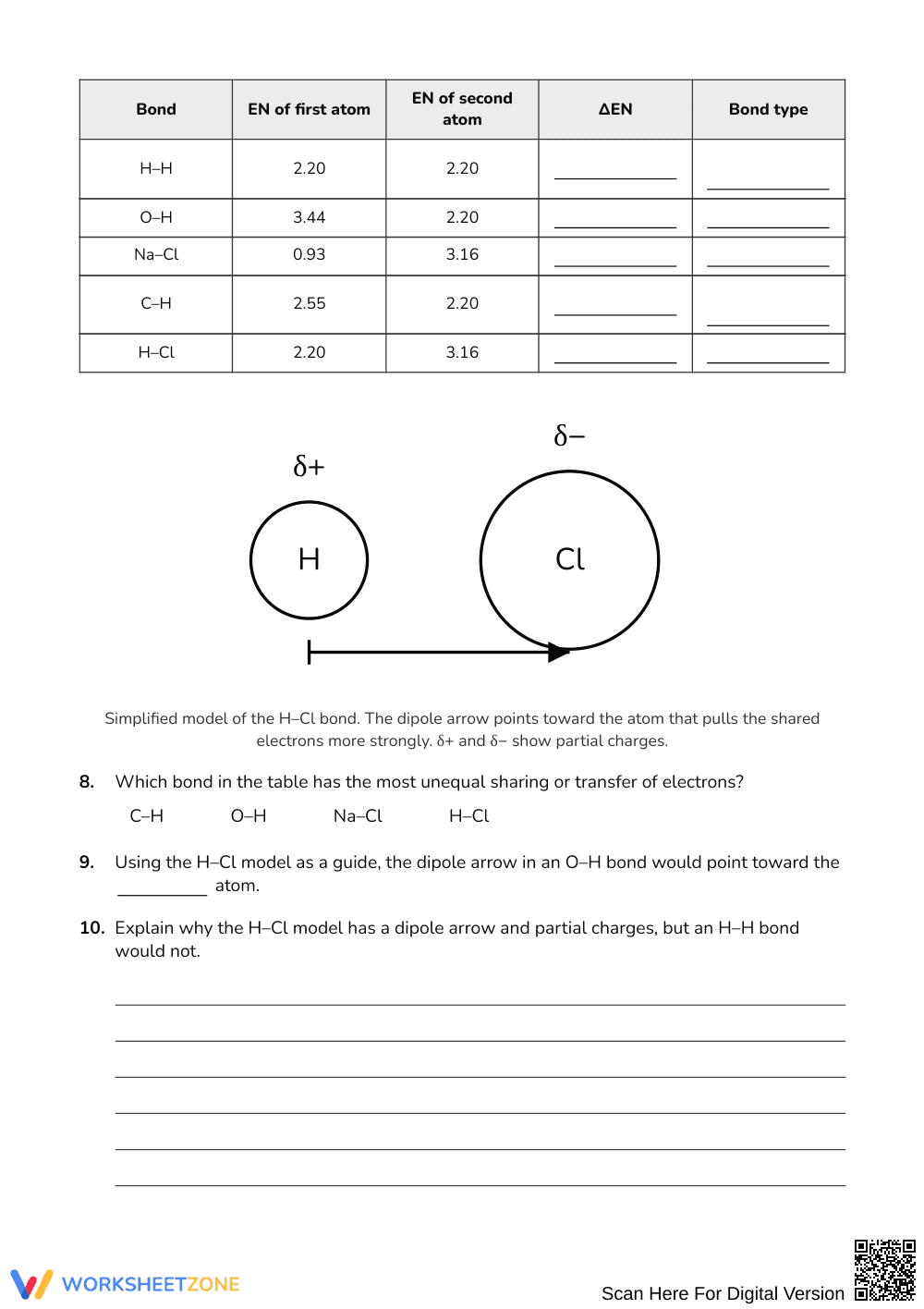
Across four pages, students examine quantitative data and visual models. The worksheet includes Pauling-scale line plots for Period 2 elements, halogen trend tables comparing atomic radii, and molecular dipole diagrams. A comprehensive four-page answer key provides complete calculations, trend rationales, and sample claim-evidence-reasoning explanations.
The 26 tasks follow a structured progression to build conceptual mastery:
- Guided practice (Part A, 7 items): High-scaffold graph interpretation where students read Period 2 values and connect increasing nuclear charge to rising electronegativity.
- Supported practice (Parts B and C, 14 items): Medium-scaffold data analysis where learners evaluate Group 17 atomic radii trends, compute differences, and categorize bond polarities.
- Independent practice (Part D, 5 items): Low-scaffold synthesis requiring students to rank polarity, construct scientific arguments, and identify limitations in bonding models.
This intentional sequence mirrors gradual release, guiding students systematically toward independent reasoning.
This resource aligns with secondary physical science standards on matter and periodicity. Paraphrasing standard expectations, learners use the periodic table to predict relative element properties and construct causal explanations based on atomic structure. Alignment details can be copied directly into lesson plans, IEP goals, or district curriculum mapping tools.
Deploy this worksheet after introducing atomic radius and electron configurations, or assign it as an exam review. For formative assessment, examine student responses in Part B to verify they attribute halogen trend drops to electron shielding rather than mass. Most learners will finish within 45 to 60 minutes.
This resource serves general and introductory chemistry students in grades 8 through 12. Teachers can differentiate by providing bond polarity cutoffs early for struggling students or prompting advanced learners to evaluate transition metals. It pairs effectively with an interactive periodic table lab or bonding lecture.
Mastering electronegativity trends requires secondary science students to integrate mathematical calculations, visual models, and atomic theory into coherent causal explanations. Research by Fisher & Frey (2014) emphasizes that gradual-release instructional designs significantly improve student performance on complex scientific argumentation tasks by anchoring abstract principles in concrete guided practice. This worksheet operationalizes that pedagogical strategy across 26 discrete items divided into four purposeful phases. Students advance from reading numerical Pauling values on Period 2 graphs to analyzing electron shielding effects down Group 17, mapping dipole charge distributions across molecular bonds, and synthesizing nuanced claim-evidence-reasoning responses. By engaging directly with quantitative differences rather than memorizing isolated rules, learners build durable mental models of chemical periodicity. The integrated four-page answer key supports immediate feedback and self-assessment, ensuring classroom educators can efficiently evaluate student mastery of physical science concepts.


