





























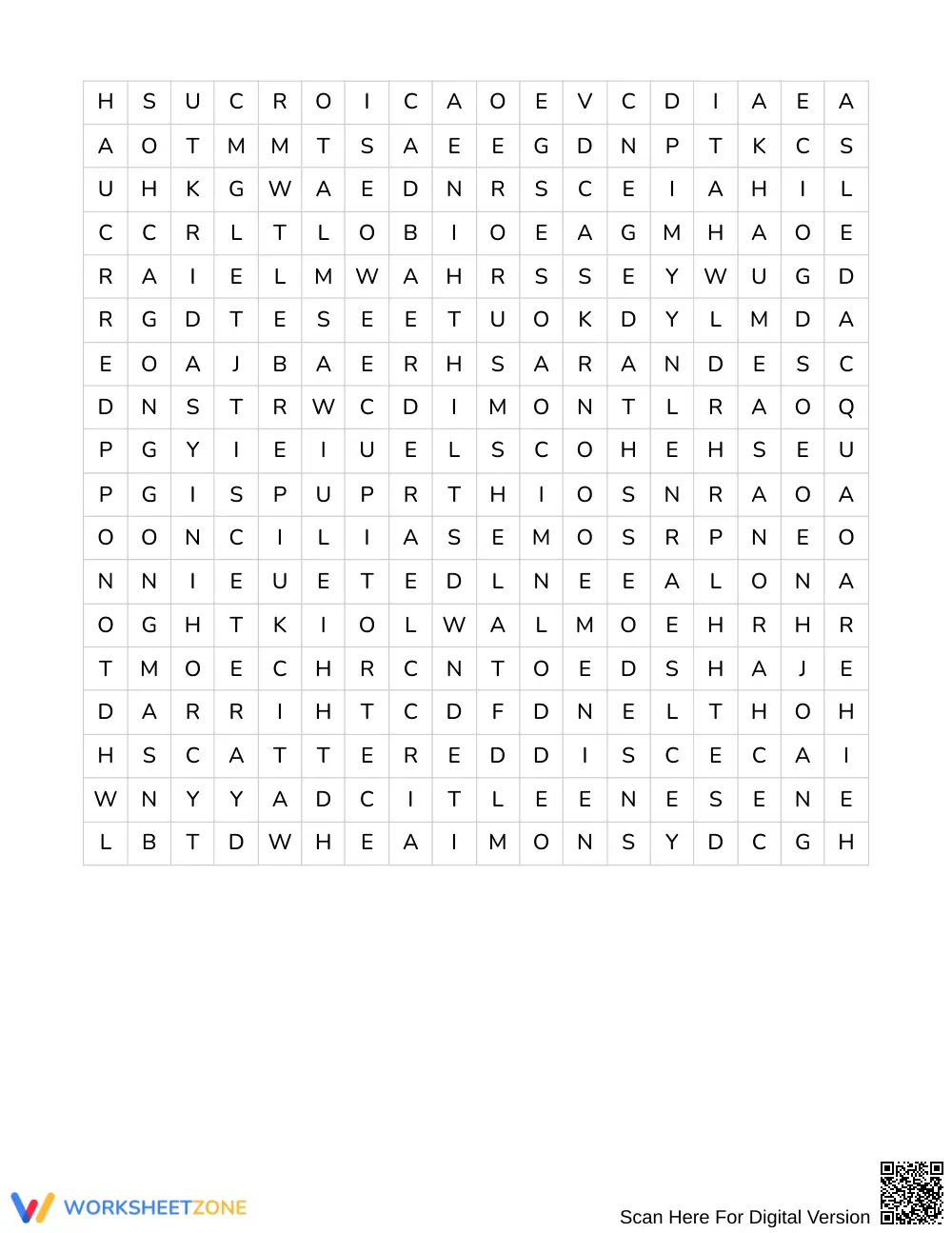


Essential Dwarf Planets Word Search | Grades 6–7 Science

Paste this activity's link or code into your existing LMS (Google Classroom, Canvas, Teams, Schoology, Moodle, etc.).
Students can open and work on the activity right away, with no student login required.
You'll still be able to track student progress and results from your teacher account.
This astronomy word search reinforces critical solar system vocabulary by challenging middle school learners to identify 16 key dwarf planet terms. Students decipher clues regarding celestial bodies, orbital mechanics, and classification criteria before locating each term across the grid. The activity consolidates conceptual understanding while promoting careful scientific reading and retention.
At a Glance
- Grade: Grades 6–7 · Subject: Science
- Standard: Not standards-assessed — vocabulary enrichment
- Skill Focus: Dwarf planets
- Format: 3 pages · 16 words · Answer key included · PDF
- Best For: Vocabulary review and extension
- Time: 25–35 minutes
This 3-page science resource presents an engaging clue-driven puzzle format without a traditional word bank. Students read 16 descriptive clues covering recognized dwarf planets, candidate bodies, related moons, and astronomical mechanics. Rather than passively scanning for terms from an alphabetized list, learners actively deduce names like Pluto, Eris, Haumea, and hydrostatic equilibrium before locating them in the puzzle. A comprehensive 4-page answer key provides clear grid solutions for rapid grading or student self-checking.
The puzzle is built on an 18 x 18 grid designed to deliver a rigorous vocabulary challenge. Because no word bank is supplied, students must read and analyze each scientific clue to identify the targeted vocabulary term. Words are hidden in all eight possible directions: north, northeast, east, southeast, south, southwest, west, and northwest. This multidirectional arrangement and clue-only structure encourages sustained focus and genuine scientific recall across all 16 terms.
This resource serves as targeted vocabulary enrichment and is not aligned to a specific state or national content standard. It deepens students' familiarity with solar system terminology, celestial classification, and orbital dynamics as covered across middle school Earth and space science curricula.
Deploy this word search during an astronomy unit after direct instruction on solar system bodies to solidify retention of minor planet terminology. Alternatively, assign it as an independent extension task for early finishers or as a ready-to-use science sub plan. As a formative assessment check, monitor whether students can determine the vocabulary terms directly from the written clues before scanning the grid. Students typically complete the 16 hidden terms within 25 to 35 minutes.
This activity is designed for Grades 6–7 science students studying planetary science, space exploration, and celestial classification. For learners needing additional support, teachers can provide the first letter of each answer or allow reference to astronomy notes. For advanced learners, prompt them to write an additional observational fact for each discovered body. Pair this puzzle with an introductory textbook reading on the Kuiper belt or an anchor chart showing planetary orbits.
Vocabulary acquisition in secondary science requires deliberate cognitive engagement rather than passive rote memorization. According to Fisher & Frey (2014), intentional word-learning tasks that require students to connect descriptive domain-specific definitions to scientific terminology significantly enhance retention and conceptual mastery. This 16-word dwarf planets word search applies that research by withholding a direct word bank, requiring Grades 6–7 learners to analyze clue descriptions of orbital resonance, hydrostatic equilibrium, and Kuiper belt bodies before searching the grid. Moving beyond simple visual scanning, students actively retrieve complex space science concepts including planetary clearing criteria and trans-Neptunian object dynamics. The multi-directional puzzle architecture reinforces orthographic memory while contextual clues anchor abstract astronomical classifications into long-term schema. When integrated into astronomy instruction, clue-based vocabulary challenges provide educators with clear evidence of student conceptual comprehension and scientific literacy progression.


