































Essential Dominance Patterns Worksheet | Grade 10 Biology

Paste this activity's link or code into your existing LMS (Google Classroom, Canvas, Teams, Schoology, Moodle, etc.).
Students can open and work on the activity right away, with no student login required.
You'll still be able to track student progress and results from your teacher account.
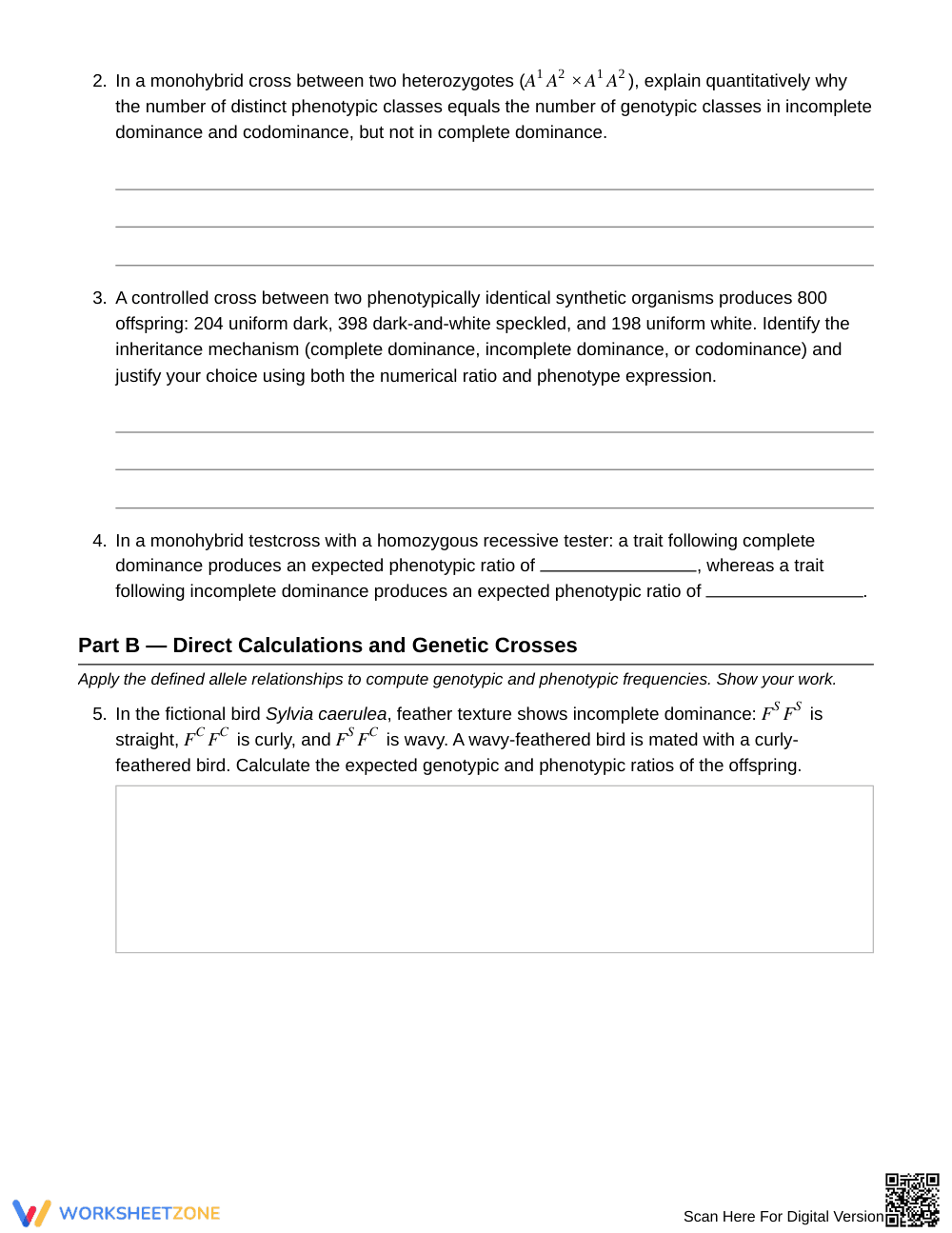
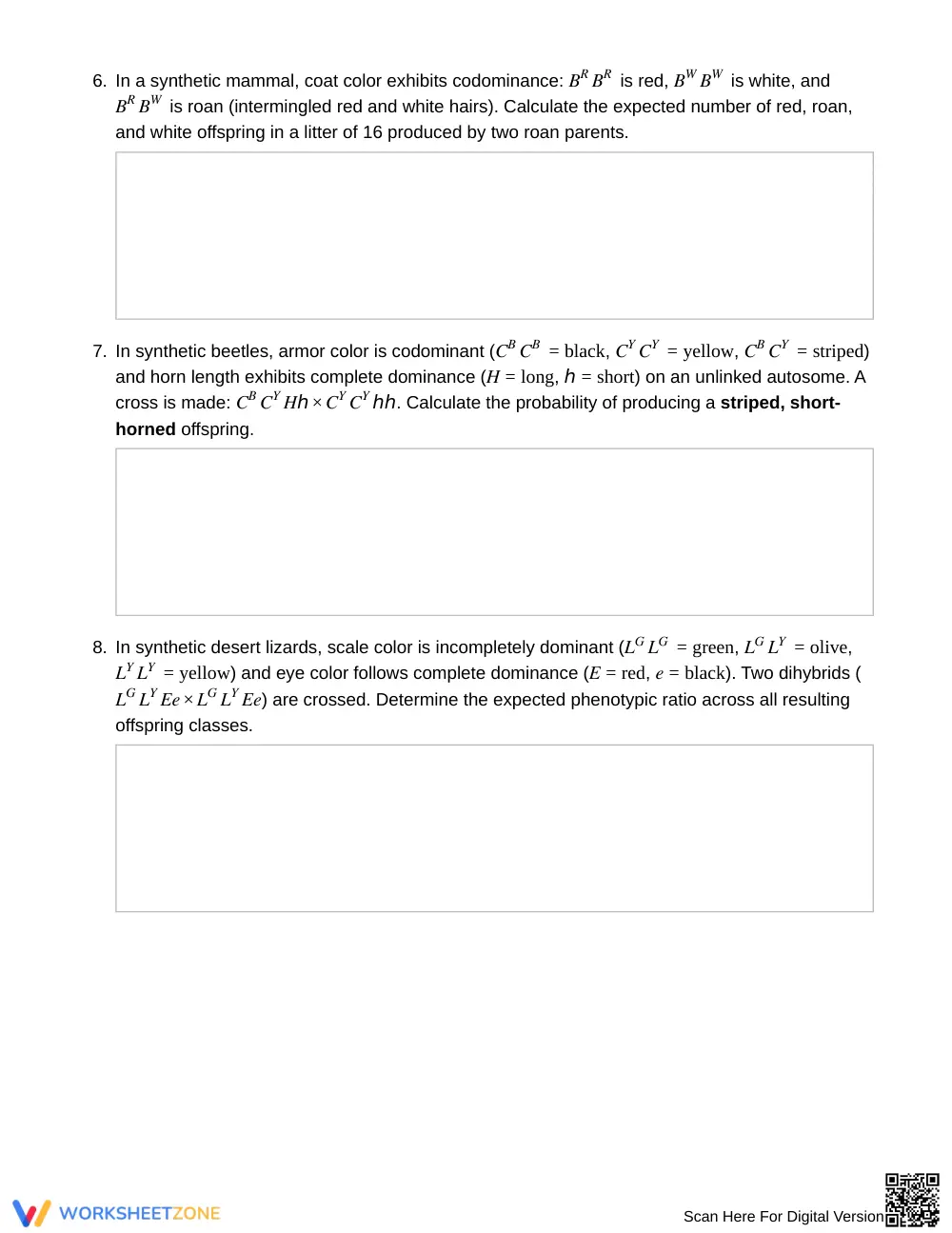
This genetics practice worksheet strengthens tenth-grade biology students' ability to differentiate between complete dominance, incomplete dominance, and codominance. Students analyze theoretical scenarios, calculate expected genotypic and phenotypic ratios, and evaluate biological claims using quantitative data to build conceptual mastery of non-Mendelian inheritance mechanisms.
At a Glance
- Grade: 10 · Subject: Biology
- Standard: Mendelian Genetics — Predict phenotypic and genotypic ratios across diverse inheritance patterns
- Skill Focus: Complete Dominance, Codominance, and Incomplete Dominance
- Format: 5 pages · 12 problems · Answer key included · PDF
- Best For: Post-instruction genetics reinforcement and review
- Time: 45–60 minutes
The 5-page worksheet includes 12 genetics problems supported by an introductory reference table of phenotypic ratios. Tasks span conceptual distinctions, multi-allele calculations, dihybrid probability problems, and claim evaluations. A 3-page answer key provides step-by-step ratio derivations and detailed explanations for immediate verification.
Skill Progression
- Guided Practice (Part A, Problems 1–4): Students analyze foundational distinctions and testcross scenarios using a summary table of 3:1 and 1:2:1 ratios.
- Supported Practice (Part B, Problems 5–10): Learners apply probability rules across multi-trait crosses and three-allele codominance calculations with reduced scaffolding.
- Independent Practice (Part C, Problems 11–12): Students evaluate flawed biological arguments, justify molecular mechanisms, and calculate percent deviations from observed data.
This structured progression uses gradual release to move students from ratio identification to independent error analysis.
Standards Alignment
This resource aligns with high school life science standards requiring students to use mathematical representations to explain how inheritance patterns produce variation. It also supports core competencies in evaluating scientific explanations and predicting cross outcomes. Both standard codes can be copied directly into lesson plans, IEP goals, or district curriculum mapping tools.
How to Use It
Deploy this worksheet after direct instruction on non-Mendelian traits as an in-class problem-solving session. During work time, observe how students set up Part B dihybrid crosses to identify if they confuse intermediate blending with codominance. Alternatively, assign Part C as a mid-unit formative check. Students complete the 12 tasks in 45 to 60 minutes.
Who It's For
This practice set is designed for Grade 10 biology students mastering complex inheritance. Visual learners benefit from the reference table, while extension prompts provide challenge for advanced learners. Pair this worksheet directly with a monohybrid cross laboratory or Punnett square lesson.
According to Fisher & Frey (2014), systematic instructional scaffolding through guided practice, supported application, and independent evaluation ensures that high school science students master abstract genetic concepts without cognitive overload. This Grade 10 genetics worksheet directly targets complete dominance, incomplete dominance, and codominance through 12 structured tasks that bridge qualitative inheritance models with quantitative probability calculations. Students advance from foundational phenotypic ratio identification to complex dihybrid crosses, multi-allele antigen systems, and scientific claim evaluation. With an integrated reference table and a 3-page comprehensive answer key, the material provides clear diagnostic checkpoints that reveal whether students comprehend allele interactions at both molecular and statistical levels. By pairing mathematical modeling with conceptual error analysis, the resource establishes reliable formative assessment data, empowering educators to address misconceptions before high-stakes summative evaluations in genetics units.


