




























Views
Downloads

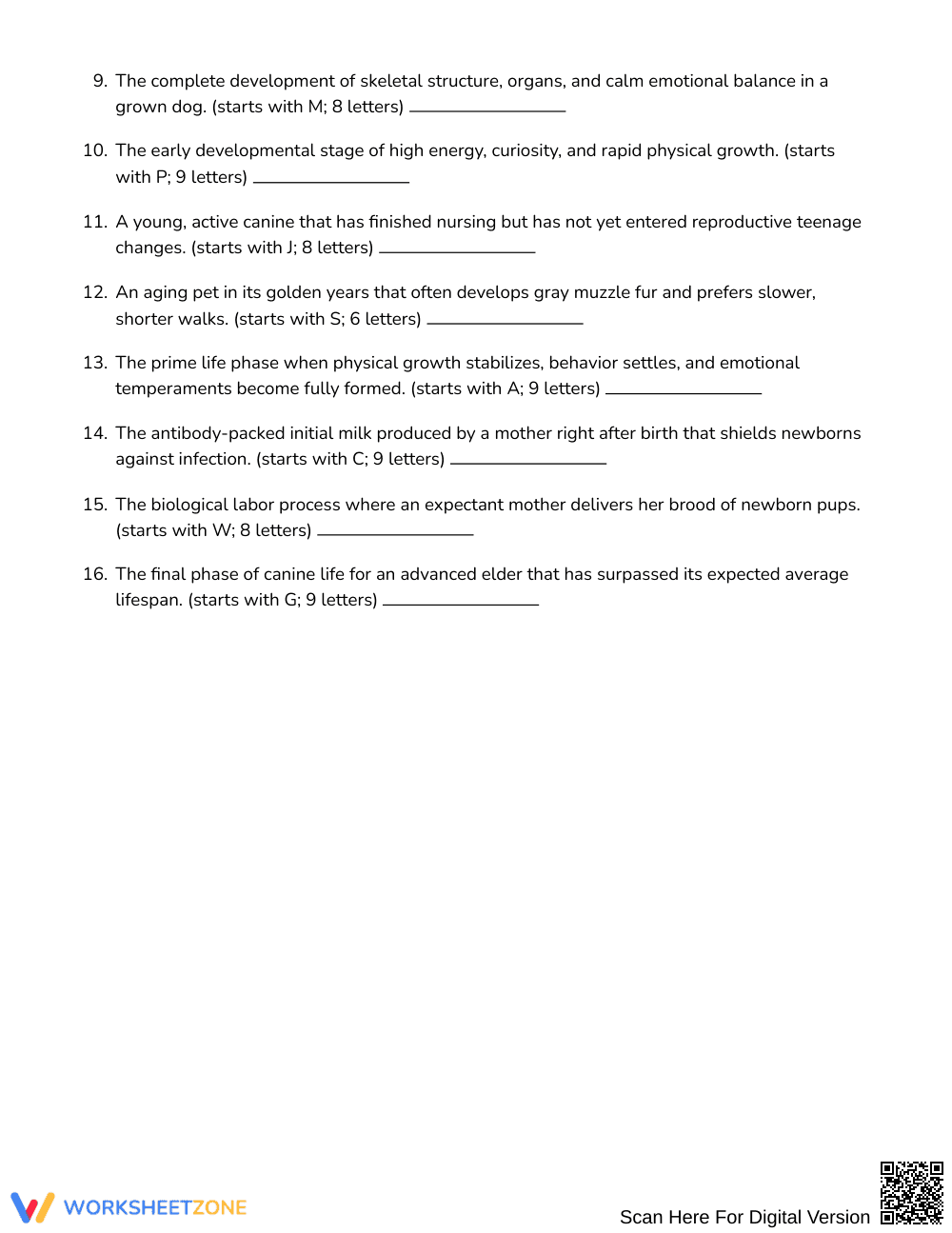


Essential Dog Life Stages Word Search | Grades 6–7 Science

Paste this activity's link or code into your existing LMS (Google Classroom, Canvas, Teams, Schoology, Moodle, etc.).
Students can open and work on the activity right away, with no student login required.
You'll still be able to track student progress and results from your teacher account.
This science word search reinforces canine biology concepts by challenging middle school learners to identify canine developmental milestones. Students read descriptive clues to deduce sixteen key dog life stage terms before locating them hidden across the puzzle. It strengthens vocabulary retention and reading comprehension through active contextual recall.
At a Glance
- Grade: Grades 6–7 · Subject: Science
- Standard: Not standards-assessed — vocabulary enrichment
- Skill Focus: Dog life stages and development vocabulary
- Format: 3 pages · 16 words · Answer key included · PDF
- Best For: Science vocabulary review or early finishers
- Time: 20–35 minutes
Inside this resource, educators will find a student puzzle page featuring an 18 by 18 grid paired with sixteen comprehensive clue prompts, omitting a passive word bank to require active retrieval. A multi-page complete solution key displays letter coordinates and highlighted word placements across the puzzle layout. This format ensures clear visual verification during grading or student self-checking routines.
The word search presents a rigorous no-bank challenge designed to test comprehension rather than simple letter scanning. Hidden vocabulary terms run in all eight possible orientations: north, northeast, east, southeast, south, southwest, west, and northwest. Students must first read each biological definition—such as distinguishing neonatal colostrum from adolescent behavior changes—to deduce the correct canine term before scanning the expansive 18 by 18 letter array.
This activity provides targeted science vocabulary enrichment and is intentionally not aligned to a single state or national standard. It functions as a cross-curricular supplemental resource that deepens life science domain-specific terminology, supporting broader animal development and mammalian life cycle instructional units across upper elementary and middle school grades.
Deploy this puzzle directly after introducing animal growth cycles to consolidate new terminology, or assign it during quiet individual work periods as an engaging review. During the activity, circulate to observe whether students use the definitions to deduce terms before searching, or if they struggle to recall stages like whelping versus weaning. Expect students to finish the complete deduction and search process within 20 to 35 minutes.
This puzzle is tailored for Grades 6–7 science students studying animal development, veterinary science, or mammalian biology. For learners needing additional support, provide a discreet term list or let partners collaborate on clue decoding. Pair this activity directly with an illustrated canine life cycle diagram or an introductory reading passage on mammalian developmental stages.
Vocabulary acquisition research from Fisher & Frey (2014) emphasizes that intentional word-learning tasks must require active processing and contextual retrieval rather than rote memorization. This word search activity targets dog life stages vocabulary through definition-based clues, requiring students in Grades 6–7 to retrieve domain-specific terminology before locating each entry in the grid. By withholding a pre-printed word bank, the design compels learners to access prior knowledge concerning developmental milestones such as whelping, socialization, and adolescence. Fisher & Frey (2014) highlight that structured retrieval practice combined with definitional analysis enhances long-term retention of scientific terminology significantly more than passive scanning exercises. Consequently, this resource serves as an effective instructional instrument for reinforcing foundational biological concepts, fostering autonomous problem-solving strategies, and establishing enduring comprehension of animal growth patterns across middle school life science curricula.


