































Essential DNA Technology Worksheet | Grade 9 Biology

Paste this activity's link or code into your existing LMS (Google Classroom, Canvas, Teams, Schoology, Moodle, etc.).
Students can open and work on the activity right away, with no student login required.
You'll still be able to track student progress and results from your teacher account.
This DNA technology worksheet equips Grade 9 biology students to master molecular biology tools, analyze gel electrophoresis data, and evaluate bioethical dilemmas. Students calculate PCR amplification, model restriction enzyme cleavage, and assess real-world agricultural and clinical biotechnology scenarios across twelve structured, standards-aligned prompts.
At a Glance
- Grade: 9 · Subject: Biology
- Standard: High School Biology — Apply molecular tools and evaluate genetic engineering applications
- Skill Focus: DNA Technology, Gel Electrophoresis, and Bioethics
- Format: 5 pages · 12 problems · Answer key included · PDF
- Best For: Mid-unit mastery check or review
- Time: 45–60 minutes
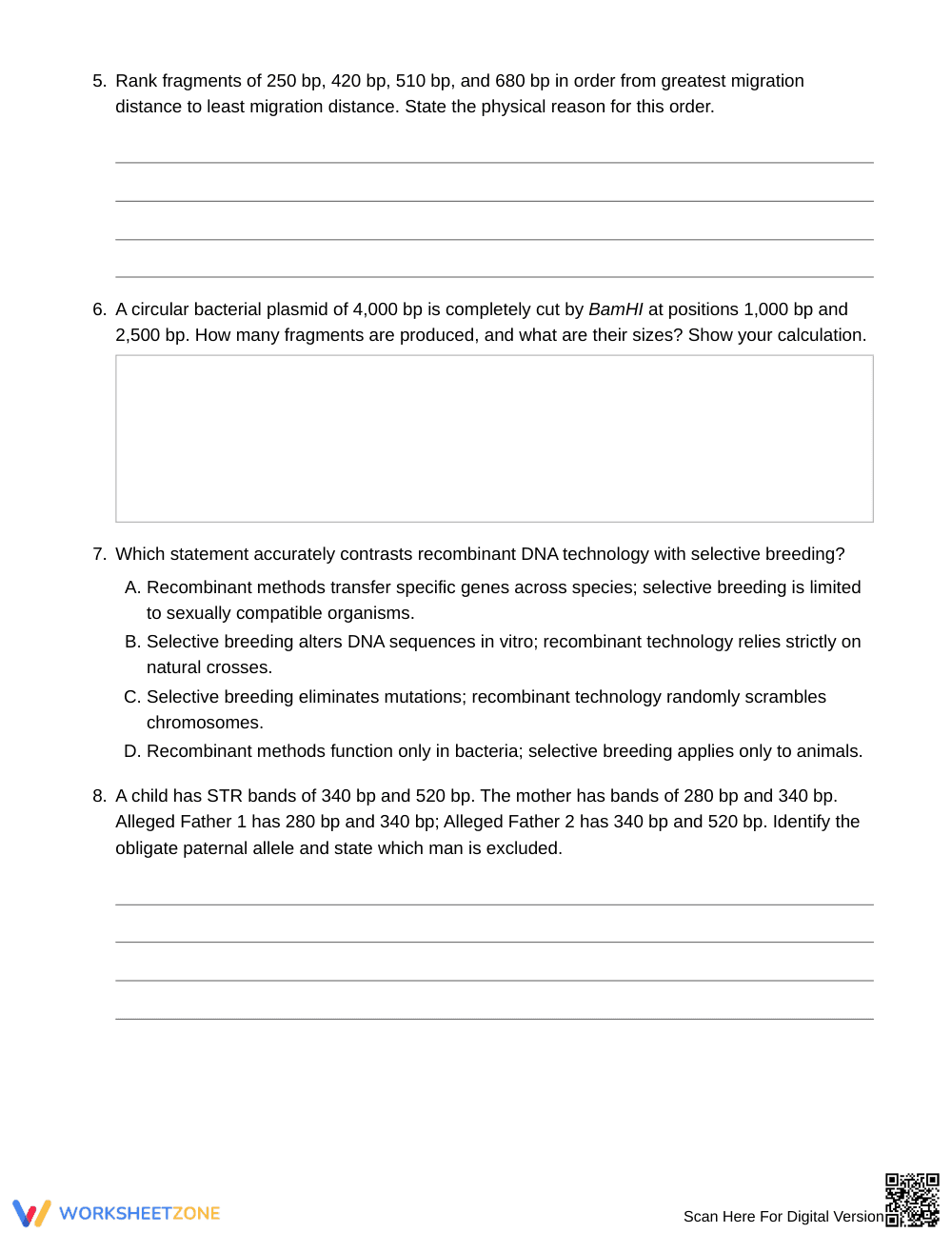
This 5-page resource features twelve structured items across three progressive sections. Students consult a molecular reference guide covering restriction enzymes, gel electrophoresis, and PCR before working through synthetic forensic short tandem repeat (STR) tables and plasmid digests. A complete 3-page answer key provides worked calculations, migration justifications, and bioethical criteria.
Skill Progression
- Guided practice (Questions 1–3): Foundation items review restriction sticky ends, electrical migration principles, and exponential PCR math with explicit formula support.
- Supported practice (Questions 4–9): Application prompts require students to interpret forensic STR tables, order fragment migration, calculate plasmid cut sizes, and analyze bacterial transformation selection.
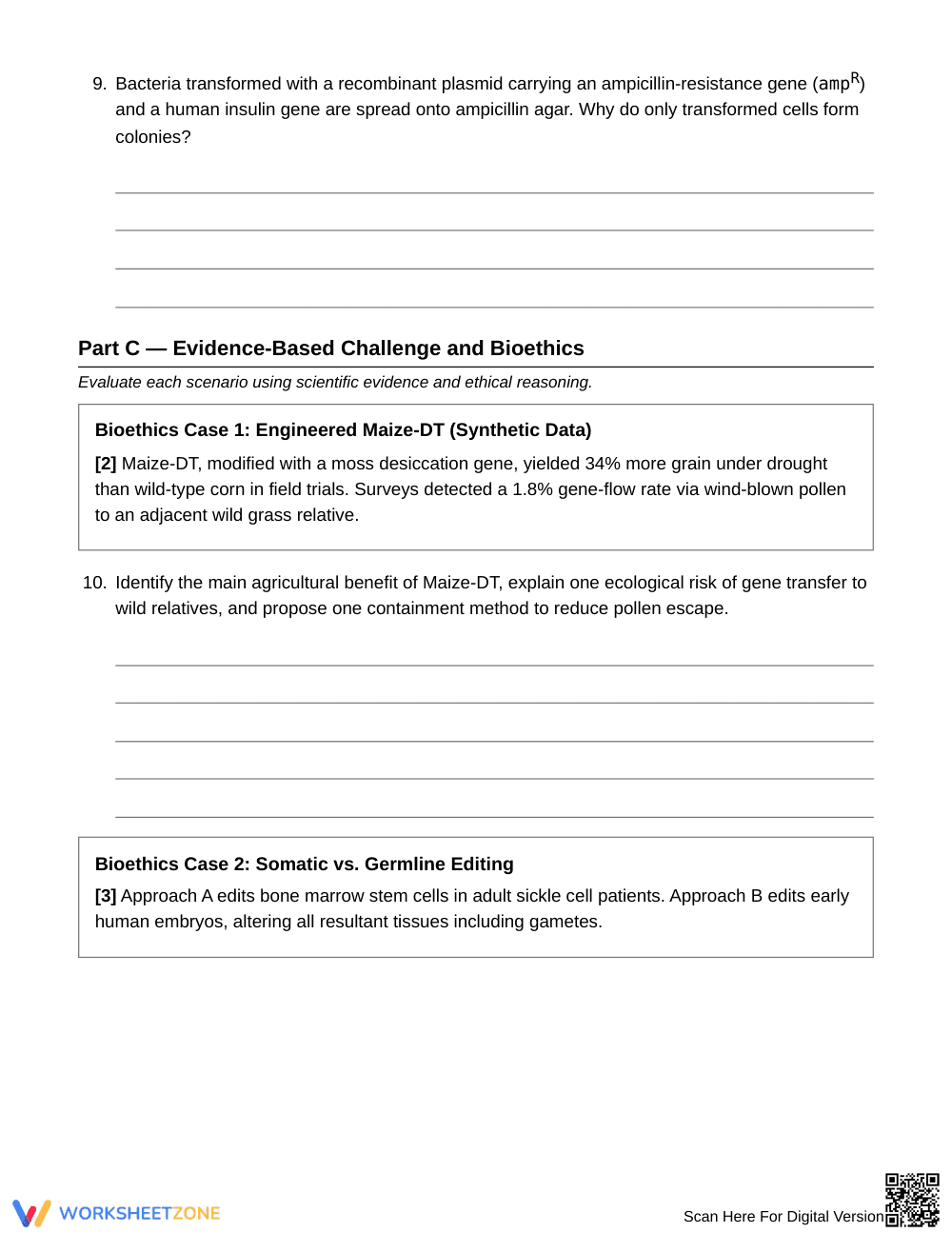
- Independent practice (Questions 10–12): Evaluative prompts challenge students to balance ecological risks of transgenic crops and debate somatic versus germline gene-editing ethics without scaffolds.
This structure follows the gradual-release framework, moving students systematically from recall toward independent analysis.
Standards Alignment
This resource aligns with high school biology standards for molecular genetics and genetic engineering. Students analyze how biotechnological techniques alter genomes and evaluate ecological implications. Both standard codes can be copied directly into lesson plans, IEP goals, or district curriculum mapping tools.
How to Use It
Use this worksheet after direct instruction on molecular tools. Assign Part A as a guided partner check, then have students complete Parts B and C independently. Alternatively, use it as a unit exam review. Formatively check Question 6 to ensure students understand circular plasmid topology. Completion takes 45 to 60 minutes.
Who It's For
This resource serves Grade 9 biology students learning modern biotechnology. Formula callouts support developing learners, while bioethics case studies extend critical thinking for advanced students. Pair this activity with an electrophoresis laboratory or a recombinant DNA lecture.
Rigorous analysis of molecular biotechnology builds essential scientific literacy in secondary biology classrooms. When Grade 9 students examine restriction digestion, gel electrophoresis profiles, and bioethical dilemmas, working directly with synthetic forensic data solidifies abstract genetic concepts into actionable understanding. According to Fisher & Frey (2014), the gradual release of responsibility model supports sustained student mastery by intentionally shifting cognitive demand from guided foundational exercises to independent evaluative problem solving. This worksheet implements that exact instructional architecture through structured practice—transitioning systematically from basic enzyme cutting rules and PCR exponential calculations to forensic STR profile interpretation and complex somatic versus germline gene-editing debates. Clear reference callouts and authentic scenario prompts ensure all biology learners build conceptual competence. Consequently, educators can measure evidence-based reasoning, evaluate student diagnostic progress, and prepare learners for advanced genetics coursework with targeted, standards-aligned practice.


