































Essential DNA Structure Worksheet | Grades 8–12 Science

Paste this activity's link or code into your existing LMS (Google Classroom, Canvas, Teams, Schoology, Moodle, etc.).
Students can open and work on the activity right away, with no student login required.
You'll still be able to track student progress and results from your teacher account.
This science worksheet develops student mastery of the DNA molecule of heredity through biological models, comparative analysis, and quantitative base-pairing evidence. High school biology students examine double-helix structural rules, compare nucleic acid properties, analyze Chargaff data tables, and evaluate chromosome inheritance mechanisms across 35 structured practice items designed for deep conceptual understanding.
At a Glance
- Grade: Grades 8–12 · Subject: Science
- Standard: Heredity — Model DNA structure and explain how base sequences transfer genetic code
- Skill Focus: DNA structure, base-pairing rules, chromosome replication, and mutations
- Format: 4 pages · 35 problems · Answer key included · PDF
- Best For: High school genetics review and formative practice
- Time: 45–60 minutes
This 4-page printable features four cohesive sections integrating diagram analysis, comparison tables, calculation exercises, and short-answer prompts. Students interact with antiparallel strand diagrams, complete structured comparative matrices for DNA versus RNA, evaluate nucleotide percentage tables, and synthesize molecular concepts through free-response questions supported by a comprehensive four-page teacher answer key.
Skill Progression
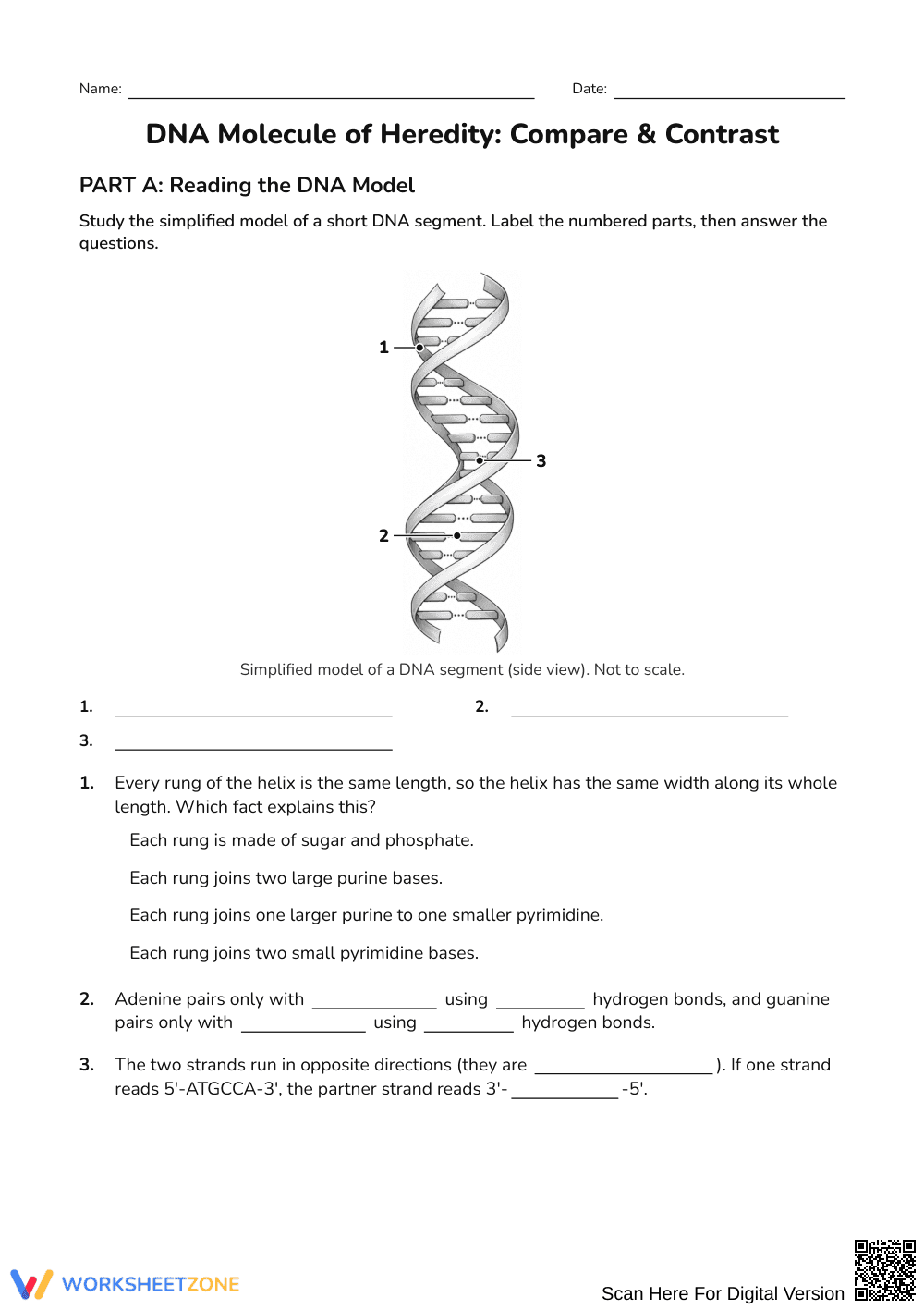
- Guided practice (Part A): Students examine an antiparallel double-helix model to identify sugar-phosphate backbones, evaluate complementary purine-pyrimidine spacing, and predict complementary 3' to 5' nucleotide sequences.
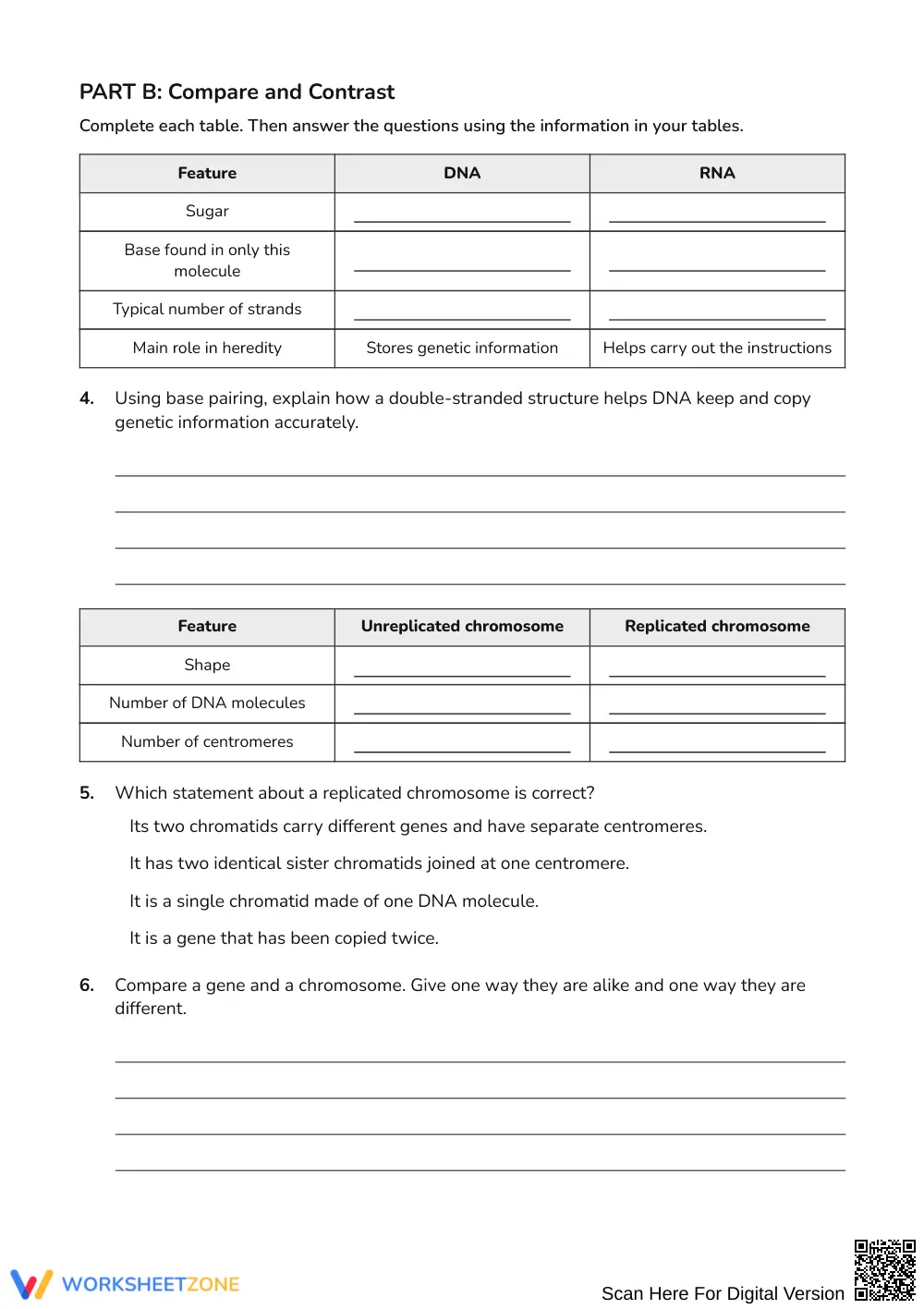
- Supported practice (Parts B & C): Learners complete dual-column comparison matrices contrasting DNA with RNA and replicated chromosomes, then calculate nucleotide proportions using Chargaff data tables to compare hydrogen-bonding strengths.
- Independent practice (Part D): Students independently explain histone wrapping, deduce why non-identical siblings share parental genes, and distinguish how germline mutations differ from somatic cellular damage.
This sequence follows a gradual-release framework, shifting students from visual model decoding to data-backed biological argumentation.
Standards Alignment
This resource aligns directly with secondary life science standards requiring students to construct explanations based on evidence for how the structure of DNA determines the structure of proteins carrying essential cellular functions. Both standard concepts and structural criteria can be copied directly into lesson plans, IEP goals, or district curriculum mapping tools.
How to Use It
Assign this worksheet during mid-unit guided practice after direct instruction on nucleotide chemistry, or use it across two 30-minute blocks as an assessment review. During completion, check student responses on Part C to identify misconceptions regarding hydrogen bonds before moving to transcription. Typical completion takes 45 to 60 minutes.
Who It's For
This resource serves general biology students, honors life science cohorts, and secondary intervention groups needing structured visual scaffolds. Pair these exercises directly with a hands-on physical molecular model kit or a DNA replication diagram anchor chart to reinforce spatial mechanics.
High school molecular genetics instruction demands structured progression from mechanical structural identification to abstract heredity modeling. This 35-task worksheet operationalizes secondary life science standards on the DNA molecule of heredity by guiding students through spatial helix architecture, base-pairing mechanics, Chargaff quantitative data evaluation, and germline mutation inheritance. Research from Fisher & Frey (2014) highlights that intentional gradual-release frameworks combining structured comparison charts with visual models significantly increase student retention of complex biochemical relationships. By systematically moving learners from double-helix diagram decoding to data-driven stability analysis of hydrogen bonding, the resource reinforces how structural nucleotide constraints govern genetic fidelity. The included four-page answer key provides clear criterion-based benchmarks, enabling secondary educators to quickly evaluate student mastery of chromosomal replication, nucleosome packaging, and Mendelian allele variation during classroom formative practice or targeted interventions across general and advanced biology classrooms.


