




























Views
Downloads


Essential DNA Structure Worksheet | Grades 8–12 Science

Paste this activity's link or code into your existing LMS (Google Classroom, Canvas, Teams, Schoology, Moodle, etc.).
Students can open and work on the activity right away, with no student login required.
You'll still be able to track student progress and results from your teacher account.
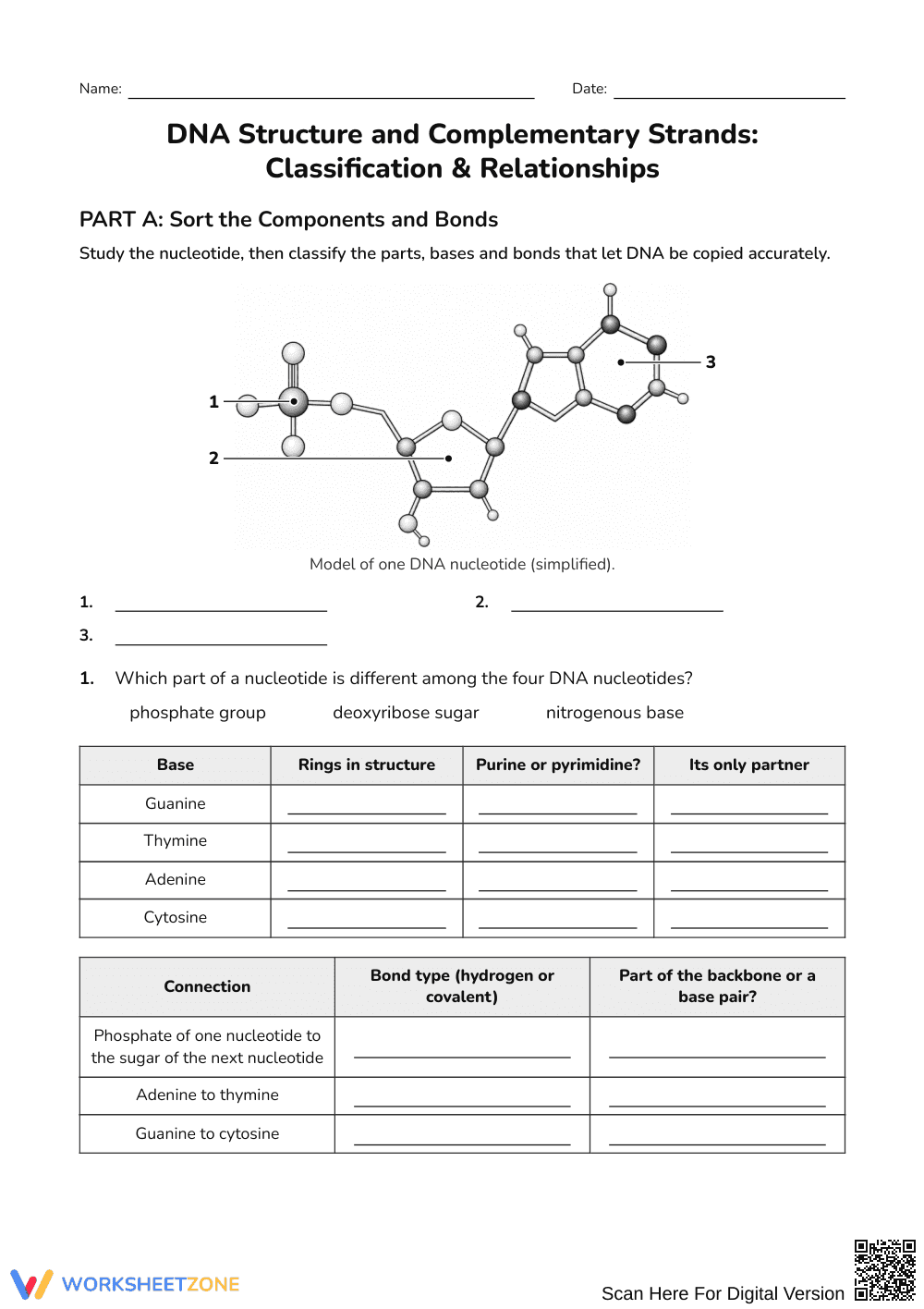
This comprehensive DNA structure worksheet provides secondary biology students with targeted practice analyzing nucleotide components, bond classifications, and complementary base-pairing rules. Learners examine how molecular geometry and chemical bonds allow DNA molecules to unzip, serve as templates, and preserve genetic sequences across successive generations.
At a Glance
- Grade: Grades 8–12 · Subject: Science
- Standard: Explain how nucleotide base pairing and bonding enable accurate genetic replication
- Skill Focus: DNA structure, antiparallel orientation, and replication models
- Format: 4 pages · 45 problems · Answer key included · PDF
- Best For: Biology unit review or guided practice
- Time: 45–60 minutes
What's Inside
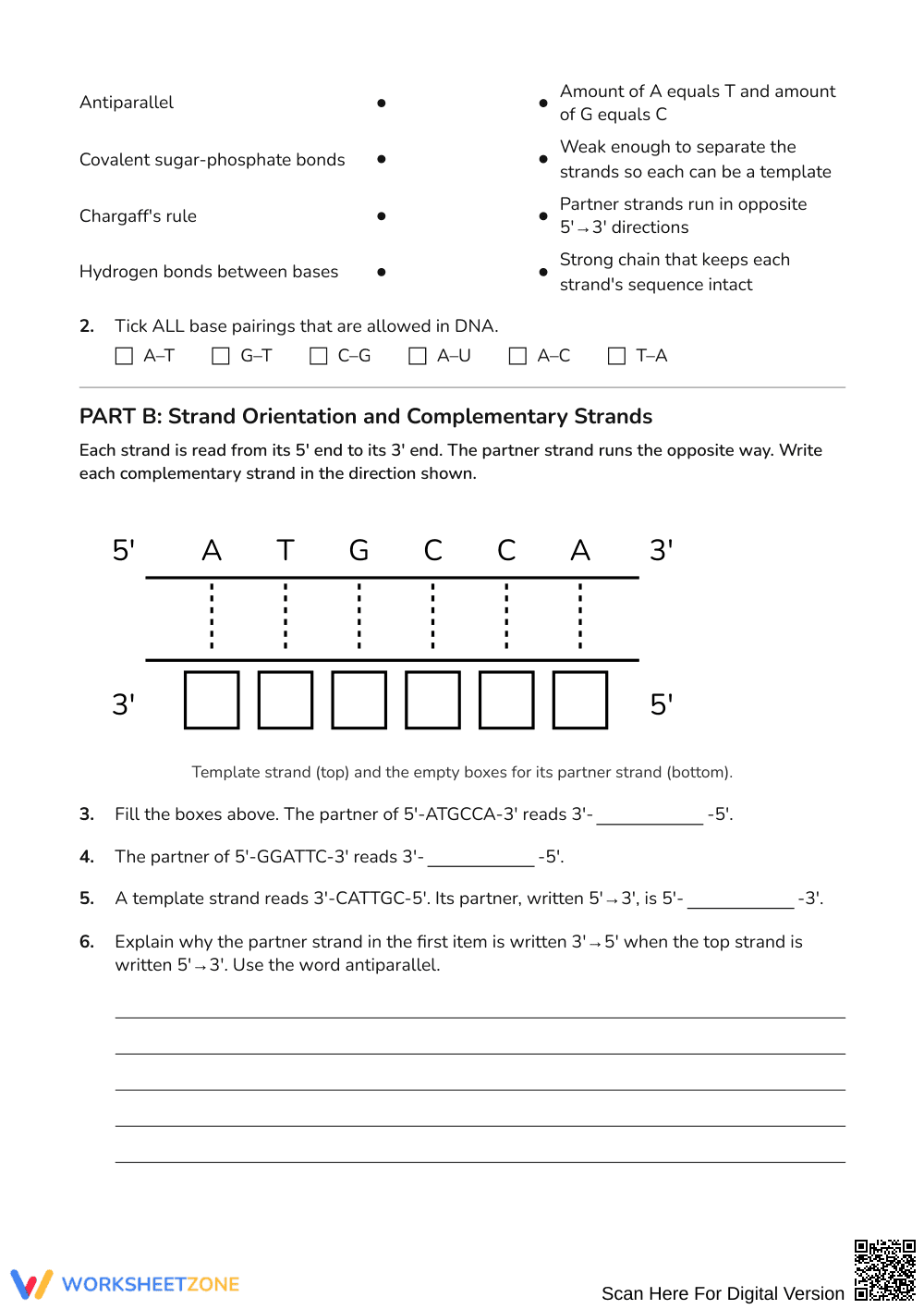
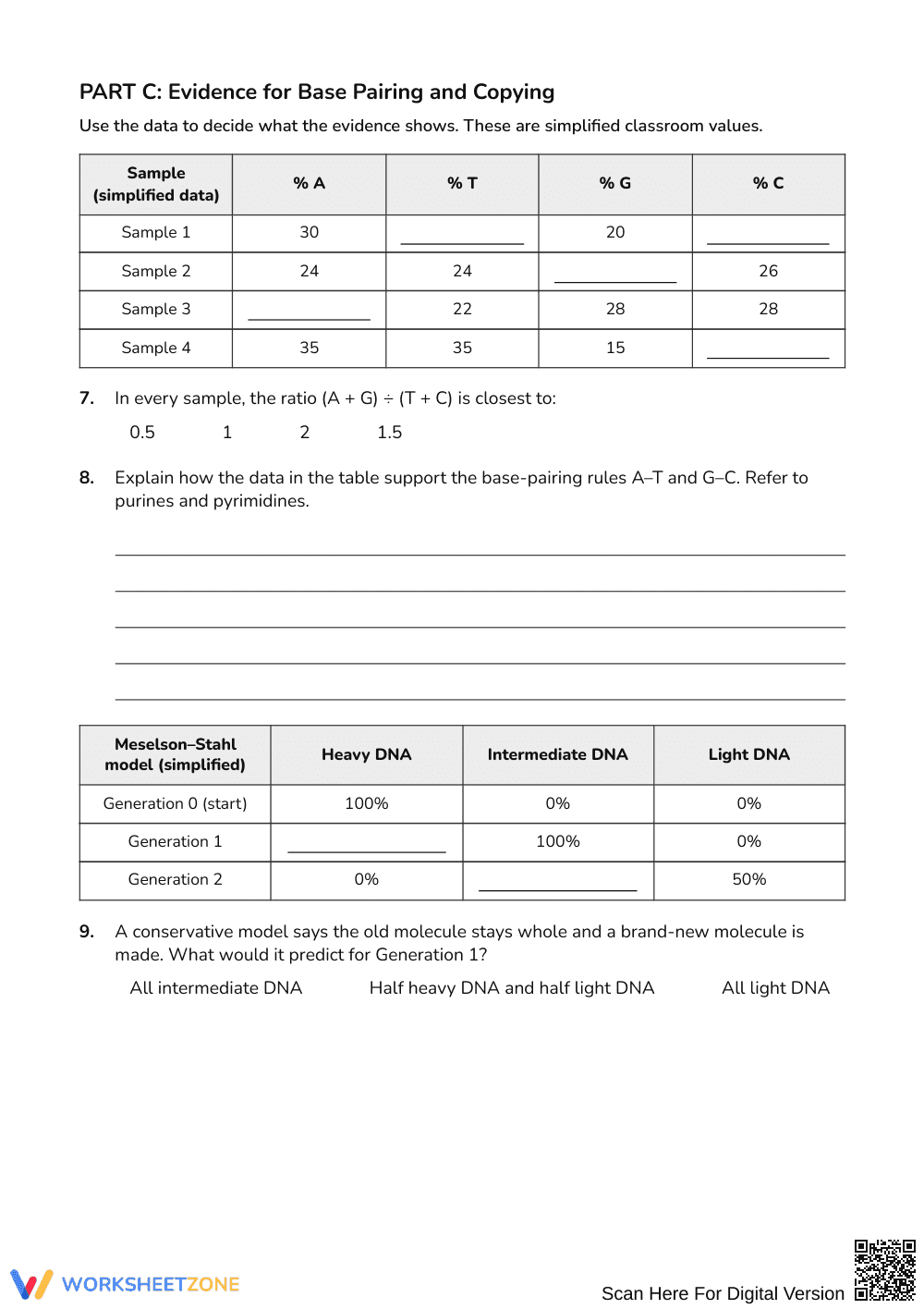
Across four organized pages, students evaluate nucleotide diagrams, classify covalent versus hydrogen bonds, build complementary strands with explicit 5′-to-3′ directional labels, and analyze historical data from Chargaff and Meselson-Stahl experiments. The packet features reference tables, fill-in template strands, and extended written-response prompts. A complete four-page teacher answer key provides full explanations and sequence solutions.
Skill Progression
- Guided practice (Part A, 18 tasks): Nucleotide anatomy, purine versus pyrimidine classification, and bond-type sorting with structured reference charts and diagram labels.
- Supported practice (Part B & Part C, 17 tasks): Determining antiparallel complementary sequences and interpreting empirical percentage ratios and isotope distribution tables.
- Independent practice (Part D, 10 tasks): Synthesizing molecular properties into cohesive mechanistic explanations, connecting bond strength differences to replication fidelity.
This deliberate sequence follows the gradual-release framework (I Do, We Do, You Do), establishing foundational vocabulary before demanding quantitative data analysis and conceptual evaluation.
Standards Alignment
This activity aligns with secondary Life Science standards focused on the structure and function of DNA. Students construct evidence-based scientific explanations showing how complementary base pairing and nucleotide bonding patterns preserve genetic information during molecular replication. Standards alignment can be copied directly into lesson plans, IEP goals, or district curriculum mapping tools.
How to Use It
Introduce this worksheet during direct instruction on molecular genetics or as an intensive review before a unit assessment. For formative assessment, observe student work on Part B to ensure learners invert the 5′ and 3′ terminal notations rather than transcribing bases without directional awareness. Most high school biology classes complete all four parts in 45 to 60 minutes.
Who It's For
Designed for introductory biology, honors life science, and AP Biology courses, this worksheet suits general education students and emerging bilingual learners needing structured visual tables. Pair this practice with physical nucleotide modeling kits or an interactive replication animation.
According to Fisher & Frey (2014), gradual-release instructional designs that systematically move students from structured categorization to open-ended causal analysis produce stronger retention in secondary science. This worksheet establishes that progression by guiding high school students through the structural mechanics of DNA replication across 45 focused tasks. Learners first identify nucleotide subunits, distinguish strong covalent backbone linkages from weak hydrogen base-pair bonds, and apply Chargaff's rules to empirical data sets. Progressing from basic component recognition to evaluating Meselson-Stahl isotope models, students articulate why semiconservative replication requires antiparallel template strands. By grounding molecular biology in direct diagrammatic and quantitative evidence, this resource ensures secondary students master the structural foundation governing genetic inheritance.


