




























Views
Downloads

Essential DNA Replication Worksheet | Grades 8-12 Science

Paste this activity's link or code into your existing LMS (Google Classroom, Canvas, Teams, Schoology, Moodle, etc.).
Students can open and work on the activity right away, with no student login required.
You'll still be able to track student progress and results from your teacher account.
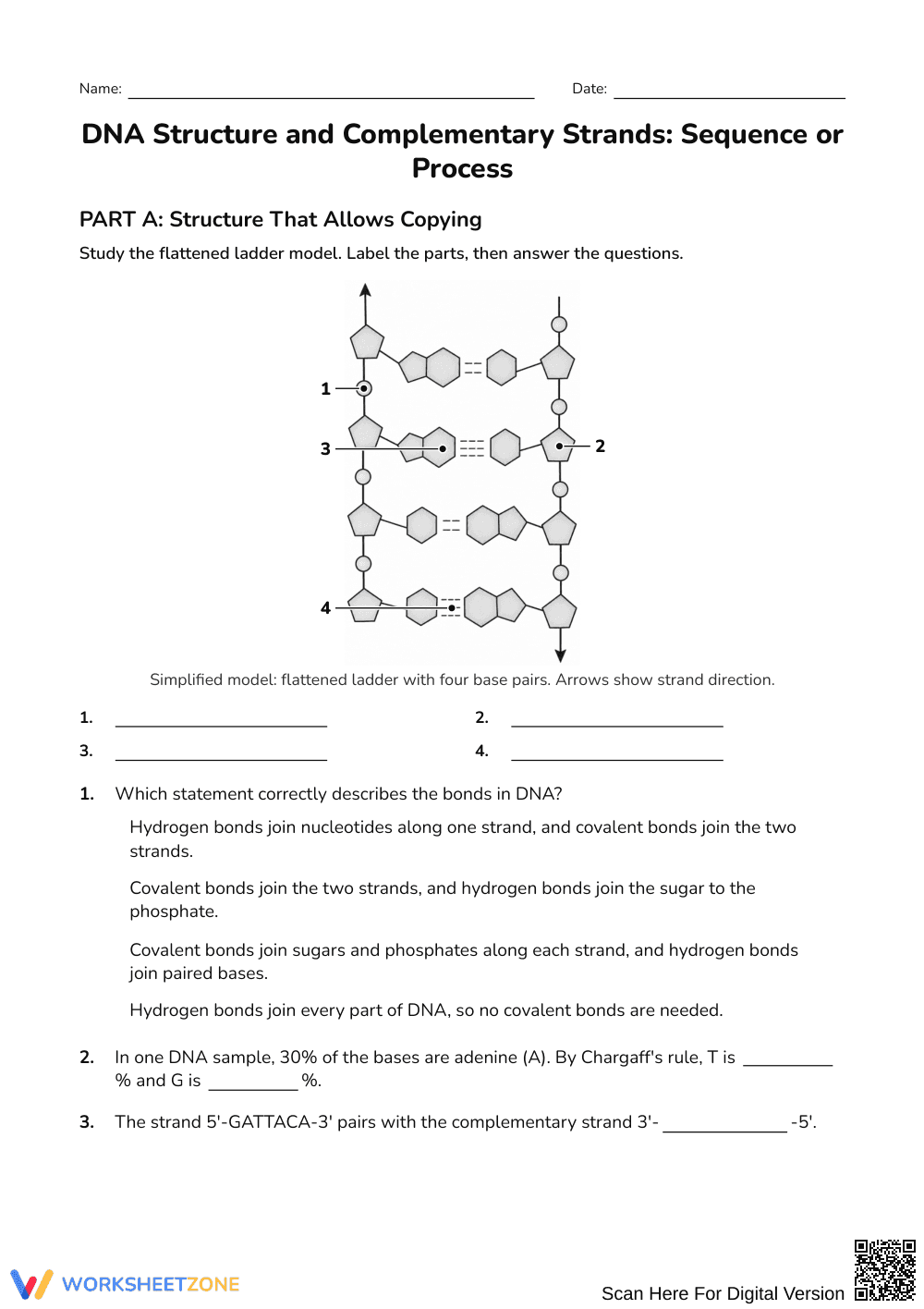
This DNA replication worksheet guides secondary science students through the molecular mechanisms of complementary base pairing and semi-conservative replication. Learners analyze structural ladder diagrams, sequence the discrete stages of strand synthesis, and evaluate empirical data from the Meselson-Stahl experiment to explain how chemical bonds preserve genetic information during cell division.
At a Glance
- Grade: Grades 8–12 · Subject: Science
- Standard: Scientific Inquiry — Model DNA structure and explain the molecular process of semi-conservative replication
- Skill Focus: Order replication stages and explain structural changes
- Format: 4 pages · 25 problems · Answer key included · PDF
- Best For: Mid-unit practice or assessment review
- Time: 45–60 minutes
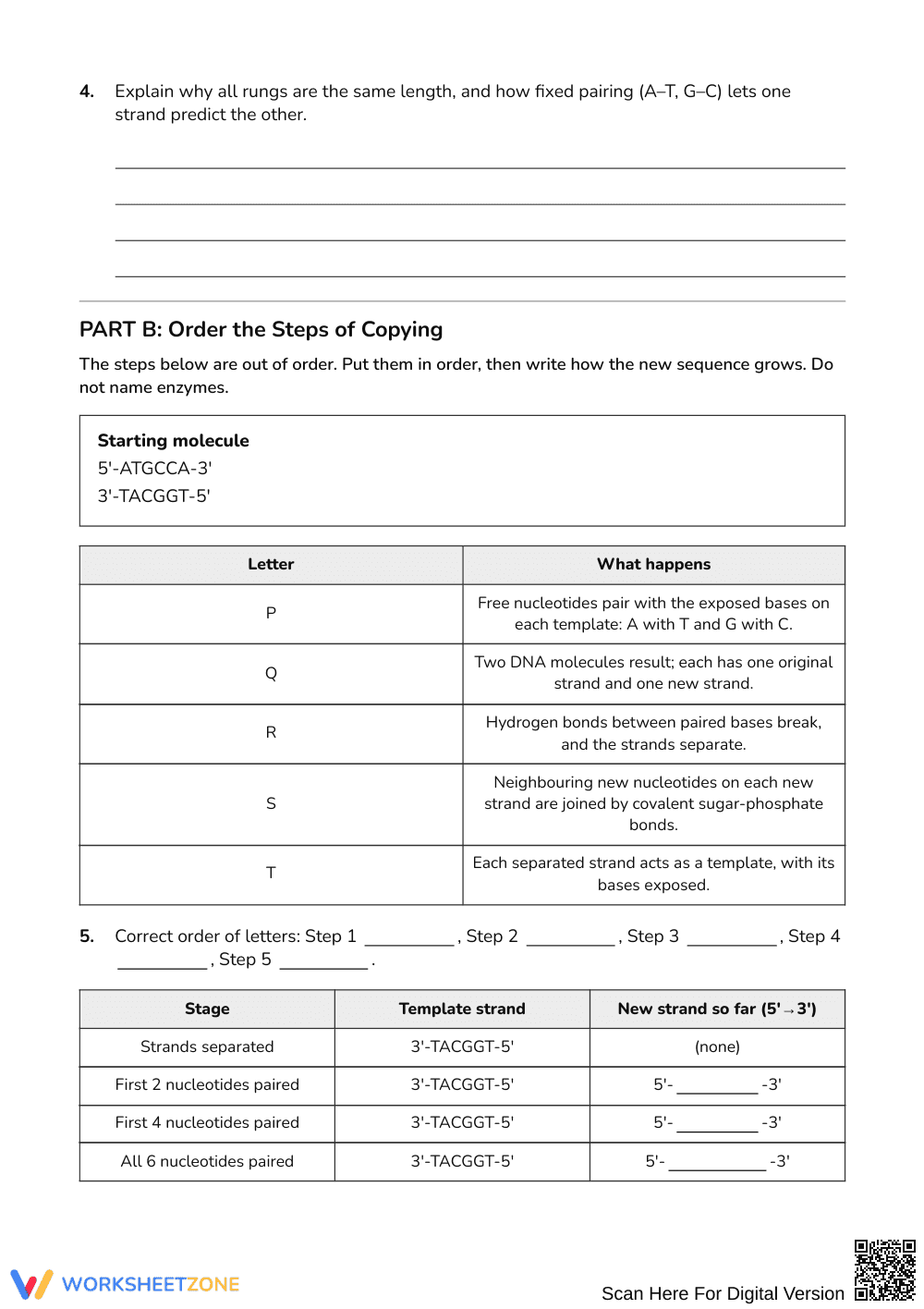
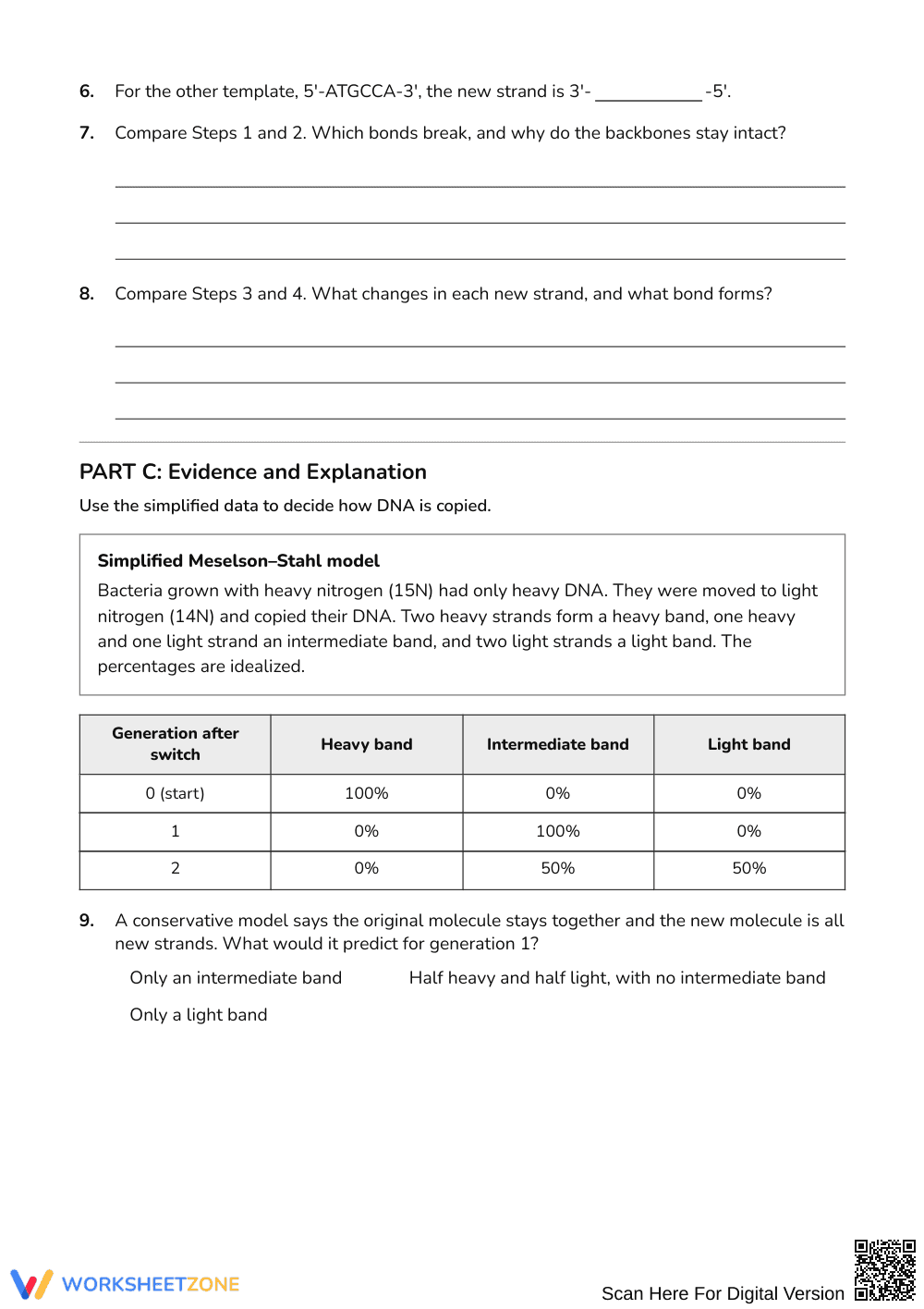
Across 4 instructional pages containing 25 structured tasks, students engage with molecular diagrams, sequence reconstruction tables, and experimental nitrogen-isotope data. The resource includes a simplified flattened ladder schematic with directional arrows, a 5-step unorganized replication sequence requiring chronological ordering, nucleotide growth tracking tables (5′→3′), and a complete 4-page answer key detailing correct mechanisms and molecular reasoning.
Skill Progression
- Guided Practice (Part A): 8 introductory tasks identify ladder components, compare covalent backbones against hydrogen base bonds, and apply Chargaff's rules to calculate complementary base proportions.
- Supported Practice (Part B): 9 process-oriented tasks challenge students to chronologically arrange five replication events, track directional nucleotide addition, and contrast hydrogen bond breaking with covalent bond formation.
- Independent Practice (Part C): 8 analytical tasks require interpreting Meselson-Stahl density band distributions across generations to defend semi-conservative replication against conservative models.
This sequence follows a gradual-release instructional model, shifting students systematically from structural identification to complex mechanistic synthesis.
Standards Alignment
This resource aligns with high school life science standards addressing heredity and molecular genetics. Students construct scientific explanations based on evidence for how the structure of DNA determines the structure of proteins and enables accurate replication during cellular reproduction. Standard alignment notes can be copied directly into lesson plans, IEP goals, or district curriculum mapping tools.
How to Use It
Deploy this worksheet after direct instruction on nucleotide structure and prior to introducing DNA replication enzymes. Use it as collaborative paired practice where student partners negotiate the sequence of Steps P through T before recording answers. As a formative assessment check, monitor student explanations in Part B regarding why sugar-phosphate backbones stay intact during strand separation. Expected completion time is 45 to 60 minutes.
Who It's For
This worksheet serves general biology, honors life science, and introductory genetics classes in grades 8 through 12. For differentiated support, pair struggling learners with a color-coded nucleotide anchor chart, while advanced students can annotate replication fork enzymes alongside the provided five-step sequence.
Effective science instruction requires secondary students to bridge physical molecular architecture with temporal biological processes. This structured worksheet targets the essential scientific skill of ordering DNA replication stages and articulating chemical bond transformations during strand synthesis. By actively guiding learners through concrete structural models, step-by-step sequence reconstruction, and empirical data analysis from classic density-gradient centrifugation experiments, the resource reinforces deep conceptual mastery rather than rote biological memorization. Research by Fisher & Frey (2014) demonstrates that structured gradual-release frameworks—transitioning from guided structural analysis to independent claims-evidence-reasoning explanations—significantly deepen disciplinary literacy and long-term retention of complex cellular mechanisms. Secondary biology educators can utilize this comprehensive 4-page resource comprising 25 targeted tasks to systematically measure student proficiency in predicting complementary base sequences, distinguishing covalent backbones from hydrogen bonds, and defending the semi-conservative replication model using quantitative scientific data.


