




























Views
Downloads
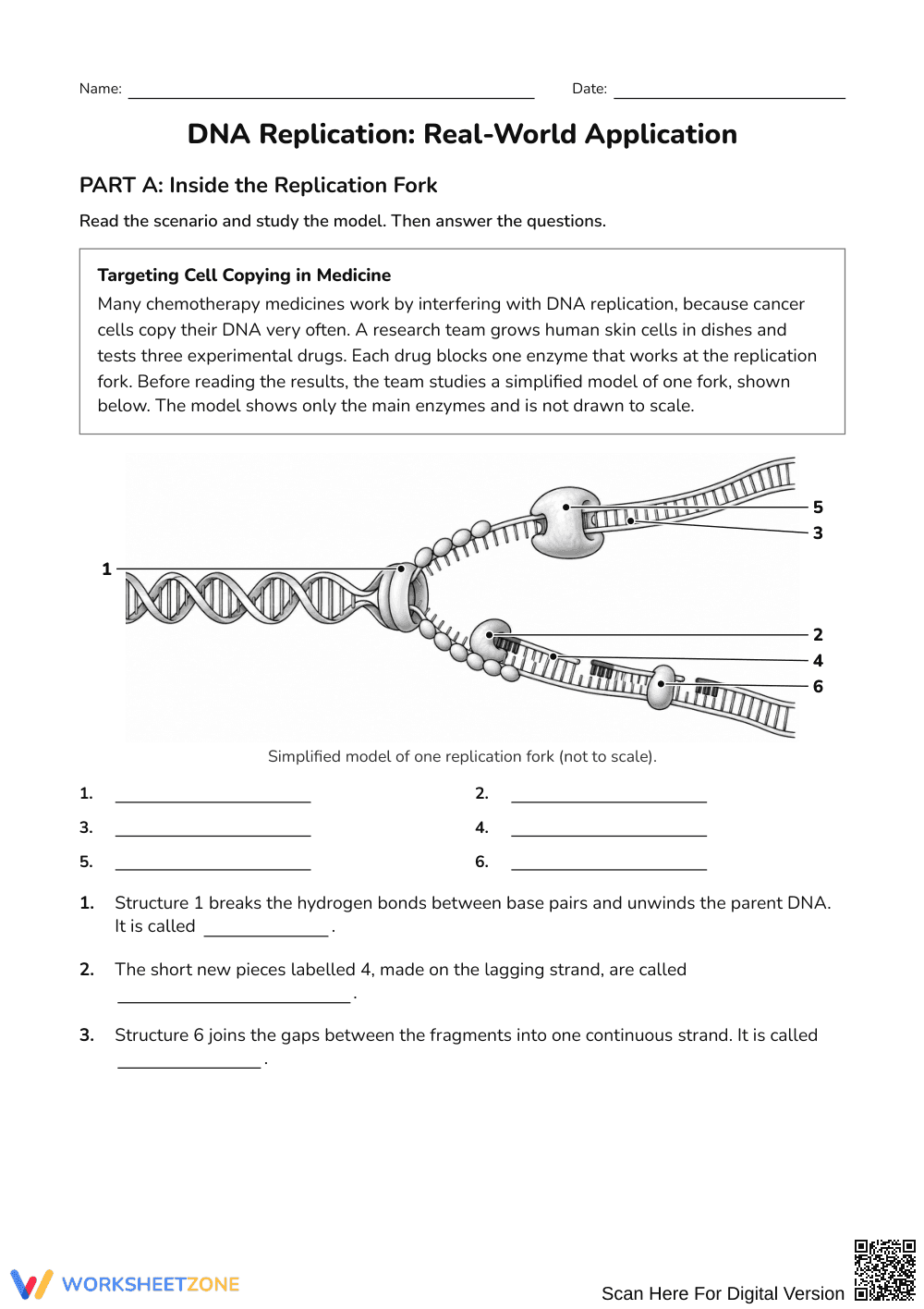
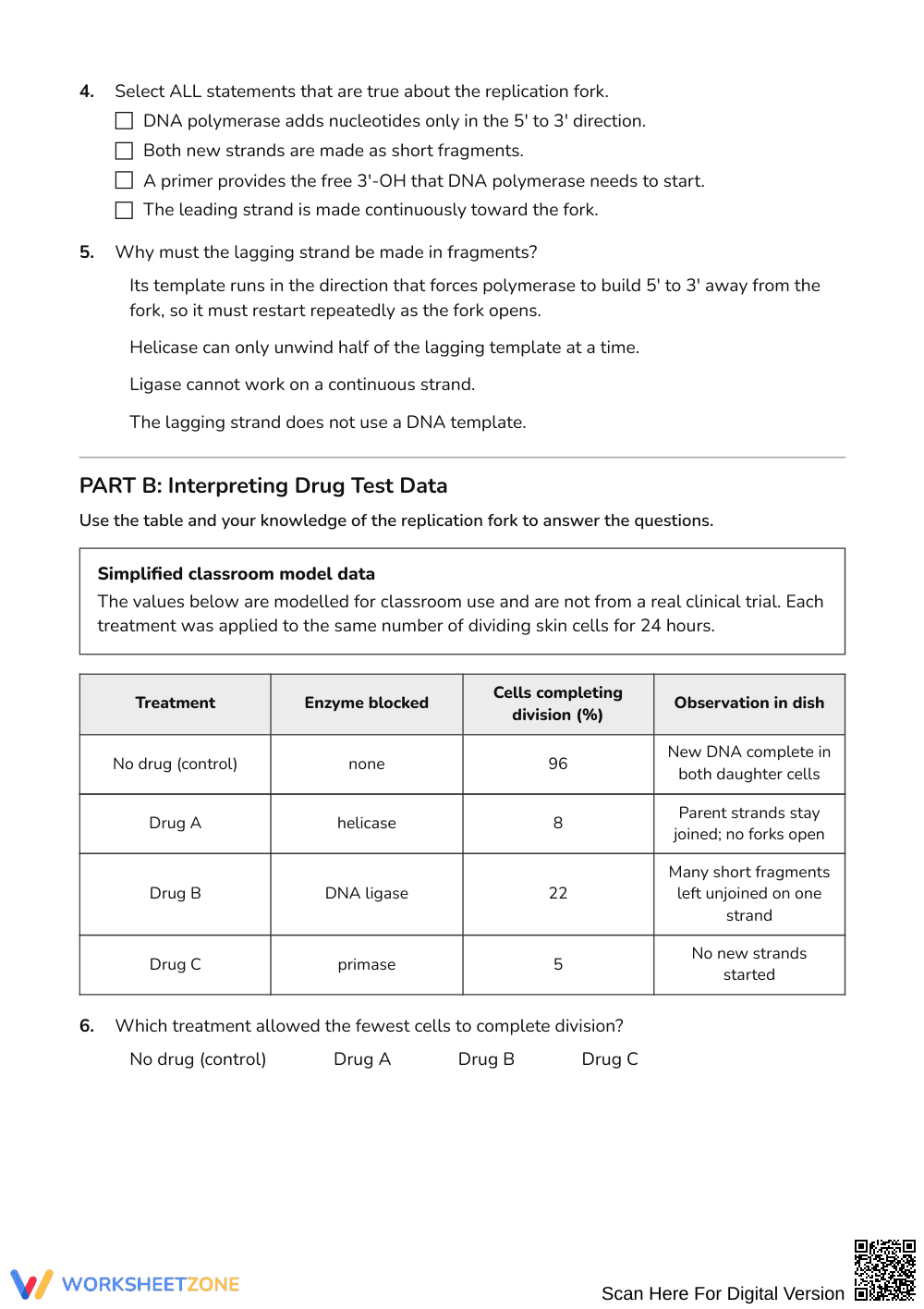

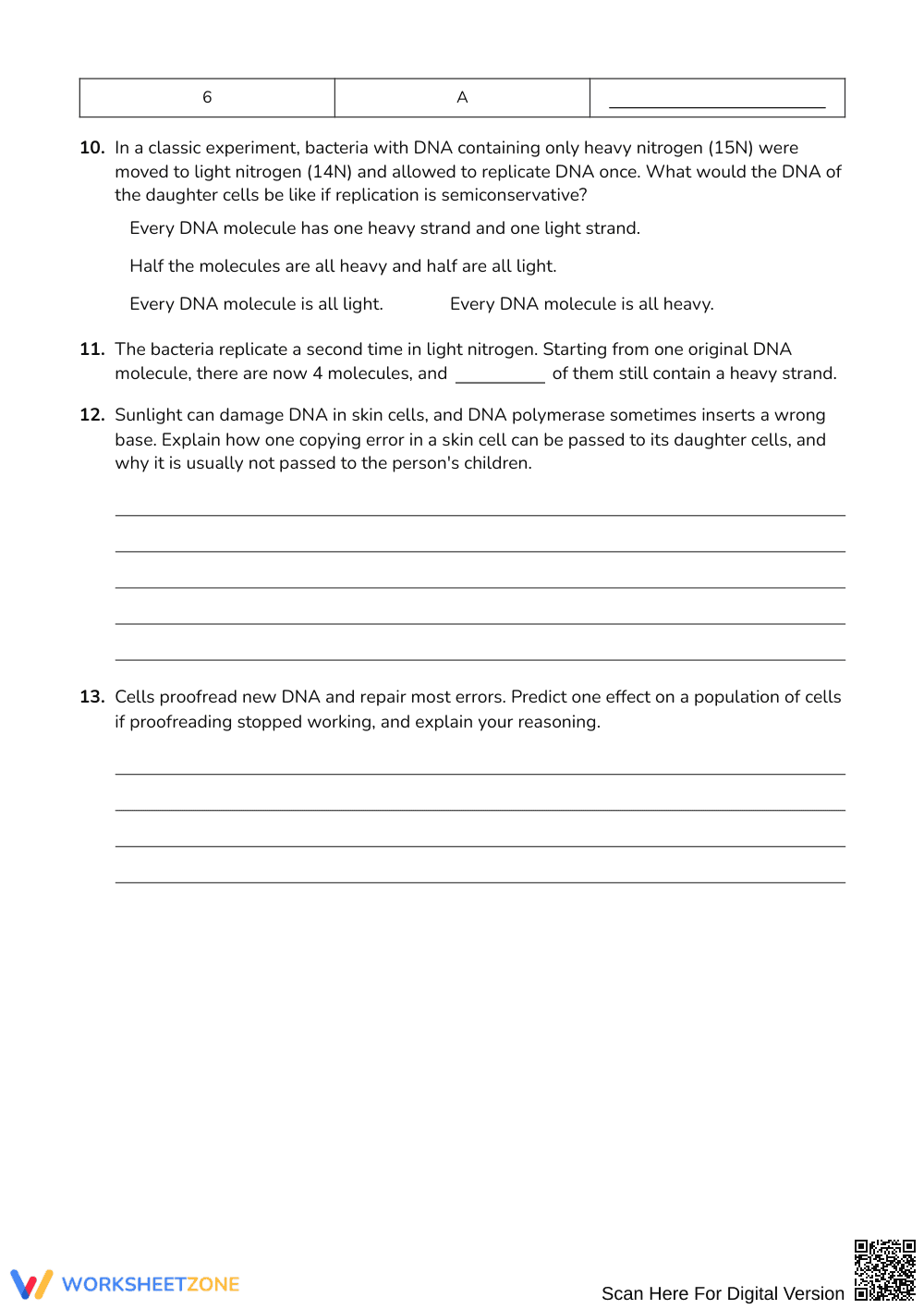

Essential DNA Replication Worksheet | Grades 8-12 Science

Paste this activity's link or code into your existing LMS (Google Classroom, Canvas, Teams, Schoology, Moodle, etc.).
Students can open and work on the activity right away, with no student login required.
You'll still be able to track student progress and results from your teacher account.
This comprehensive DNA replication worksheet engages students in applying molecular genetics concepts to real-world biomedical contexts. Rather than relying on simple recall, learners evaluate how targeted chemotherapy medications disrupt replication fork enzymes, interpret laboratory cell division data, and analyze somatic mutation inheritance across 26 rigorous, scaffolded problems.
At a Glance
- Grade: Grades 8–12 · Subject: Science
- Standard: Life Science Core — Model DNA replication and explain how cellular mechanisms transfer genetic information
- Skill Focus: Real-world DNA replication application and data analysis
- Format: 4 pages · 26 problems · Answer key included · PDF
- Best For: Post-lecture application and formative assessment
- Time: 45–60 minutes
Across 4 structured pages, this resource features a realistic scenario evaluating chemotherapy drugs targeting helicase, primase, and ligase. Students work through structural identification, multi-select conceptual checks, a quantitative experimental data table, a 3' to 5' complementary base-pairing matrix, and extended-response prompts explaining semiconservative replication and somatic versus germline mutations. A complete 4-page answer key provides full explanations.
Skill Progression
- Guided Practice (Part A): Students examine an annotated replication fork diagram, identifying helicase, ligase, and Okazaki fragments with directional prompts.
- Supported Practice (Part B): Learners interpret experimental chemotherapy data, applying enzyme knowledge to explain why ligase blockers permit partial division while helicase blockers halt it entirely.
- Independent Practice (Part C): Students build complementary base sequences, calculate strand ratios in isotopic models, and evaluate somatic versus germline mutation inheritance.
This gradual-release progression moves students systematically from structural identification to independent scientific evaluation.
Standards Alignment
This resource aligns with high school life science performance expectations requiring students to construct explanations based on evidence for how the structure of DNA determines cellular function and how replication guides inheritance. Both standard descriptions can be copied directly into lesson plans, IEP goals, or district curriculum mapping tools.
How to Use It
Deploy this worksheet immediately following direct instruction on replication fork enzymes or as an active mid-unit collaborative task. During completion, conduct formative observation by monitoring Part B responses to verify whether students recognize that unsealed lagging strands still permit leading strand synthesis. The entire 26-task sequence requires approximately 45 to 60 minutes of focused class time.
Who It's For
This activity supports introductory biology, honors biology, and AP Biology students in Grades 8–12. Teachers can differentiate by providing a visual enzyme reference sheet for struggling readers or assigning the mutation analysis prompts in Part C as an extension for advanced learners. It pairs naturally with molecular animation models or DNA structure labs.
According to research highlighted by Fisher & Frey (2014) on guided instruction, student mastery of abstract molecular mechanisms increases significantly when conceptual knowledge is transferred to unfamiliar, authentic scenarios. Rather than asking students to identify replication fork enzymes in isolation, this worksheet embeds enzyme inhibition within an oncological chemotherapy trial. As learners analyze how blocking helicase or DNA ligase alters cell division percentages across 26 structured tasks, they synthesize structural biology with clinical physiology. Research indicates that structured problem-solving tasks requiring students to explain molecular mechanisms and differentiate somatic mutations from germline heredity enhance retention and scientific reasoning far more effectively than passive terminology recall. This self-contained inquiry sequence provides an evidence-based pathway for students to demonstrate genuine conceptual transfer while practicing rigorous data interpretation and molecular modeling skills in secondary science classrooms.


