




























Views
Downloads



Essential DNA Replication Worksheet | Grades 8-12 Science

Paste this activity's link or code into your existing LMS (Google Classroom, Canvas, Teams, Schoology, Moodle, etc.).
Students can open and work on the activity right away, with no student login required.
You'll still be able to track student progress and results from your teacher account.
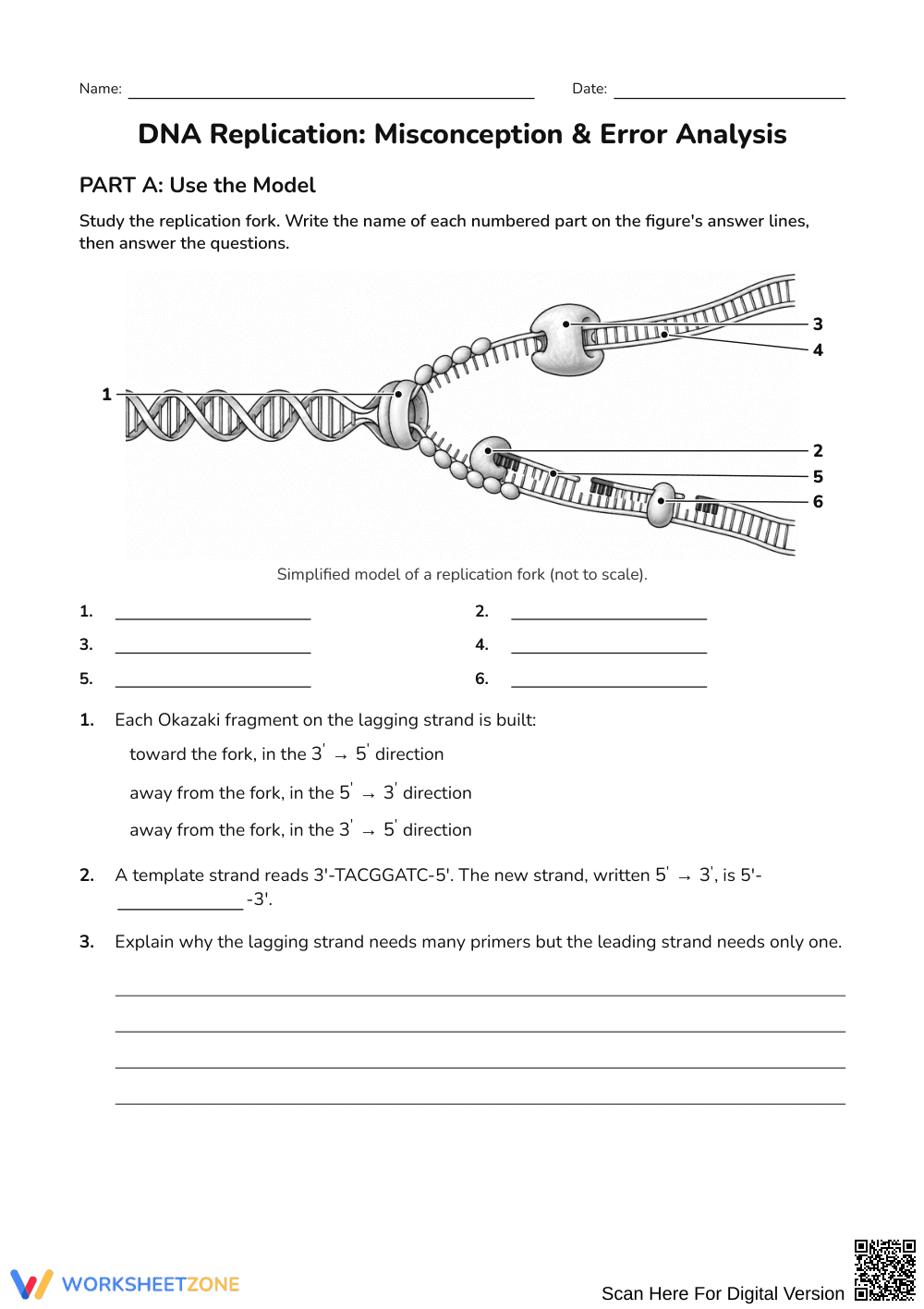
This science worksheet guides secondary students through targeted error analysis and data evaluation in DNA replication. Learners examine structural models of the replication fork, identify conceptual flaws in peer explanations, and interpret density-gradient centrifugation data to prove that replication follows a semiconservative mechanism.
At a Glance
- Grade: Grades 8–12 · Subject: Science
- Standard: Construct explanations and models showing how DNA replication maintains genetic continuity across generations
- Skill Focus: Misconception and error analysis in DNA replication
- Format: 4 pages · 19 problems · Answer key included · PDF
- Best For: Mid-unit formative assessment or review
- Time: 45–55 minutes
What's Inside
Across 4 focused pages, this resource delivers 19 rigorous analytical tasks. Students encounter labeled replication fork diagrams, a 3-claim peer critique scenario, and a tabular Meselson-Stahl density dataset spanning 4 generations. Structural supports include clear visual prompts, directional labeling cues, and a complete 4-page teacher answer key containing sample written justifications.
Skill Progression
- Guided Practice: Tasks 1–6 direct students to analyze a simplified replication fork diagram, label fundamental enzymes including helicase, primase, and ligase, and calculate complementary base sequences in the standard 5' to 3' orientation.
- Supported Practice: Tasks 7–13 present three common student claims regarding conservative replication, bidirectional synthesis, and primer excision. Learners identify specific factual errors, cite biochemical constraints, and draft scientifically valid corrections.
- Independent Practice: Tasks 14–19 require students to evaluate simulated isotopic data from nitrogen-15 and nitrogen-14 experiments, predicting strand percentages and writing formal justifications that refute conservative models.
This structured progression follows the gradual-release framework, transitioning learners from concrete model identification to sophisticated scientific argumentation.
Standards Alignment
This worksheet directly addresses high school life science standards that require students to construct explanations based on evidence for how the structure of DNA determines the structure of proteins, which carry out the essential functions of life through systems of specialized cells. Students demonstrate mastery of DNA structure and molecular replication mechanisms by analyzing how complementary base pairing preserves genetic information across generations. Both the objective and evidence criteria can be copied directly into lesson plans, IEP goals, or district curriculum mapping tools.
How to Use It
Deploy this resource during the synthesis phase of instruction, immediately after students have learned the primary enzymes of replication. For a collaborative station activity, assign pairs to critique one student claim in Part B and defend their revision to the class. As an individual check for understanding, use Part C as an exit ticket to assess data literacy. Most high school biology classes complete the full set within 45 to 55 minutes.
Who It's For
This activity supports introductory high school biology, honors biology, and early AP Biology students needing deeper engagement with molecular genetics. It pairs naturally with a hands-on magnetic nucleotide modeling kit or an interactive Meselson-Stahl laboratory simulation.
Secondary biology curricula require students to reconcile molecular mechanics with empirical data. According to Fisher & Frey (2014), structured error analysis accelerates conceptual mastery by forcing students to articulate why common misconceptions fail under physical constraints. This 4-page worksheet guides learners through 19 tasks that challenge intuitive but inaccurate assumptions regarding conservative replication and continuous synthesis. Students analyze enzyme directionality at the replication fork, evaluate conflicting claims about strand assembly, and calculate generation percentages from nitrogen isotope experiments to confirm semiconservative replication. By integrating visual labeling, analytical writing, and quantitative data analysis, the activity equips high school science students to construct robust scientific justifications and evaluate experimental claims with confidence.


