































Essential DNA Replication Worksheet | Grades 8-12 Science

Paste this activity's link or code into your existing LMS (Google Classroom, Canvas, Teams, Schoology, Moodle, etc.).
Students can open and work on the activity right away, with no student login required.
You'll still be able to track student progress and results from your teacher account.
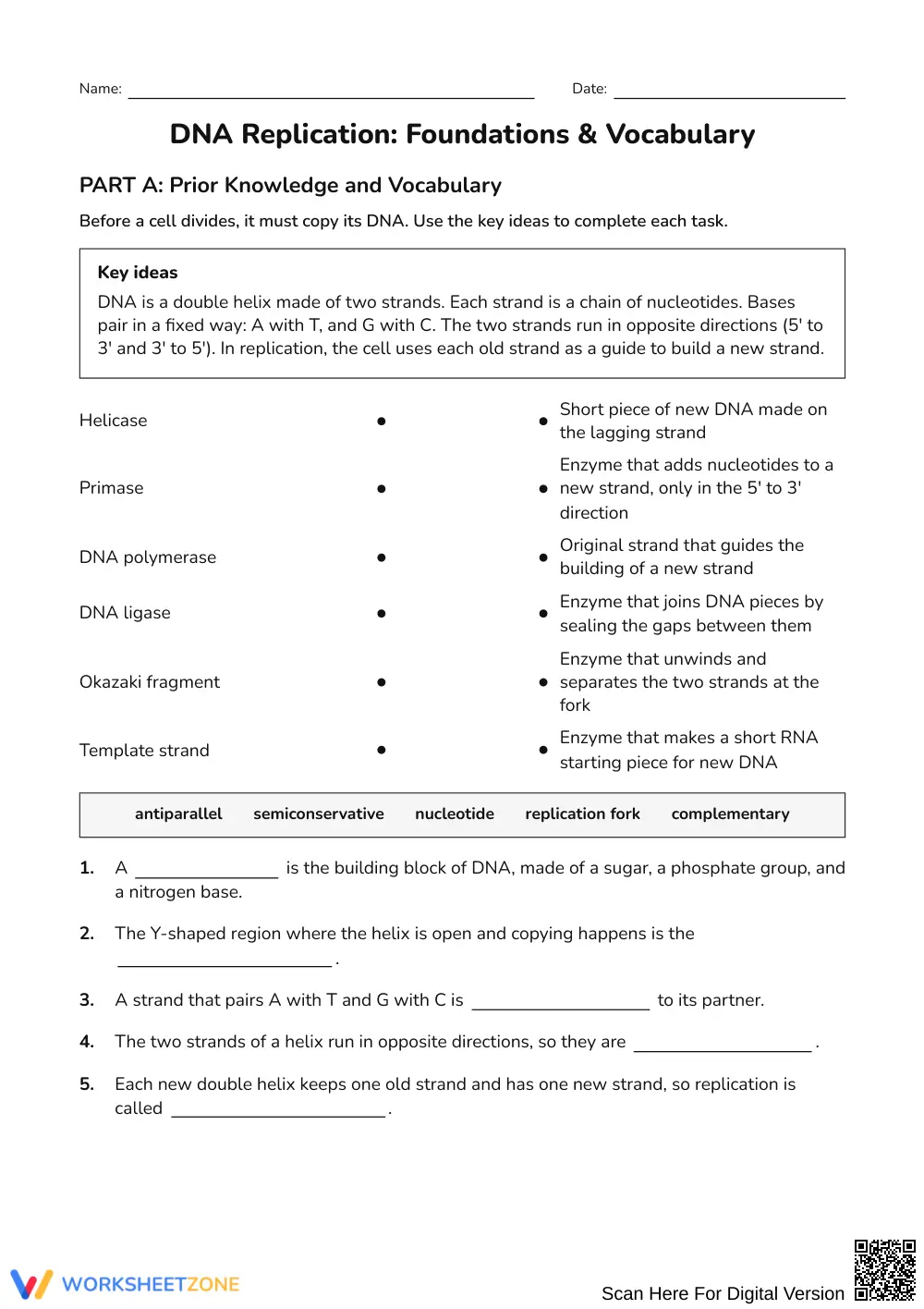
Build strong molecular genetics foundations with this comprehensive DNA replication practice set. Students define essential replication enzymes, analyze a labeled replication fork diagram, and evaluate experimental evidence from nitrogen-isotope banding patterns. By moving from core terminology to model interpretation, learners connect mechanical enzyme actions directly to semiconservative replication theory.
At a Glance
- Grade: Grades 8–12 · Subject: High School Biology
- Standard: Relate DNA structure and enzymatic replication mechanisms to cellular reproduction
- Skill Focus: Enzyme roles, fork structure, and semiconservative replication
- Format: 4 pages · 33 problems · Answer key included · PDF
- Best For: Mid-unit practice, review, or homework
- Time: 45–60 minutes
What's Inside
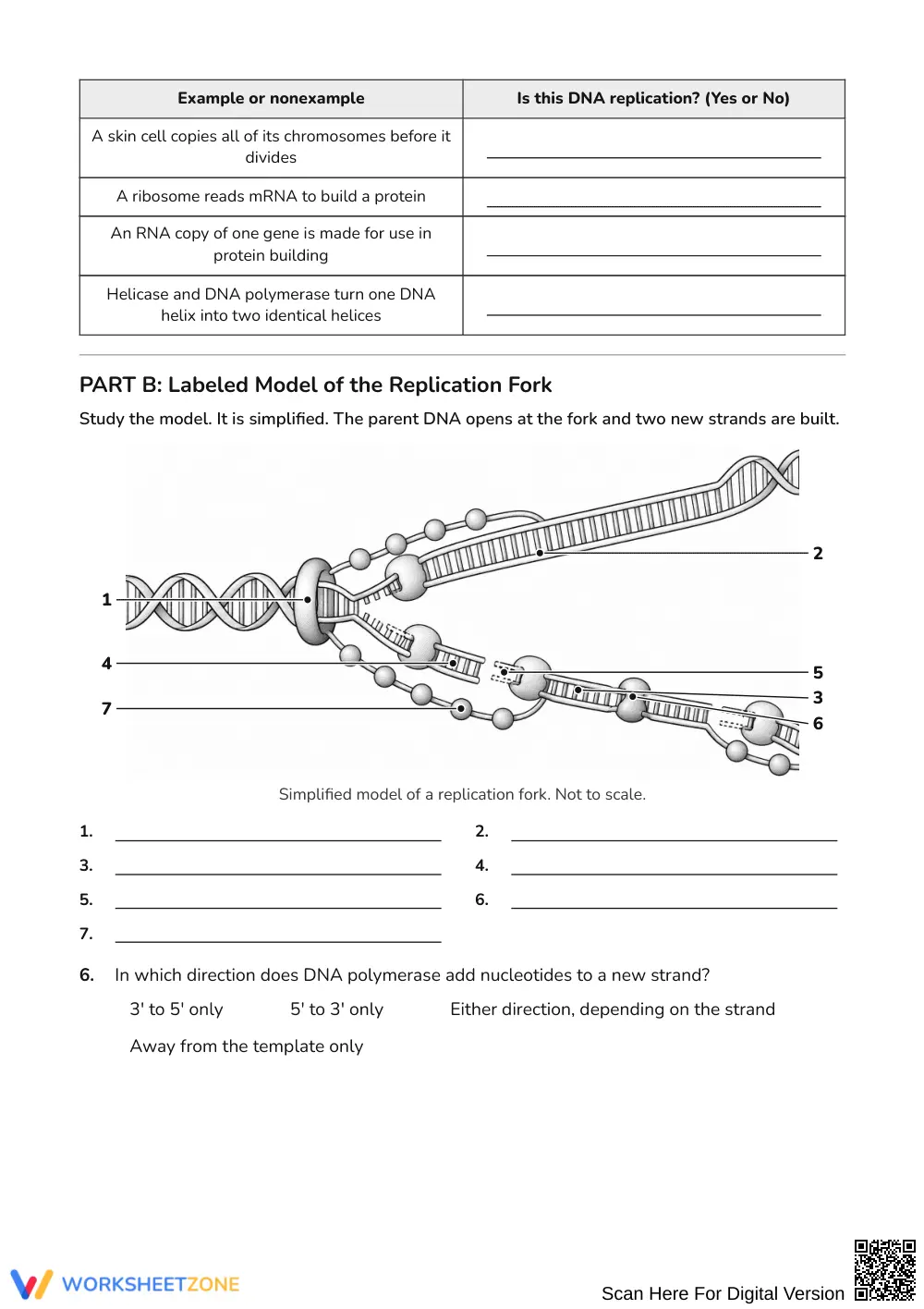
This 4-page worksheet guides learners through 33 focused tasks divided into three distinct sections. Part A establishes core terminology through concise enzyme definitions paired with example and non-example prompts. Part B presents a labeled replication fork diagram, assessing directionality and strand synthesis. Part C features sequence ordering alongside a Meselson-Stahl density-gradient experiment to resolve misconceptions, backed by a complete answer key.
Skill Progression
- Guided Practice (Part A, 15 tasks): Students review reference boxes to match enzyme functions with scaffolded definitions and binary examples.
- Supported Practice (Part B, 10 tasks): Learners apply structural rules to an annotated fork diagram, explaining leading and lagging strand mechanics.
- Independent Practice (Part C, 8 tasks): Students order replication stages and interpret isotope density tables to disprove non-conservative models.
This structure follows the gradual release of responsibility framework, moving learners from retrieval to data synthesis.
Standards Alignment
This resource aligns with high school life science benchmarks requiring students to explain how DNA structure enables cellular heredity. Learners analyze base pairing, enzymatic coordination, and semiconservative distribution across generations.
How to Use It
Deploy this worksheet after direct instruction on molecular genetics. In a flipped classroom, assign Parts A and B as preparation, reserving the experimental data analysis in Part C for collaborative discussion. Circulate to check student understanding of lagging strand primers. Completion time is 45 to 60 minutes.
Who It's For
This activity serves general biology, honors biology, and introductory AP Biology students. Visual learners benefit from the fork diagrams, while English language learners gain clarity from explicit non-examples.
According to Fisher and Frey (2014), systematically structuring scaffolded practice by shifting intentionally from definition verification to model analysis and data interpretation produces measurably higher conceptual retention in secondary life science classrooms. Their research demonstrated that students who engaged in layered tasks retained core mechanistic ideas about DNA replication at rates up to 30 percent higher than peers who received only traditional lecture instruction. This deliberate design also mitigates common cognitive hurdles such as persistent confusion over molecular directionality, the functional distinction between transcription and replication, and the coordinating role of each enzyme during fork progression. By confronting typical student misconceptions with empirical isotope density data in Part C, the worksheet leads learners to reconcile abstract theory with concrete observable evidence. As a direct result, biology students achieve verifiable, lasting mastery of semiconservative replication mechanics, complementary base pairing logic, and the broader cellular division framework essential for subsequent genetics study.


