

































Essential DNA Replication Worksheet | Grade 8-12 Science

Paste this activity's link or code into your existing LMS (Google Classroom, Canvas, Teams, Schoology, Moodle, etc.).
Students can open and work on the activity right away, with no student login required.
You'll still be able to track student progress and results from your teacher account.
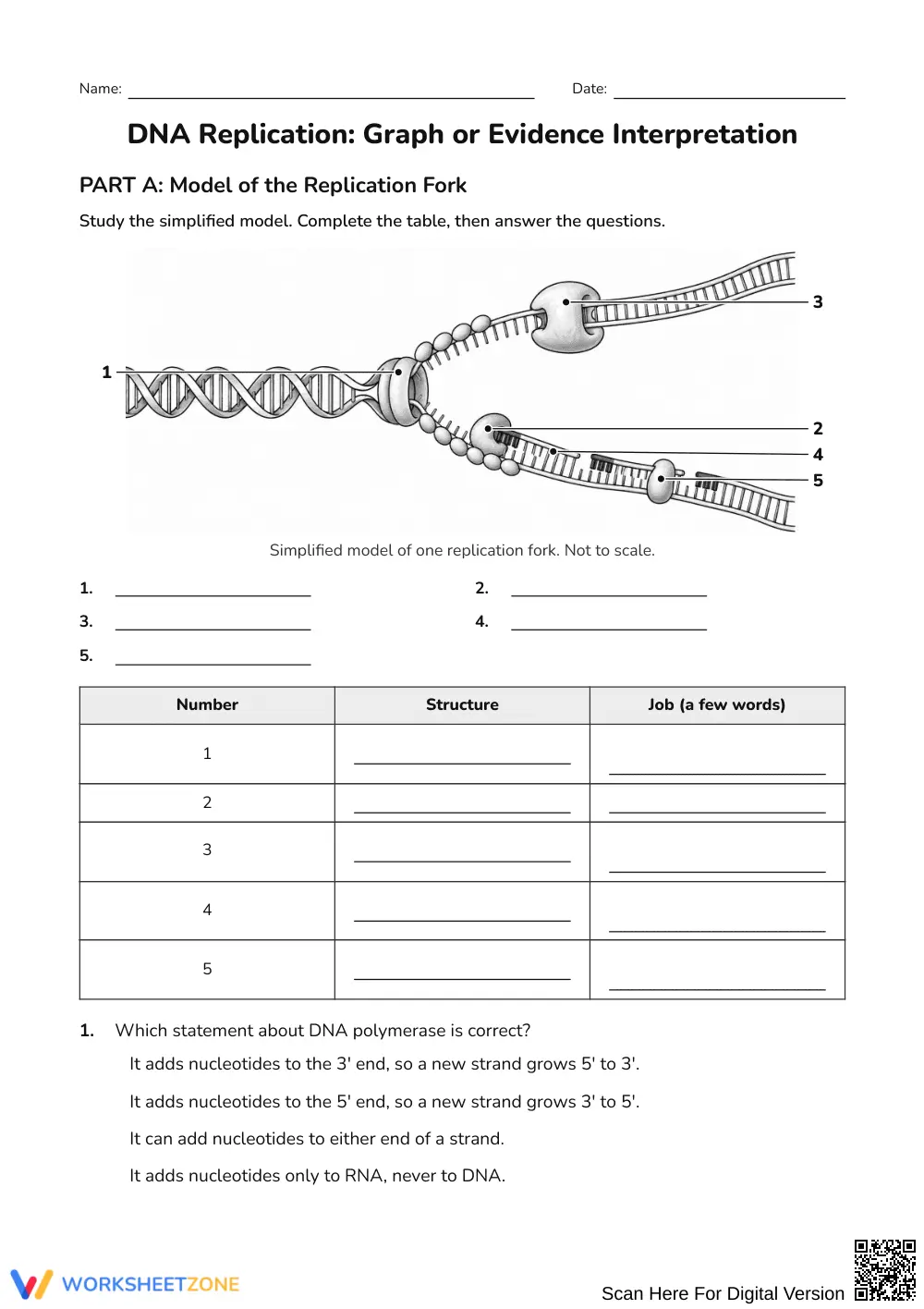
This comprehensive DNA replication worksheet equips secondary biology students to analyze molecular mechanisms, interpret classic experimental findings, and evaluate quantitative replication rates. Through scaffolded scientific reasoning, learners connect fork anatomy to Meselson-Stahl density data, replication speed graphs, and polymerase proofreading fidelity.
At a Glance
- Grade: Grades 8–12 · Subject: Science
- Standard: Interpret molecular models and empirical evidence explaining DNA replication mechanisms
- Skill Focus: DNA replication graph or evidence interpretation
- Format: 4 pages · 29 problems · Answer key included · PDF
- Best For: High school molecular genetics practice
- Time: 45–60 minutes
What's Inside
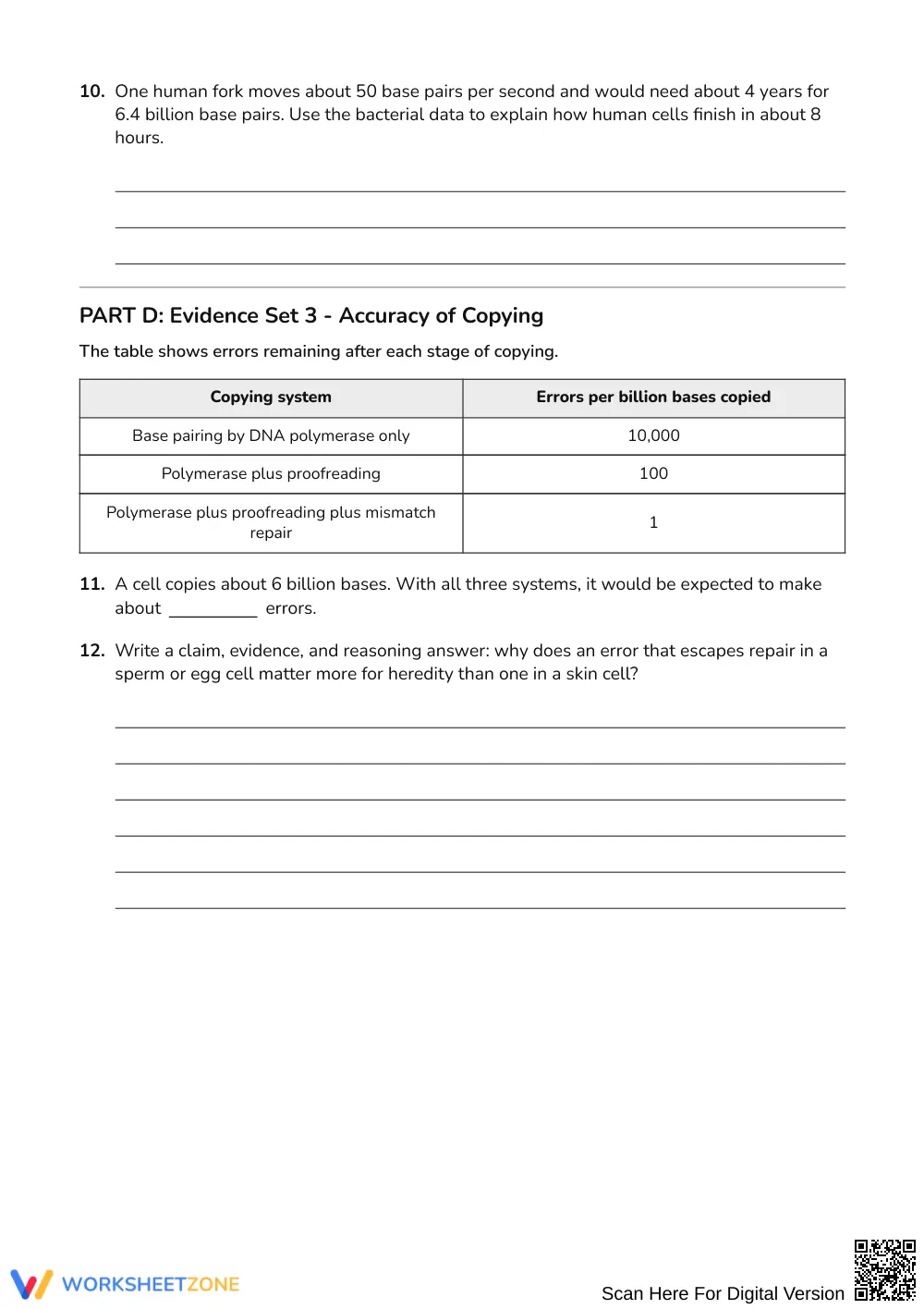
Across four structured student pages, this resource features 29 targeted tasks spanning four rigorous evidence sets. Students analyze an anatomical diagram of the replication fork, interpret Meselson-Stahl isotopic density gradient data, calculate directional rates from chromosome replication graphs, and evaluate DNA polymerase proofreading error statistics with complete answer explanations.
Skill Progression
- Guided practice (Part A): Students identify replication fork machinery, defining roles for helicase, primase, and ligase before explaining 5'-to-3' leading and lagging strand asymmetry.
- Supported practice (Parts B & C): Learners evaluate Meselson-Stahl centrifuge data tables and quantify bacterial versus eukaryotic fork velocities using coordinate graphs.
- Independent practice (Part D): Students construct a claim-evidence-reasoning response examining repair fidelity and the hereditary consequences of germline versus somatic mutations.
This structure adheres to the gradual release of responsibility model, guiding students systematically toward evidence evaluation.
Standards Alignment
This resource aligns with high school life science standards requiring students to communicate how DNA structure facilitates accurate cellular replication. It also reinforces standards for analyzing empirical data to support scientific claims. Both standard descriptions can be copied directly into lesson plans, IEP goals, or district curriculum mapping tools.
How to Use It
Deploy this 45-to-60-minute activity immediately after direct instruction on molecular replication mechanisms. For a high-yield formative assessment check, monitor student responses to Part B's generation 2 density table to ensure they distinguish between hybrid and fully light duplexes before starting the multi-fork eukaryotic rate calculations.
Who It's For
Designed for introductory biology, Honors, and AP Biology students, this activity supports varied learners through explicit data tables and structural diagrams. Pair this worksheet directly with a physical molecular modeling lab or interactive enzyme animation to ground theoretical concepts in observable phenomena.
According to research highlighted by Fisher & Frey (2014), structured progressions that transition from visual modeling to quantitative data interpretation significantly improve high school science comprehension. When students evaluate molecular biology through empirical data—such as Meselson-Stahl density gradients, chromosomal fork kinetics, and polymerase proofreading error frequencies—they develop robust scientific reasoning beyond rote memorization. This instructional progression provides 29 deliberate tasks distributed across 4 comprehensive pages, targeting DNA replication graph and evidence interpretation. Secondary students analyze biochemical structures, predict experimental isotope distributions, and construct written arguments regarding somatic versus germline mutation inheritance. By integrating scaffolded graphical representations and rigorous data analysis, educators ensure learners master complex biochemical mechanisms while meeting rigorous secondary life science objectives. This balanced, evidence-based format produces measurable gains in scientific literacy, critical reasoning, and long-term concept retention across varied learning environments.


