


























Views
Downloads




Essential DNA Replication Worksheet | Grade 8-12 Science
Paste this activity's link or code into your existing LMS (Google Classroom, Canvas, Teams, Schoology, Moodle, etc.).
Students can open and work on the activity right away, with no student login required.
You'll still be able to track student progress and results from your teacher account.
This Grade 8–12 DNA replication worksheet builds conceptual mastery of molecular genetics through the sequential mechanics of semiconservative copying. High school biology learners identify replication fork enzymes, sequence biochemical stages, transcribe complementary strands, and evaluate Meselson-Stahl experimental density data.
At a Glance
- Grade: Grades 8–12 · Subject: Science
- Standard: Model how DNA replicates through coordinated enzymatic action
- Skill Focus: DNA replication stages, fork anatomy, and experimental evidence
- Format: 4 pages · 31 problems · Answer key included · PDF
- Best For: High school biology review or direct instruction follow-up
- Time: 45–60 minutes
What's Inside
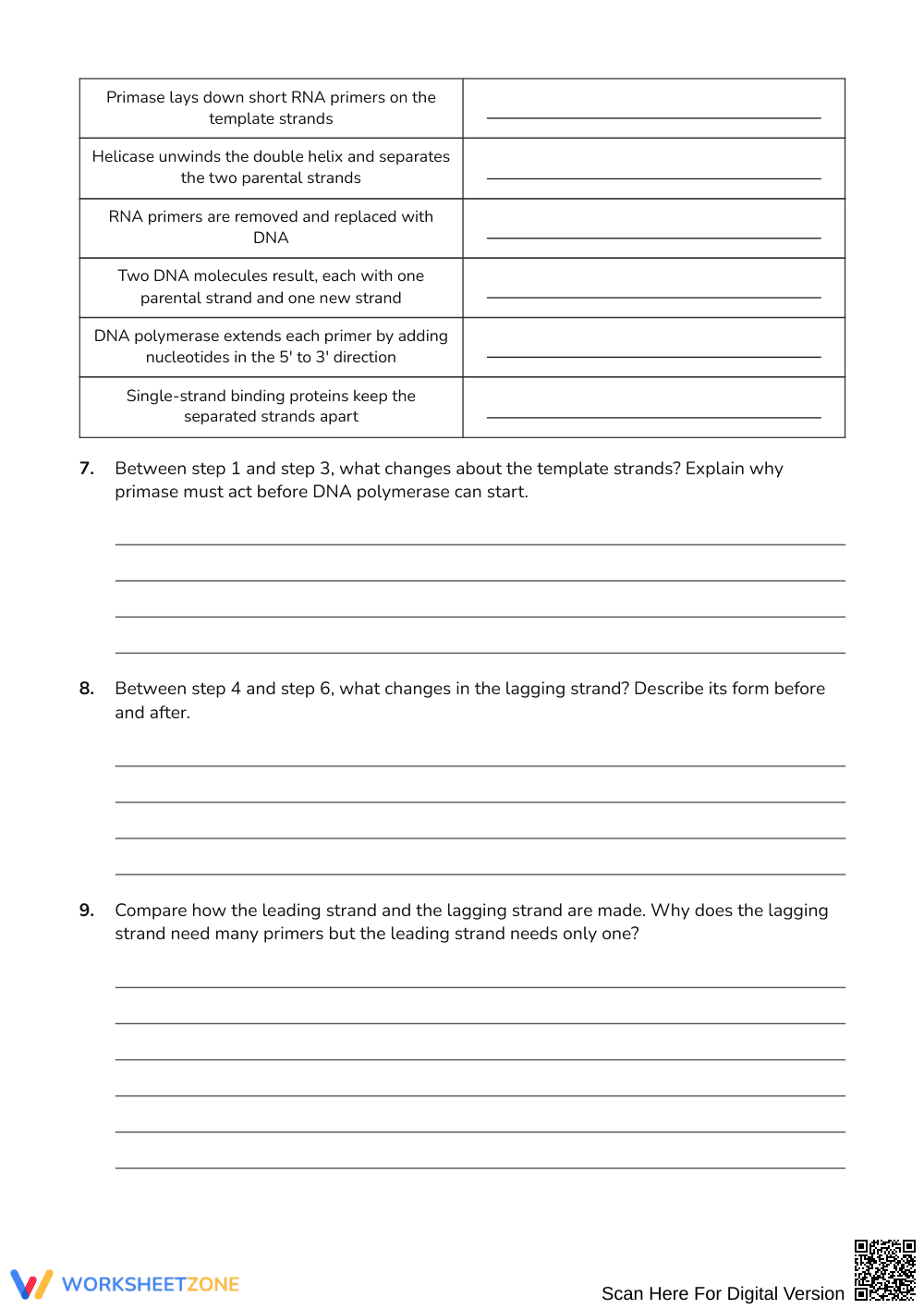
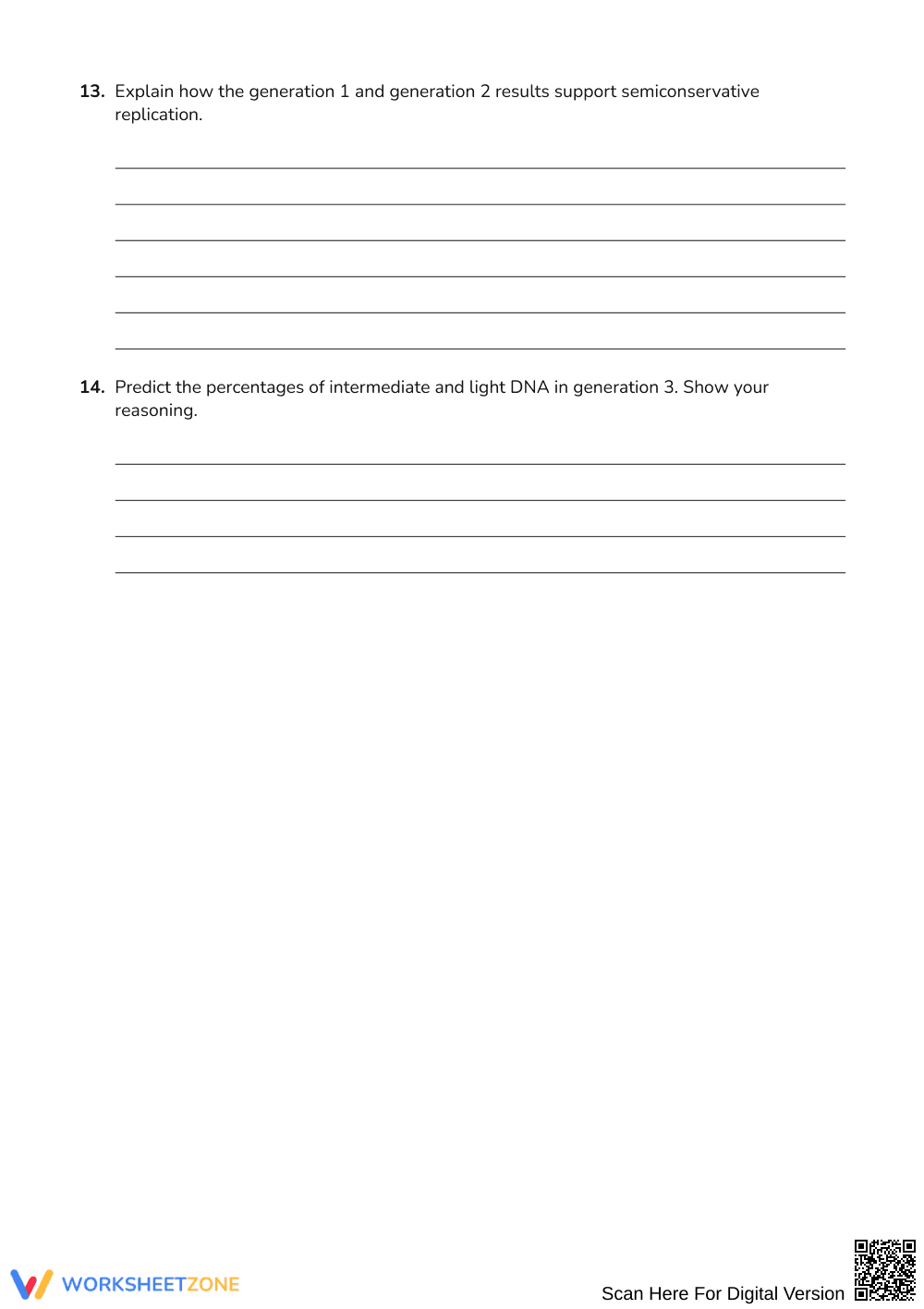
The 4-page student activity features 31 tasks organized across four progressive parts. Part A provides a labeled replication fork diagram with a helpful word bank. Part B tasks learners with sequencing seven biochemical events and comparing continuous and discontinuous synthesis. Part C targets complementary base-pairing and antiparallel orientation, while Part D presents Meselson-Stahl experimental data. A complete 4-page answer key provides full model responses.
Skill Progression
This resource utilizes a gradual-release architecture to guide scientific understanding:
- Guided practice (Tasks 1–6): Visual diagram matching reinforces enzyme recognition using an authentic replication fork model and word bank.
- Supported practice (Tasks 7–16): Chronological sequencing and short-answer prompts require students to explain structural transitions between strands.
- Independent practice (Tasks 17–31): Complement generation and density data analysis challenge students to evaluate semiconservative copying.
This sequence follows the I Do, We Do, You Do framework, transitioning students from anatomical labeling to empirical reasoning.
Standards Alignment
This worksheet aligns with high school life science standards requiring students to model how DNA replicates and transfers genetic information. Students analyze enzyme specificity and evaluate empirical density data. Learning goals can be copied directly into lesson plans, IEP goals, or district curriculum mapping tools.
How to Use It
Implement this worksheet after direct instruction on nucleic acids. Model the fork diagram as a class, then have students collaborate on sequencing and lagging strand analysis in Part B. As a formative check, observe how students explain why primase must precede polymerase; this clarifies directional addition rules before students analyze Meselson-Stahl data. Typical completion takes 45 to 60 minutes.
Who It's For
This resource serves general biology, honors life science, and introductory AP Biology classrooms. Scaffolds like word banks support English learners, while quantitative generation forecasting extends advanced learners. Pair this worksheet with a 3D molecular animation or an interactive base-pairing laboratory.
According to Fisher & Frey (2014), academic achievement in complex scientific concepts improves significantly when instructional materials guide learners through a deliberate progression from visual models to independent empirical analysis. This worksheet directly supports students in mastering the DNA replication process, enabling them to identify replication fork enzymes, correctly sequence cellular events, and explain why DNA polymerase requires a free 3'-OH group provided by RNA primers. By requiring students to analyze complementary base-pairing alongside historical data from the Meselson-Stahl experiment, the resource bridges molecular mechanics with scientific inquiry. Scaffolded tasks ensure that students transition from concrete anatomical recognition of helicase and ligase to abstract predictions of isotope density distributions across multiple bacterial generations. As established by Fisher & Frey (2014), structured cognitive scaffolding fosters durable conceptual schema, allowing high school biology learners to explain how semiconservative replication preserves genetic fidelity during cellular reproduction.


