





























Essential Digestive System Worksheet | Grades 6-10 Science
Paste this activity's link or code into your existing LMS (Google Classroom, Canvas, Teams, Schoology, Moodle, etc.).
Students can open and work on the activity right away, with no student login required.
You'll still be able to track student progress and results from your teacher account.
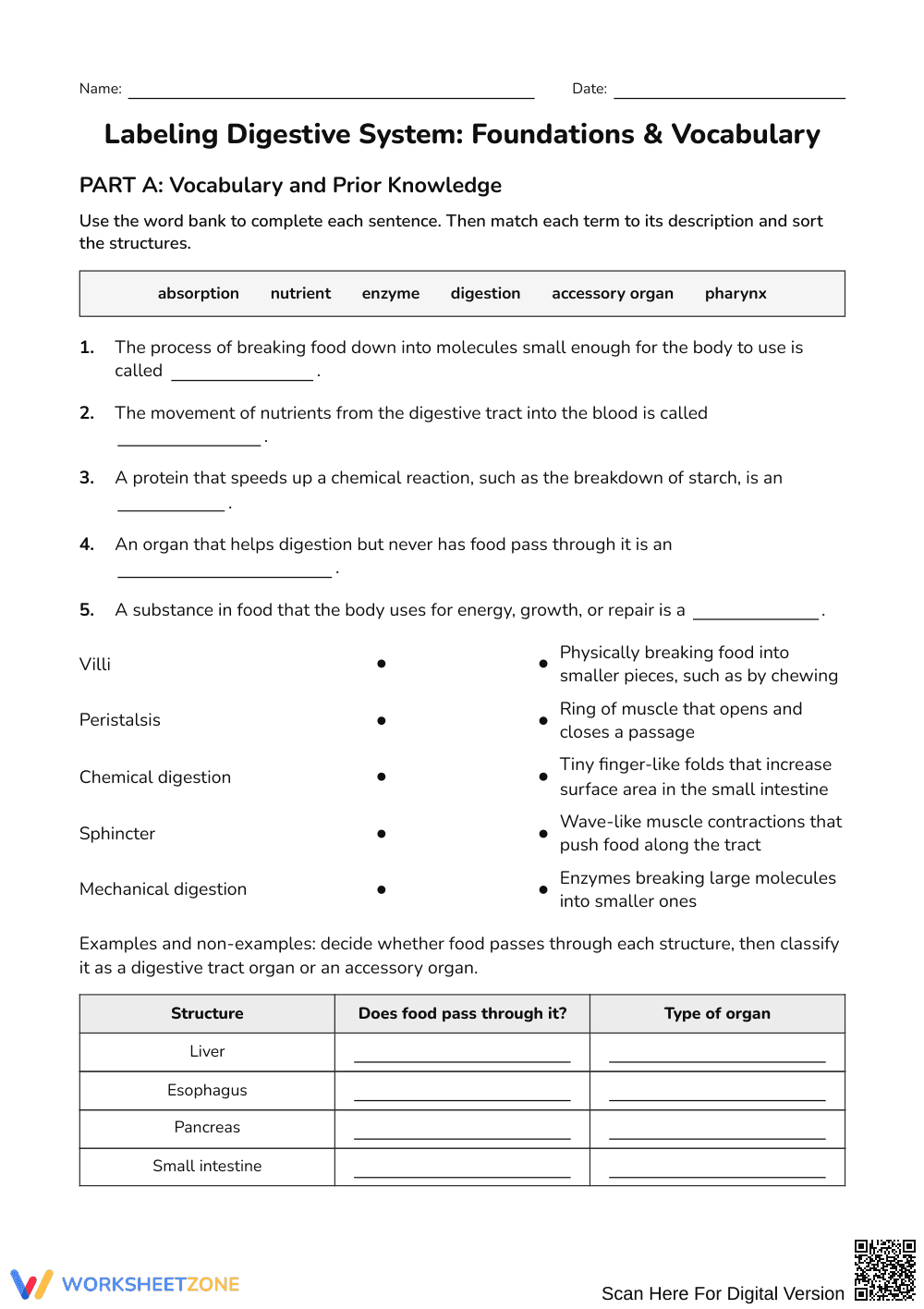
This comprehensive science worksheet prepares secondary students to master human digestive system anatomy and physiology through structured terminology, organ classification, and misconception analysis. Students build conceptual foundations across 37 targeted problems, differentiating tract organs from accessory structures while explaining digestive mechanisms before undertaking advanced anatomical diagrams.
At a Glance
- Grade: Grades 6–10 · Subject: Science
- Standard: Body Systems — Identify digestive structures, accessory organs, and nutrient absorption functions
- Skill Focus: Digestive system vocabulary and structural labeling
- Format: 4 pages · 37 problems · Answer key included · PDF
- Best For: Biology unit introduction or vocabulary review
- Time: 40–50 minutes
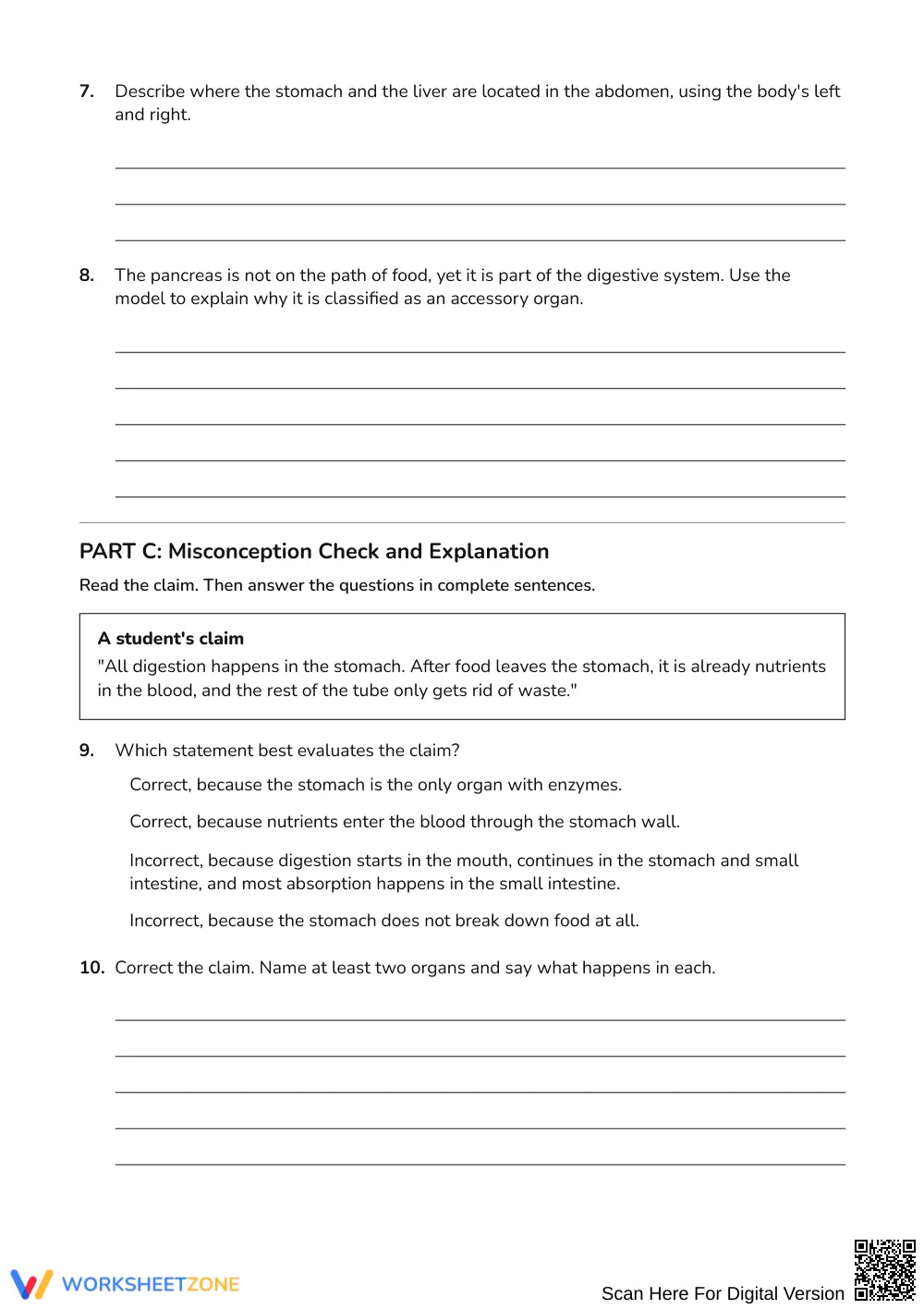
The 4-page worksheet includes a comprehensive 4-page answer key for quick grading. Across three parts, students engage with word bank fill-in-the-blanks, a structural classification chart distinguishing tract from accessory organs, an eight-part anatomical diagram analysis, and short-answer misconception prompts requiring complete sentences.
- Guided practice: Students define core terms using a word bank and classify organs into tract and accessory categories across 16 scaffolded tasks.
- Supported practice: Learners examine an eight-part anatomical diagram, identify organs, and describe organ locations using anatomical orientation cues.
- Independent practice: Students evaluate a common physiological misconception and write analytical responses connecting digestive and circulatory systems.
This progression mirrors the gradual release of responsibility framework, transitioning learners from foundational recall to written scientific analysis.
This resource aligns with middle and high school life science standards addressing how specialized body systems interact to maintain homeostasis and process energy. The tasks emphasize anatomical identification and system-level physiological mechanisms. These foundational standards can be copied directly into lesson plans, IEP goals, or district curriculum mapping tools.
Administer this worksheet during direct instruction on human body systems or as an independent review before summative assessments. During the Part A organ classification task, check whether students incorrectly label accessory organs as tract organs to quickly address misconceptions. Expect completion within 40 to 50 minutes.
Designed for middle school life science and introductory high school biology students, this worksheet supports diverse learners through structured classification tables and visual diagrams. It pairs effectively with an interactive torso model or human anatomy anchor chart.
Educational research by Fisher & Frey (2014) highlights the importance of structured vocabulary acquisition and scaffolded cognitive modeling in secondary science instruction. To comprehend complex physiological systems, students must first master key terminology and structural relationships before interpreting systemic functions. This worksheet operationalizes this framework across 37 targeted problems, guiding learners from basic definitions to analytical diagram labeling and misconception checks. By distinguishing alimentary canal pathways from accessory structures, students build mental models that support deeper comprehension of chemical and mechanical digestion. The progression from guided vocabulary sorting to independent written explanations ensures learners articulate how organ systems collaborate to nourish cells. Science educators can leverage this structured resource to assess baseline understanding, rectify common physiological misunderstandings, and build academic vocabulary essential for advanced biology coursework.


