




























Views
Downloads



Essential Design Controls Worksheet | Grade 9 Biology

Paste this activity's link or code into your existing LMS (Google Classroom, Canvas, Teams, Schoology, Moodle, etc.).
Students can open and work on the activity right away, with no student login required.
You'll still be able to track student progress and results from your teacher account.
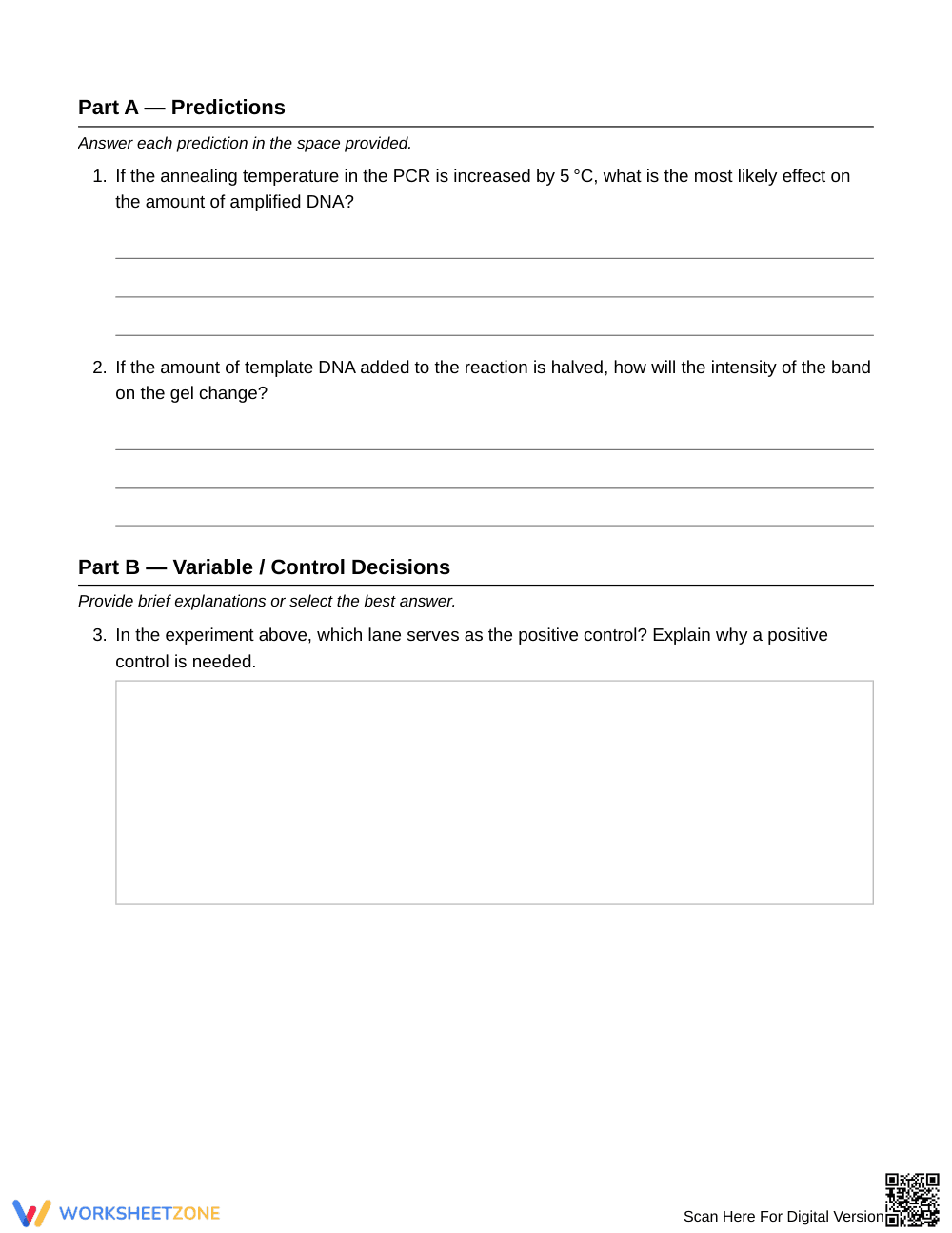
Students will master the design of experimental controls for a simplified DNA analysis, interpreting PCR and gel‑electrophoresis results while justifying variable choices. This worksheet guides them through predictions, control decisions, and evidence evaluation to build reliable investigative skills in the classroom.
At a Glance
- Grade: 9 · Subject: Biology
- Standard: students design controls and evaluate PCR evidence
- Skill Focus: Design Controls for a Simplified Analysis
- Format: 4 pages · 10 problems · Answer key included · PDF
- Best For: classroom labs and test‑prep review
- Time: 30–45 minutes
What’s Inside – The four‑page packet contains ten varied tasks: prediction questions, variable‑control decisions, multiple‑choice comparisons, and evidence‑evaluation prompts. An answer key occupies two pages and mirrors the student layout for quick checking. Scaffolds include a key‑concept box, a worked example in Part A, and sentence frames for explanations.
- Guided practice: 3 prediction items with a teacher‑led model (Part A).
- Supported practice: 4 variable/control decisions with sentence frames (Part B).
- Independent practice: 3 evidence‑evaluation prompts requiring written justification (Part C).
This progression follows the classic I Do, We Do, You Do release, ensuring students move from teacher‑supported reasoning to autonomous analysis.
Standards Alignment
Students design appropriate experimental controls, identify variables, and evaluate data reliability in a DNA‑analysis context. This aligns with high‑school biology expectations for experimental design and data interpretation. Both statements can be copied directly into lesson plans, IEP goals, or district curriculum mapping tools.
How to Use It
1. Before a lab on PCR, assign Part A for students to predict outcomes; observe misconceptions and address them during the demonstration. 2. During the lab, have students complete Part B on the bench, using the worksheet as a checklist; quickly scan responses for understanding. 3. After the experiment, use Part C as a formative exit ticket, noting whether students can justify the best explanation for the observed band.
Who It’s For
Designed for ninth‑grade biology students, especially those preparing for AP or state assessments. The worksheet’s built‑in scaffolds support struggling learners, while the open‑ended evidence prompts challenge advanced students. Pair it with a short video on PCR controls or an anchor chart summarizing positive and negative controls for effective integration.
Educational research demonstrates that explicit instruction in experimental design significantly strengthens scientific literacy and critical reasoning skills across secondary grade levels (Fisher & Frey 2014). When students actively identify variables, construct positive controls, and evaluate negative controls within realistic lab scenarios, they develop deeper conceptual models of biological inquiry. By structuring tasks around prediction, procedural decision-making, and written justifications, this worksheet translates evidence-based pedagogical strategies into practical daily practice. High school learners frequently struggle with abstract laboratory techniques like gel electrophoresis, but targeted scaffolding enables them to connect experimental controls directly to data reliability. Implementing these structured reflection routines helps educators bridge the gap between procedural lab execution and high-level analytical thinking, ensuring students gain the foundational competence needed for advanced biological investigations, classroom laboratory coursework, and comprehensive science assessments. Teachers can rely on this resource to reinforce scientific methodology.


